Tahir Hasan Nawaz, Ullah Naseer, Tahir Mursala, Domnic Inbaraj Susai, Prabhakar Ramaprabha, Meerasa Semmal Syed, AbdElneam Ahmed Ibrahim, Tahir Shahnawaz, Ali Yousaf
Department of Community Medicine, College of Medicine, Dwadimi, Shaqra University, Shaqra, Saudi Arabia.
Department of Community Medicine, Khyber Medical College Peshawar, Peshawar, Pakistan.
Front Med (Lausanne). 2025 May 7;12:1519768. doi: 10.3389/fmed.2025.1519768. eCollection 2025.
Diabetic retinopathy is one of the leading causes of blindness globally, among individuals with diabetes mellitus. Early detection through screening can help in preventing disease progression. In recent advancements artificial Intelligence assisted screening has emerged as an alternative to traditional manual screening methods. This diagnostic test accuracy (DTA) review aims to compare the sensitivity and specificity of AI versus manual screening for detecting diabetic retinopathy, focusing on both dilated and un-dilated eyes.
A systematic review and meta-analysis were conducted for comparison of AI vs. manual screening of diabetic retinopathy using 25 observational (cross sectional, validation and cohort) studies with total images of 613,690 used for screening published between January 2015 and December 2024. Outcomes of the study was sensitivity, and specificity. Risk of bias was assessed using the QUADAS-2 tool for validation studies, the AXIS tool for cross-sectional studies, and the Newcastle-Ottawa Scale for cohort studies.
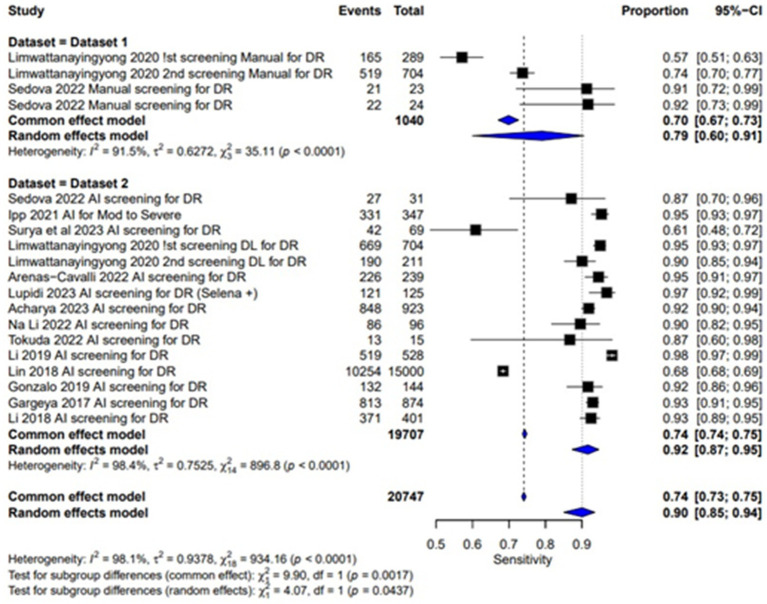
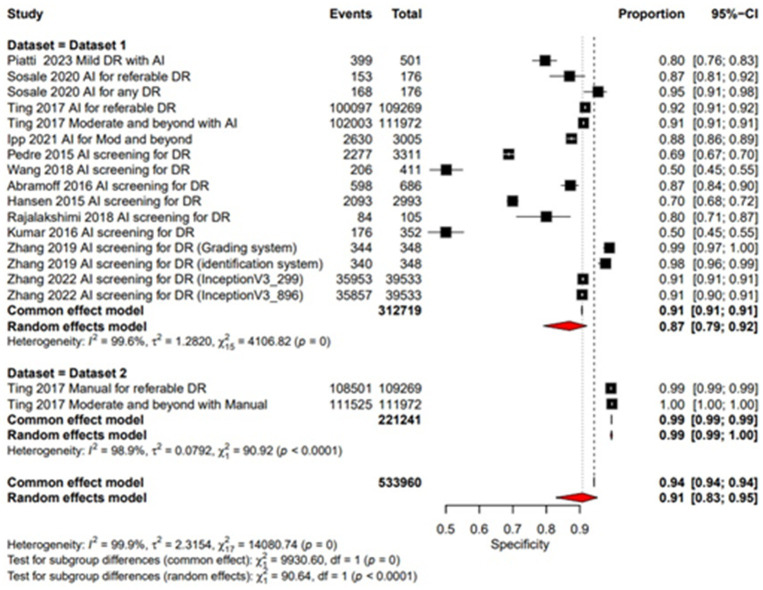
The results of this meta-analysis showed that for un-dilated eyes, AI screening showed pooled sensitivity of 0.90 [95% CI: 0.85-0.94] and pooled specificity of 0.94 [95% CI: 0.91-0.96] while manual screening shows pooled sensitivity of 0.79 [95% CI: 0.60-0.91] and pooled specificity of 0.99 [95% CI: 0.98-0.99]. For dilated eyes the pooled sensitivity of AI screening is 0.95 [95% CI: 0.91-0.97] and pooled specificity is 0.87 [95% CI: 0.79-0.92], while manual screening sensitivity is 0.90 [95% CI: 0.87-0.92] and specificity is 0.99 [95% CI: 0.99-1.00]. These data show comparable sensitivities and specificities of AI and manual screening, with AI performing better in sensitivity.
AI-assisted screening for diabetic retinopathy shows comparable sensitivity and specificity compared to manual screening. These results suggest that AI can be a reliable alternative in clinical settings, with increased early detection rates and reducing the burden on ophthalmologists. Further research is needed to validate these findings.
https://www.crd.york.ac.uk/PROSPERO/home, CRD42024596611.
糖尿病视网膜病变是全球糖尿病患者失明的主要原因之一。通过筛查进行早期检测有助于预防疾病进展。在最近的进展中,人工智能辅助筛查已成为传统手动筛查方法的替代方案。本诊断测试准确性(DTA)综述旨在比较人工智能与手动筛查在检测糖尿病视网膜病变方面的敏感性和特异性,重点关注散瞳和未散瞳的眼睛。
进行了一项系统综述和荟萃分析,以比较人工智能与手动筛查糖尿病视网膜病变的情况,使用了25项观察性(横断面、验证性和队列)研究,共613,690张用于筛查的图像,这些研究发表于2015年1月至2024年12月之间。研究结果为敏感性和特异性。使用QUADAS - 2工具评估验证性研究的偏倚风险,使用AXIS工具评估横断面研究的偏倚风险,使用纽卡斯尔 - 渥太华量表评估队列研究的偏倚风险。
该荟萃分析结果表明,对于未散瞳的眼睛,人工智能筛查的合并敏感性为0.90[95%置信区间:0.85 - 0.94],合并特异性为0.94[95%置信区间:0.91 - 0.96],而手动筛查的合并敏感性为0.79[95%置信区间:0.60 - 0.91],合并特异性为0.99[95%置信区间:0.98 - 0.99]。对于散瞳的眼睛,人工智能筛查的合并敏感性为0.95[95%置信区间:0.91 - 0.97],合并特异性为0.87[95%置信区间:0.79 - 0.92],而手动筛查的敏感性为0.90[95%置信区间:0.87 - 0.92],特异性为0.99[95%置信区间:0.99 - 1.00]。这些数据显示了人工智能和手动筛查具有可比的敏感性和特异性,人工智能在敏感性方面表现更好。
人工智能辅助筛查糖尿病视网膜病变与手动筛查相比,显示出可比的敏感性和特异性。这些结果表明,人工智能在临床环境中可以是一种可靠的替代方法,可提高早期检测率并减轻眼科医生的负担。需要进一步研究来验证这些发现。