Tolera Sina Temesgen, Gobena Tesfaye, Geremew Abraham, Toseva Elka, Assefa Nega
College of Health and Medical Sciences, Haramaya University, Harar, Ethiopia.
Department of Hygiene, Faculty of Public Health, Medical University of Plovdiv, Plovdiv, Bulgaria.
Front Public Health. 2025 May 9;13:1509595. doi: 10.3389/fpubh.2025.1509595. eCollection 2025.
Occupational health risks (OHRs) perception refer to an individual's subjective assessment of the likelihood and severity of potential health hazards within their workplace, which are influenced by their knowledge and attitude. The OHRs perceptions of sanitary workers (SWs) in Ethiopia have not yet been well studied. Therefore, this study aims to assess the knowledge and attitude of SWs about OHR perceptions and their determinants in public hospitals of eastern Ethiopia.
A hospital-based cross-sectional study was conducted on a total of 809 SWs, which comprised face-to-face interviews. Knowledge items were measured by [YES/NO] and then categorized as "good" if they scored 16-20 points; "fair" if 10-15 points; and "poor" if < 10 points. On the other hand, attitude items were measured on Likert scales [strongly disagree (1) to strongly agree (5)] and classified as level 1: unfavorable; level 2: neutral; and level 3: favorable. Stata 17MP version was used for data analysis. The univariate analysis was applied for frequency, prevalence, media, and mean. Multilevel ordinal logistic regression was conducted for the predictions. Structural equation modeling (SEM) was used to determine the correlations between level of knowledge of and attitude toward OHRs perceptions as well as with their predictors.
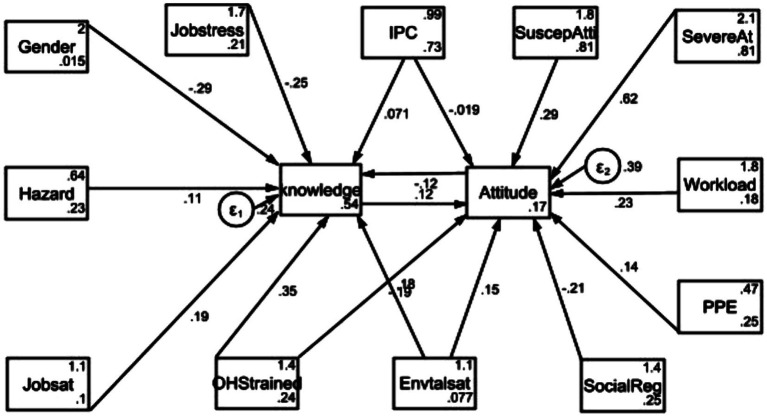
This study found that the poor level of knowledge of and unfavorable attitude toward OHRs among SWs were 67.35 and 42.66%, respectively. The difference in knowledge of and attitude toward OHRs perceptions of SWs between hospitals was 19.34 and 39.55%, respectively. The final model showed that the variables trained on occupational health and safety [OHS] (AOR: 4.90; 3.10, 7.75), satisfied with job (AOR: 1.88; 1.10, 3.75), and satisfied with environment (AOR: 2.57; 1.09, 6.05) were significantly associated with higher knowledge levels about OHRs. However, SWs who were satisfied with environment (AOR: 2.67; 1.03, 6.92) and who follow good infection prevention and control (IPC) practice (AOR: 20.43; 15, 35.84) were significantly associated with a high level of attitude toward OHRs. SEM results showed that OHS training (: 0.35; 0.27, 0.44) and compliance with IPC (: 0.07; 0.02, 0.12), as well as compliance with personal protective equipment (: 0.14; 0.04, 0.23), had a positive impact on the knowledge and attitude about OHRs.
This study concluded that the majority of SWs had inadequate knowledge about and negative attitude toward OHRs perceptions. The following variables played the most significant role in predicting the SWs' knowledge of and attitude toward OHRs: OHS training, job and environmental satisfaction, safety measures, and job stress, which could be considered for further interventions.
职业健康风险认知是指个体对工作场所潜在健康危害的可能性和严重性的主观评估,它受个体知识和态度的影响。埃塞俄比亚卫生工作者对职业健康风险的认知尚未得到充分研究。因此,本研究旨在评估埃塞俄比亚东部公立医院卫生工作者对职业健康风险认知及其决定因素的知识和态度。
在总共809名卫生工作者中开展了一项基于医院的横断面研究,其中包括面对面访谈。知识项目通过[是/否]进行测量,得分16 - 20分则归类为“良好”;10 - 15分则为“中等”;低于10分则为“较差”。另一方面,态度项目采用李克特量表[强烈不同意(1)到强烈同意(5)]进行测量,并分为1级:不利;2级:中性;3级:有利。使用Stata 17MP版本进行数据分析。单变量分析用于频率、患病率、中位数和均值。采用多水平有序逻辑回归进行预测。结构方程模型(SEM)用于确定职业健康风险认知的知识水平与态度之间以及与预测因素之间的相关性。
本研究发现,卫生工作者中职业健康风险知识水平较差和态度不利的比例分别为67.35%和42.66%。不同医院的卫生工作者对职业健康风险认知的知识和态度差异分别为19.34%和39.55%。最终模型显示,接受职业健康与安全[OHS]培训(调整优势比[AOR]:4.90;3.10,7.75)、对工作满意(AOR:1.88;1.10,3.75)以及对环境满意(AOR:2.57;1.09,6.05)的变量与更高的职业健康风险知识水平显著相关。然而,对环境满意(AOR:2.67;1.03,6.92)以及遵循良好感染预防与控制(IPC)措施(AOR:20.43;15,35.84)的卫生工作者与对职业健康风险的高度积极态度显著相关。结构方程模型结果表明,职业健康与安全培训(β:0.35;0.27,0.44)、遵守感染预防与控制措施(β:0.07;0.02,0.12)以及遵守个人防护设备(β:0.14;0.04,0.23)对职业健康风险的知识和态度有积极影响。
本研究得出结论,大多数卫生工作者对职业健康风险认知的知识不足且态度消极。以下变量在预测卫生工作者对职业健康风险的知识和态度方面发挥了最重要作用:职业健康与安全培训、工作和环境满意度、安全措施以及工作压力,可考虑针对这些因素进行进一步干预。