Caro Lews, Wei Aguan D, Thomas Christopher A, Posch Galen, Uremis Ahmet, Franzi Michaela C, Abell Sarah J, Laszlo Andrew H, Gundlach Jens H, Ramirez Jan-Marino, Ailion Michael
Molecular and Cellular Biology Ph.D. Program, University of Washington, Seattle, Washington, United States of America.
Department of Biochemistry, University of Washington, Seattle, Washington, United States of America.
PLoS Biol. 2025 May 27;23(5):e3003182. doi: 10.1371/journal.pbio.3003182. eCollection 2025 May.
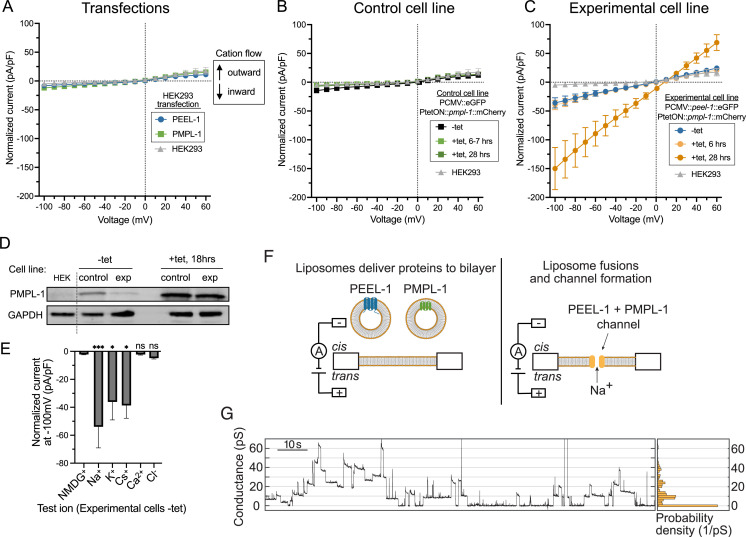
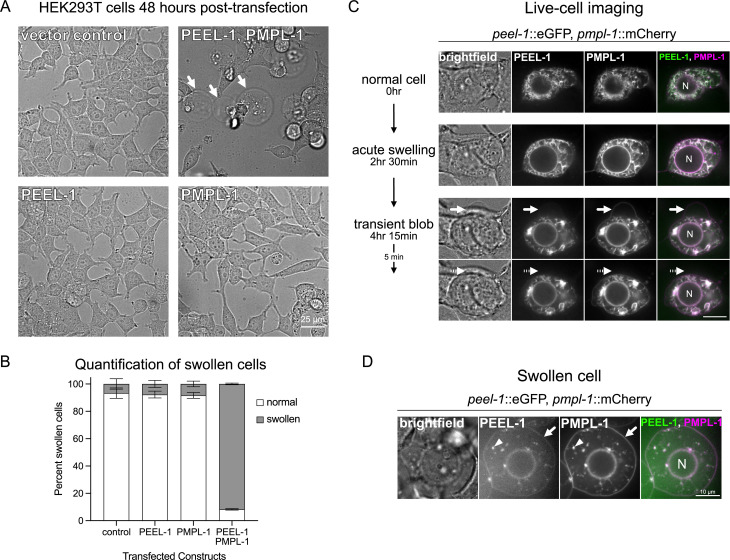
Toxin-antidote systems are selfish genetic elements composed of a linked toxin and antidote. The peel-1 zeel-1 toxin-antidote system in C. elegans consists of a transmembrane toxin protein PEEL-1 which acts cell autonomously to kill cells. Here we investigate the molecular mechanism of PEEL-1 toxicity. We find that PEEL-1 requires a small membrane protein, PMPL-1, for toxicity. Together, PEEL-1 and PMPL-1 are sufficient for toxicity in a heterologous system, HEK293T cells, and cause cell swelling and increased cell permeability to monovalent cations. Using purified proteins, we show that PEEL-1 and PMPL-1 allow ion flux through lipid bilayers and generate currents which resemble ion channel gating. Our work suggests that PEEL-1 kills cells by co-opting PMPL-1 and creating a cation channel.
毒素-解毒剂系统是由相连的毒素和解毒剂组成的自私遗传元件。秀丽隐杆线虫中的peel-1/zeel-1毒素-解毒剂系统由一种跨膜毒素蛋白PEEL-1组成,该蛋白通过细胞自主作用杀死细胞。在这里,我们研究了PEEL-1毒性的分子机制。我们发现PEEL-1毒性需要一种小的膜蛋白PMPL-1。PEEL-1和PMPL-1共同作用足以在异源系统HEK293T细胞中产生毒性,并导致细胞肿胀和单价阳离子的细胞通透性增加。使用纯化的蛋白质,我们表明PEEL-1和PMPL-1允许离子通过脂质双层流动并产生类似于离子通道门控的电流。我们的工作表明,PEEL-1通过利用PMPL-1并创建一个阳离子通道来杀死细胞。