Yang Xiaodong, Dou Fulin, Tang Guoshuo, Xiu Ruipu, Zhao Xiaogang
Department of Thoracic Surgery, The Second Hospital of Shandong University, Beiyuan Street, Jinan City, 250021, Shandong Province, China.
Department of Nephrology, The Second Hospital of Shandong University, Jinan, Shandong Province, China.
BMC Cancer. 2025 Jun 1;25(1):976. doi: 10.1186/s12885-025-14387-3.
Postoperative anastomotic leakage (AL) is a severe complication following esophageal cancer surgery, that often leads to a poor prognosis. This study aims to develop an interpretable machine learning (ML) model to predict AL occurrence and identify associated risk factors.
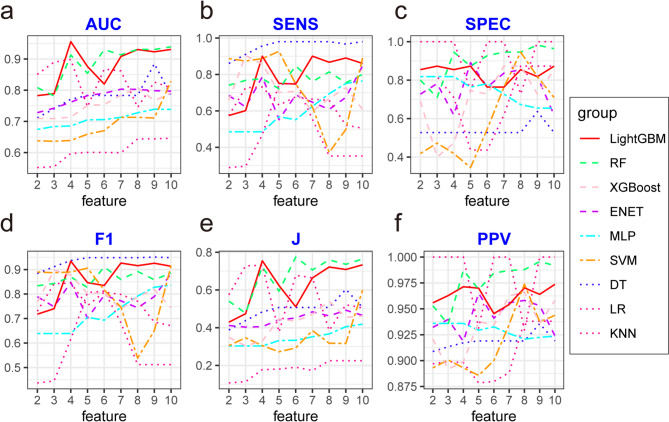
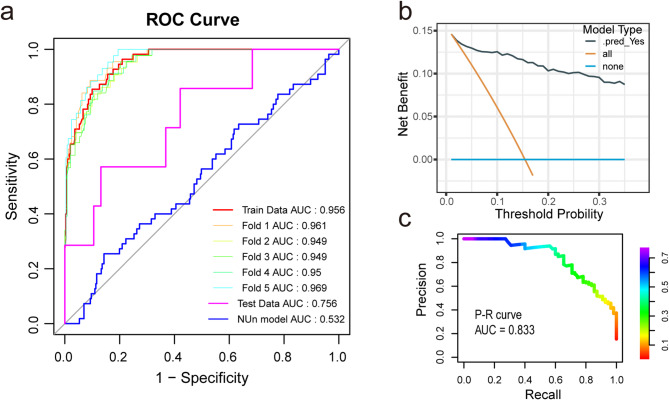
A retrospective case‒control study analyzed clinical and laboratory data from esophageal cancer patients obtained via a case management system. Nine machine learning (ML) models were compared to identify the best-performing model and its optimal feature set. The selected LightGBM-based model underwent internal cross-validation and external validation. Performance was evaluated via metrics such as ROC, DCA, and PR curves. To enhance interpretability, the SHapley Additive exPlanations (SHAP) method was applied for feature analysis.
Data from a total of 406 esophageal cancer patients were collected, and the LightGBM-based model showed the best performance. The model included the following features: lesion length, McKeown surgery, gastrointestinal decompression drainage (GID) volume on postoperative day 1, and prealbumin difference. SHAP dependence plots were created for each variable to understand their impact on the outcome. The model achieved an AUC of 0.956 (95% CI: 0.934–0.978).
This study successfully developed an interpretable ML model based on the LightGBM to predict postoperative AL in patients with esophageal cancer.
The online version contains supplementary material available at 10.1186/s12885-025-14387-3.
术后吻合口漏(AL)是食管癌手术后的一种严重并发症,常导致预后不良。本研究旨在开发一种可解释的机器学习(ML)模型,以预测AL的发生并确定相关风险因素。
一项回顾性病例对照研究分析了通过病例管理系统获得的食管癌患者的临床和实验室数据。比较了九种机器学习(ML)模型,以确定性能最佳的模型及其最佳特征集。所选的基于LightGBM的模型进行了内部交叉验证和外部验证。通过ROC、DCA和PR曲线等指标评估性能。为了增强可解释性,应用Shapley加性解释(SHAP)方法进行特征分析。
共收集了406例食管癌患者的数据,基于LightGBM的模型表现最佳。该模型包括以下特征:病变长度、McKeown手术、术后第1天的胃肠减压引流量(GID)和前白蛋白差值。为每个变量创建了SHAP依赖图,以了解它们对结果的影响。该模型的AUC为0.956(95%CI:0.934-0.978)。
本研究成功开发了一种基于LightGBM的可解释ML模型,用于预测食管癌患者术后的AL。
在线版本包含可在10.1186/s12885-025-14387-3获取的补充材料。