Ma Rui, Yin Yue, Zhang Jian-Ping, Zhang Mei-Xiang, Zhou Jing-Rui, He Yun, Gai Wei, Zhang Xiao-Hui, Wang Yu, Xu Lan-Ping, Liu Kai-Yan, Huang Xiao-Jun, Sun Yu-Qian
National Clinical Research Center for Treatment of Hematological Disease, Beijing Key Laboratory of Hematopoietic Stem Cell Transplantation for the Treatment of Hematological Diseases, Peking University People's Hospital, Peking University Institute of Hematology, Beijing, China.
Department of Hematology, Peking University First Hospital, Beijing, China.
Open Forum Infect Dis. 2025 May 16;12(6):ofaf288. doi: 10.1093/ofid/ofaf288. eCollection 2025 Jun.
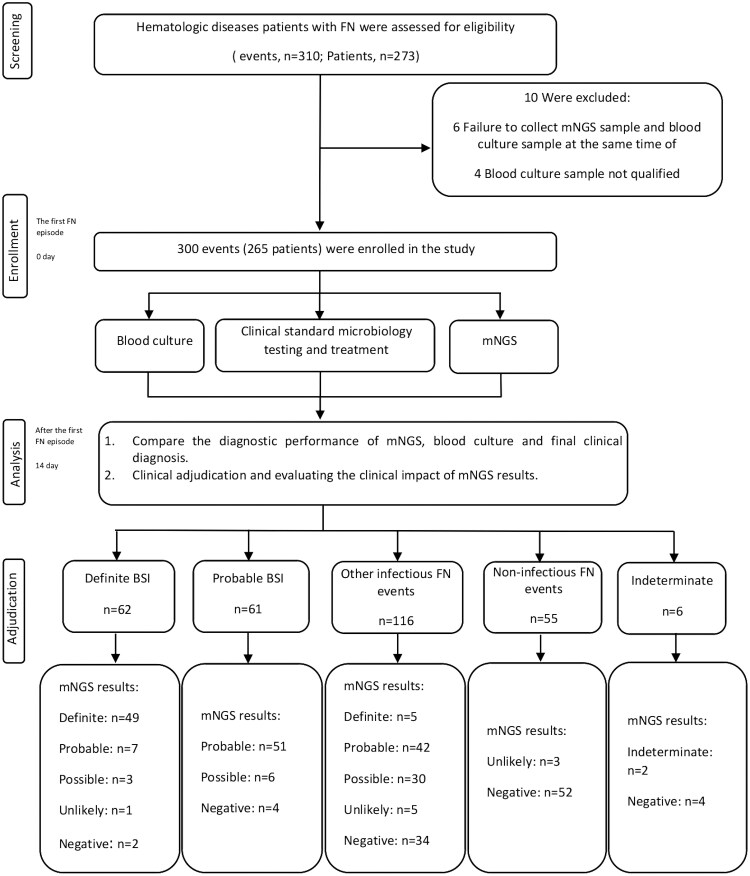
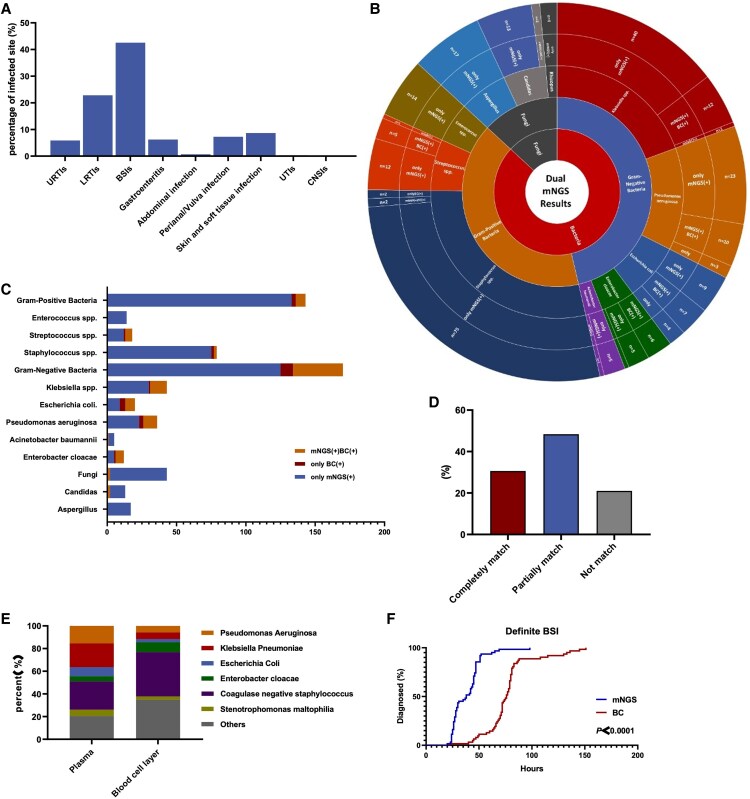
Bloodstream infection (BSI) is a frequent but lethal complication in hematologic patients with febrile neutropenia (FN). However, blood culture (BC) only detects an organism in 20%-30% of patients with FN. We aimed to evaluate the diagnostic performance of metagenomic next-generation sequencing (mNGS) as a first-line diagnostic method in BSI. This study was prospectively performed in 4 Chinese hematologic centers. In patients aged ≥15 years with hematologic diseases, peripheral blood specimens were collected per patient for simultaneous BC and mNGS at the onset of FN. The clinical physician and mNGS analysis team were double-blinded, and the adjudication of the clinical diagnosis was evaluated by another expert panel of 4 specialists. The primary endpoint of this study was the diagnostic performance of mNGS. This study was registered on ClinicalTrials.gov. Three hundred FN events were enrolled, including 62 definite BSI, 61 probable BSI, 116 infectious FN other than BSI, 55 noninfectious FN events, and 6 FN of indeterminate cause. Among 62 definite BSI cases, mNGS identified causative pathogens in 59 (95.2%). Concurrent BC initially detected pathogens in 59 cases, and 3 additional pathogens consistent with mNGS were later identified in repeated BC testing. The sensitivity, specificity, positive predictive value, and negative predictive value of mNGS were 95.2%, 94.6%, 95.2%, and 94.6%, respectively. The diagnostic time of mNGS was significantly shorter than that of BC (39.7 ± 15.0 vs 119.8 ± 31.9 hours, < .0001). The findings suggest that the mNGS approach has excellent diagnostic performance for the first-line diagnosis of BSI in patients with FN. The study will promote early diagnosis and better management of the patients.
血流感染(BSI)是发热性中性粒细胞减少症(FN)血液系统患者常见但致命的并发症。然而,血培养(BC)仅在20%-30%的FN患者中检测到病原体。我们旨在评估宏基因组下一代测序(mNGS)作为BSI一线诊断方法的诊断性能。本研究在4家中国血液学中心前瞻性开展。纳入年龄≥15岁的血液病患者,在FN发作时为每位患者采集外周血标本,同时进行血培养和mNGS检测。临床医生和mNGS分析团队采用双盲法,由另一个由4名专家组成的专家小组评估临床诊断的判定结果。本研究的主要终点是mNGS的诊断性能。本研究已在ClinicalTrials.gov上注册。共纳入300例FN事件,包括62例确诊的BSI、61例可能的BSI、116例非BSI的感染性FN、55例非感染性FN事件以及6例病因不明的FN。在62例确诊的BSI病例中,mNGS鉴定出59例(95.2%)致病病原体。同时进行的血培养最初在59例中检测到病原体,随后在重复血培养检测中又鉴定出3种与mNGS结果一致的病原体。mNGS的敏感性、特异性、阳性预测值和阴性预测值分别为95.2%、94.6%、95.2%和94.6%。mNGS的诊断时间显著短于血培养(39.7±15.0小时 vs 119.8±31.9小时,P<0.0001)。研究结果表明,mNGS方法对FN患者BSI的一线诊断具有优异的诊断性能。该研究将促进患者的早期诊断和更好的管理。