Brimhall Kim C, Kuhfeldt Kayla, Kotton Darrell N, Jones Matthew R
Clinical and Translational Science Institute, Boston University, Boston, MA, United States.
Department of Health Policy, Law, and Management, School of Public Health, Boston University, Boston, MA, United States.
Front Public Health. 2025 May 19;13:1581205. doi: 10.3389/fpubh.2025.1581205. eCollection 2025.
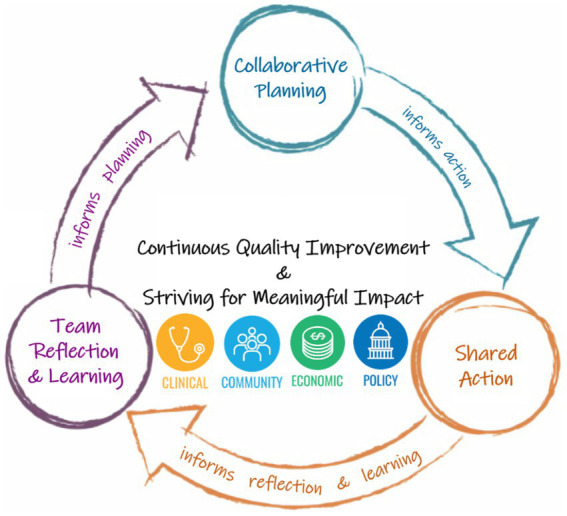
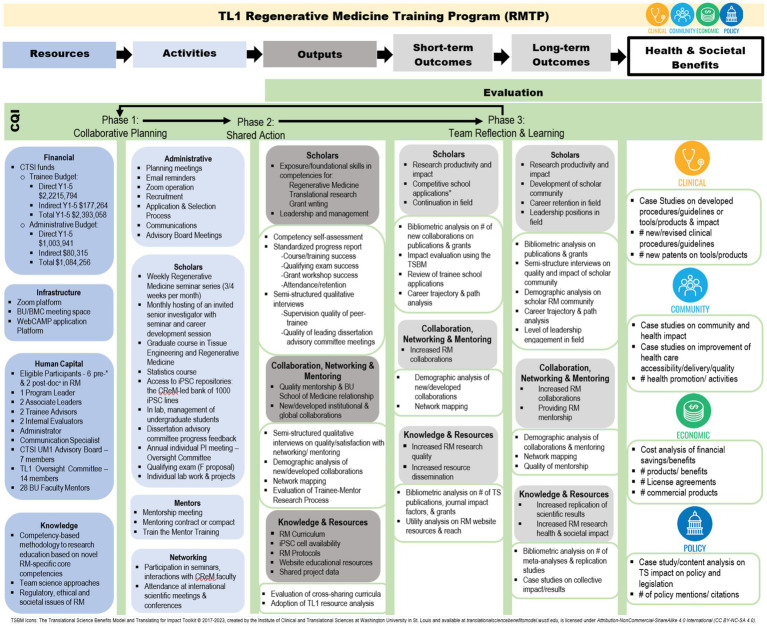
Clinical and Translational Science Award (CTSA) programs seek to improve the quality and impact of clinical and translational science. CTSA evaluation teams implement structured, evidence-based continuous quality improvement (CQI) processes to enhance activities and outcomes, ultimately benefiting public health. The Translational Science Benefits Model (TSBM) provides a framework for assessing translational science's health and societal impact, yet additional tools are needed to integrate CQI with impact evaluation. Addressing this gap requires combining CQI methodologies with team science approaches. Building on TSBM, CQI theories (e.g., Plan-Do-Study-Act cycles), and team science principles (e.g., inclusive leadership), we propose a theory-driven, evidence-based logic model to enhance CTSA programs. Using our TL1 Regenerative Medicine Training Program (RMTP) as a case study, we demonstrate its practical application for CTSA evaluation teams.
We conducted a literature review on impact evaluation, CQI, and team science to develop a theory-based approach for CTSA evaluation teams. Using case study methodology, we analyzed RMTP data (2015-2023) through: (a) Interviews with RMTP leaders, mentors, and trainees to explore program implementation and outcomes; (b) Document analysis of program materials, meeting notes, and reports; (c) Bibliometric and policy analysis of publications, citations, and policy documents to assess impact; and (d) Surveys to capture trainees' perspectives on program quality and leadership. This mixed-methods approach provided a comprehensive assessment of RMTP's impact and demonstrated the utility of our team science-based approach to CQI and evaluation.
Our sample included RMTP directors ( = 2), mentors ( = 24), and trainees ( = 38). Among trainees, 68% identified as female, and 21% were from underrepresented groups in medicine. Of 34 graduates, 31 continued in regenerative medicine research. Qualitative data highlighted CQI strategies, such as embedding evaluation into advisory meetings to enhance program functioning. Inclusive leadership fostered a climate where diverse perspectives informed improvements. Quantitative and document analysis further demonstrated how RMTP activities led to positive health and societal impacts within the TSBM framework.
CTSA evaluation teams must integrate CQI and impact evaluation, yet few theory-based approaches exist. Our evaluation and CQI framework merges TSBM, CQI, and team science principles, providing a practical tool for guiding evaluation teams in continuous improvement while maximizing translational science impact.
临床与转化科学奖(CTSA)项目旨在提高临床与转化科学的质量和影响力。CTSA评估团队实施结构化、循证的持续质量改进(CQI)流程,以加强各项活动并提升成果,最终造福公众健康。转化科学效益模型(TSBM)为评估转化科学对健康和社会的影响提供了一个框架,但还需要其他工具来将CQI与影响评估相结合。解决这一差距需要将CQI方法与团队科学方法相结合。在TSBM、CQI理论(如计划-执行-研究-行动循环)和团队科学原则(如包容性领导)的基础上,我们提出了一个理论驱动、循证的逻辑模型,以加强CTSA项目。以我们的TL1再生医学培训项目(RMTP)为例,我们展示了其在CTSA评估团队中的实际应用。
我们对影响评估、CQI和团队科学进行了文献综述,以开发一种基于理论的CTSA评估团队方法。使用案例研究方法,我们通过以下方式分析了RMTP数据(2015 - 2023年):(a)采访RMTP负责人、导师和学员,以探讨项目实施情况和成果;(b)对项目材料、会议记录和报告进行文件分析;(c)对出版物、引用和政策文件进行文献计量和政策分析,以评估影响;(d)进行调查,以了解学员对项目质量和领导力的看法。这种混合方法全面评估了RMTP的影响,并展示了我们基于团队科学的CQI和评估方法的实用性。
我们的样本包括RMTP主任(n = 2)、导师(n = 24)和学员(n = 38)。在学员中,68%为女性,21%来自医学领域代表性不足的群体。34名毕业生中,31人继续从事再生医学研究。定性数据突出了CQI策略,如将评估融入咨询会议以增强项目功能。包容性领导营造了一种氛围,使不同观点为改进提供信息。定量和文件分析进一步证明了RMTP活动如何在TSBM框架内产生积极的健康和社会影响。
CTSA评估团队必须将CQI和影响评估相结合,但基于理论的方法很少。我们的评估和CQI框架融合了TSBM、CQI和团队科学原则,为指导评估团队持续改进并最大化转化科学影响提供了一个实用工具。