Choi Arom, Park Incheol, You Je Sung, Chung Sung Phil, Park Yoo Seok
Department of Emergency Medicine, Yonsei University College of Medicine, Seoul, Korea.
J Korean Med Sci. 2025 Jun 2;40(21):e96. doi: 10.3346/jkms.2025.40.e96.
Out-of-hospital cardiac arrest (OHCA) is a major public health issue associated with low survival rates and poor neurological outcomes. Comorbidities and various triggers are associated with OHCA incidence and outcomes. However, the association between alcohol consumption and the neurological prognosis in patients with OHCA remains unknown. Therefore, this study aimed to examine the potential association between the frequency of alcohol consumption and neurological outcomes in patients with OHCA.
This retrospective observational study used data from the Korean Cardiac Arrest Research Consortium registry, encompassing 62 hospitals in Korea. Patients aged > 18 years who experienced OHCA and were transported by the public emergency medical service system were included. Alcohol consumption was categorized into four groups: never drinkers, light drinkers, moderate drinkers, and heavy drinkers. The primary outcome measured was a favorable neurological outcome at hospital discharge (cerebral performance category score 1 or 2).
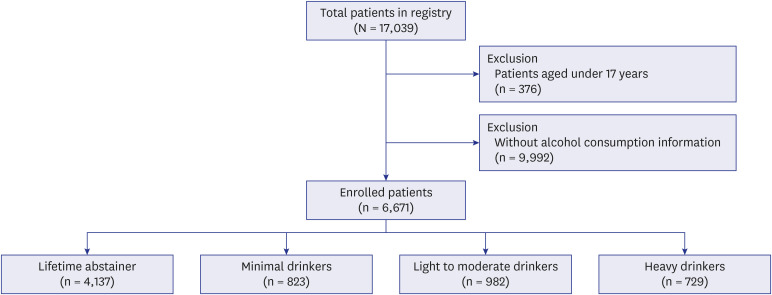
Among the 6,671 enrolled patients, 14.7% had favorable neurological outcomes. The odd ratio of achieving a good neurologic outcome was reduced by 0.597 (95% confidence interval [CI], 0.444-0.802; < 0.001), 0.650 (95% CI, 0.431-0.983; = 0.041), and 0.666-fold (95% CI, 0.448-0.989; = 0.044) for never, light, and heavy drinkers, respectively, compared to moderate drinkers.
This study revealed a nonlinear association between the frequency of alcohol consumption and neurological prognosis in patients with OHCA. Therefore, future studies should focus on investigating the mechanism underlying the potential brain-protective effects of alcohol to further understand its impact on neurological recovery following OHCA.
ClinicalTrials.gov Identifier: NCT03222999.
院外心脏骤停(OHCA)是一个重大的公共卫生问题,其生存率低且神经功能预后差。合并症和各种诱因与OHCA的发病率及预后相关。然而,饮酒与OHCA患者神经功能预后之间的关联尚不清楚。因此,本研究旨在探讨饮酒频率与OHCA患者神经功能预后之间的潜在关联。
这项回顾性观察性研究使用了韩国心脏骤停研究联盟登记处的数据,该登记处涵盖了韩国的62家医院。纳入年龄大于18岁、经历过OHCA并由公共紧急医疗服务系统转运的患者。饮酒情况分为四组:从不饮酒者、轻度饮酒者、中度饮酒者和重度饮酒者。测量的主要结局是出院时良好的神经功能预后(脑功能类别评分1或2)。
在6671名登记患者中,14.7%有良好的神经功能预后。与中度饮酒者相比,从不饮酒者、轻度饮酒者和重度饮酒者实现良好神经功能预后的比值比分别降低了0.597(95%置信区间[CI],0.444 - 0.802;P < 0.001)、0.650(95% CI,0.431 - 0.983;P = 0.041)和0.666倍(95% CI,0.448 - 0.989;P = 0.044)。
本研究揭示了OHCA患者饮酒频率与神经功能预后之间存在非线性关联。因此,未来的研究应侧重于探究酒精潜在脑保护作用的机制,以进一步了解其对OHCA后神经功能恢复的影响。
ClinicalTrials.gov标识符:NCT03222999。