• 文献检索
  • 文档翻译
  • 深度研究
  • 学术资讯
  • Suppr Zotero 插件Zotero 插件
  • 邀请有礼
  • 套餐&价格
  • 历史记录
应用&插件
Suppr Zotero 插件Zotero 插件浏览器插件Mac 客户端Windows 客户端微信小程序
定价
高级版会员购买积分包购买API积分包
服务
文献检索文档翻译深度研究API 文档MCP 服务
关于我们
关于 Suppr公司介绍联系我们用户协议隐私条款
关注我们

Suppr 超能文献

核心技术专利:CN118964589B侵权必究
粤ICP备2023148730 号-1Suppr @ 2026

文献检索

告别复杂PubMed语法,用中文像聊天一样搜索,搜遍4000万医学文献。AI智能推荐,让科研检索更轻松。

立即免费搜索

文件翻译

保留排版,准确专业,支持PDF/Word/PPT等文件格式,支持 12+语言互译。

免费翻译文档

深度研究

AI帮你快速写综述,25分钟生成高质量综述,智能提取关键信息,辅助科研写作。

立即免费体验

医学生对ChatGPT应用的现状与认知:一项基于调查的研究。

Status and perceptions of ChatGPT utilization among medical students: a survey-based study.

作者信息

Hu Na, Jiang Xiao Qin, Wang Yi Da, Kang Yan Ming, Xia Zhen, Chen Hao Hui, Duan Sai Nan, Chen Dong Xu

机构信息

Department of Anesthesiology, West China Second University Hospital, Sichuan University, Chengdu, China.

Key Laboratory of Birth Deficits and Related Diseases of Women and Children, Sichuan University, Ministry of Education, Chengdu, China.

出版信息

BMC Med Educ. 2025 Jun 4;25(1):831. doi: 10.1186/s12909-025-07438-7.

DOI:10.1186/s12909-025-07438-7
PMID:40468340
原文链接:https://pmc.ncbi.nlm.nih.gov/articles/PMC12135314/
Abstract

BACKGROUND

The integration of ChatGPT with educational settings is happening at an unprecedented rate, and there is a growing trend for students to use ChatGPT for various academic work. Although numerous studies have evaluated the knowledge, attitudes, and practices related to ChatGPT among students in diverse medical fields, there remains a notable absence of such research within the Chinese context.

METHODS

The questionnaire survey was conducted to a sample of 1,133 medical students from various medical colleges across Sichuan Province, China, between May 2024 and November 2024 to explore the awareness and attitudes of medical students towards ChatGPT. Descriptive statistics were used to tabulate the frequency of each variable. A chi-square test and multiple regression analysis were employed to investigate the factors influencing participants' positive attitudes toward the prospective use of ChatGPT.

RESULTS

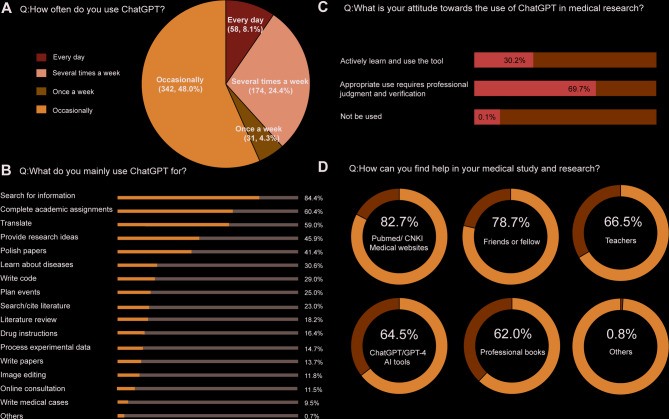
The findings revealed that 62.9% of participants had employed ChatGPT in their medical studies, with 16.5% having utilized the tool in a published article. Participants primarily used ChatGPT for searching information (84.4%) and completing academic assignments (60.4%). However, concerns were expressed regarding the potential for ChatGPT to disseminate misinformation (76.9%) and facilitate plagiarism or complicate its detection (65.4%). Despite these concerns, 64.4% of respondents indicated a willingness to use ChatGPT to seek assistance with learning problems. Overall, a majority of participants (60.7%) maintained a positive attitude on the future use of ChatGPT in the medical field.

CONCLUSION

Our research showed that while most medical students perceived ChatGPT as a valuable tool for academic study and research, they remained cautious about its potential risks, particularly regarding misinformation and plagiarism concerns. Despite these reservations, a majority participants indicated a willingness to incorporate ChatGPT into their academic workflow, specifically for problem-solving tasks, and maintained optimistic perspectives regarding its potential integration into medical education and clinical practice. It is therefore essential to improve student literacy about AI, develop clear guidelines for its acceptable use, and implement support systems to ensure that medical students are fully prepared for the upcoming integration of AI into medical education.

TRIAL REGISTRATION

Not applicable.

摘要

背景

ChatGPT与教育环境的整合正以前所未有的速度进行,学生使用ChatGPT完成各种学术任务的趋势也在不断增加。尽管众多研究评估了不同医学领域学生对ChatGPT的了解、态度和使用情况,但在中国背景下,此类研究仍明显不足。

方法

于2024年5月至11月对来自中国四川省各医学院校的1133名医学生进行问卷调查,以探究医学生对ChatGPT的认知和态度。采用描述性统计列出各变量的频率。运用卡方检验和多元回归分析来研究影响参与者对ChatGPT未来使用持积极态度的因素。

结果

研究结果显示,62.9%的参与者在医学学习中使用过ChatGPT,其中16.5%在已发表的文章中使用过该工具。参与者主要将ChatGPT用于搜索信息(84.4%)和完成学术作业(60.4%)。然而,他们也表达了对ChatGPT传播错误信息(76.9%)以及助长抄袭或使抄袭检测复杂化(65.4%)的担忧。尽管存在这些担忧,64.4%的受访者表示愿意使用ChatGPT来寻求学习问题的帮助。总体而言,大多数参与者(60.7%)对ChatGPT未来在医学领域的使用持积极态度。

结论

我们的研究表明,虽然大多数医学生将ChatGPT视为学术学习和研究的宝贵工具,但他们对其潜在风险仍持谨慎态度,尤其是在错误信息和抄袭方面。尽管有所保留,但大多数参与者表示愿意将ChatGPT纳入其学术工作流程,特别是用于解决问题的任务,并对其可能融入医学教育和临床实践持乐观态度。因此,提高学生的人工智能素养、制定关于其可接受使用的明确指导方针并实施支持系统,以确保医学生为即将到来的人工智能融入医学教育做好充分准备至关重要。

试验注册

不适用。

https://cdn.ncbi.nlm.nih.gov/pmc/blobs/037b/12135314/5de881a5af3e/12909_2025_7438_Fig3_HTML.jpg
https://cdn.ncbi.nlm.nih.gov/pmc/blobs/037b/12135314/95ba245ad9ed/12909_2025_7438_Fig1_HTML.jpg
https://cdn.ncbi.nlm.nih.gov/pmc/blobs/037b/12135314/dcac75fd67f2/12909_2025_7438_Fig2_HTML.jpg
https://cdn.ncbi.nlm.nih.gov/pmc/blobs/037b/12135314/5de881a5af3e/12909_2025_7438_Fig3_HTML.jpg
https://cdn.ncbi.nlm.nih.gov/pmc/blobs/037b/12135314/95ba245ad9ed/12909_2025_7438_Fig1_HTML.jpg
https://cdn.ncbi.nlm.nih.gov/pmc/blobs/037b/12135314/dcac75fd67f2/12909_2025_7438_Fig2_HTML.jpg
https://cdn.ncbi.nlm.nih.gov/pmc/blobs/037b/12135314/5de881a5af3e/12909_2025_7438_Fig3_HTML.jpg

相似文献

1
Status and perceptions of ChatGPT utilization among medical students: a survey-based study.医学生对ChatGPT应用的现状与认知:一项基于调查的研究。
BMC Med Educ. 2025 Jun 4;25(1):831. doi: 10.1186/s12909-025-07438-7.
2
Medical students and ChatGPT: analyzing attitudes, practices, and academic perceptions.医学生与ChatGPT:分析态度、实践及学术认知
BMC Med Educ. 2025 Feb 5;25(1):187. doi: 10.1186/s12909-025-06731-9.
3
Understanding Health Care Students' Perceptions, Beliefs, and Attitudes Toward AI-Powered Language Models: Cross-Sectional Study.理解医学生对人工智能语言模型的看法、信念和态度:横断面研究。
JMIR Med Educ. 2024 Aug 13;10:e51757. doi: 10.2196/51757.
4
Navigating the integration of artificial intelligence in the medical education curriculum: a mixed-methods study exploring the perspectives of medical students and faculty in Pakistan.探索人工智能在医学教育课程中的整合:一项采用混合方法的研究,探讨巴基斯坦医学生和教师的观点。
BMC Med Educ. 2025 Feb 20;25(1):273. doi: 10.1186/s12909-024-06552-2.
5
Health profession students' perceptions of ChatGPT in healthcare and education: insights from a mixed-methods study.健康专业学生对ChatGPT在医疗保健和教育领域的看法:一项混合方法研究的见解
BMC Med Educ. 2025 Jan 21;25(1):98. doi: 10.1186/s12909-025-06702-0.
6
Incorporating ChatGPT in Medical Informatics Education: Mixed Methods Study on Student Perceptions and Experiential Integration Proposals.将 ChatGPT 融入医学信息学教育:学生认知和体验融入建议的混合方法研究。
JMIR Med Educ. 2024 Mar 20;10:e51151. doi: 10.2196/51151.
7
AI usage among medical students in Palestine: a cross-sectional study and demonstration of AI-assisted research workflows.巴勒斯坦医学生对人工智能的使用情况:一项横断面研究及人工智能辅助研究工作流程的演示
BMC Med Educ. 2025 May 12;25(1):693. doi: 10.1186/s12909-025-07272-x.
8
Perceptions and Earliest Experiences of Medical Students and Faculty With ChatGPT in Medical Education: Qualitative Study.医学生和教师在医学教育中对ChatGPT的认知与早期体验:定性研究
JMIR Med Educ. 2025 Feb 20;11:e63400. doi: 10.2196/63400.
9
ChatGPT for Academic Purposes: Survey Among Undergraduate Healthcare Students in Malaysia.用于学术目的的ChatGPT:马来西亚本科医学生的调查
Cureus. 2024 Jan 27;16(1):e53032. doi: 10.7759/cureus.53032. eCollection 2024 Jan.
10
Integrating AI in medical education: a comprehensive study of medical students' attitudes, concerns, and behavioral intentions.将人工智能融入医学教育:对医学生态度、担忧及行为意图的全面研究。
BMC Med Educ. 2025 Apr 23;25(1):599. doi: 10.1186/s12909-025-07177-9.

本文引用的文献

1
Understanding Psychosocial Barriers to Healthcare Technology Adoption: A Review of TAM Technology Acceptance Model and Unified Theory of Acceptance and Use of Technology and UTAUT Frameworks.理解医疗技术采用中的社会心理障碍:技术接受模型(TAM)、技术接受与使用统一理论(UTAUT)框架综述
Healthcare (Basel). 2025 Jan 27;13(3):250. doi: 10.3390/healthcare13030250.
2
The technology acceptance model and adopter type analysis in the context of artificial intelligence.人工智能背景下的技术接受模型与采用者类型分析
Front Artif Intell. 2025 Jan 16;7:1496518. doi: 10.3389/frai.2024.1496518. eCollection 2024.
3
Utilization of, Perceptions on, and Intention to Use AI Chatbots Among Medical Students in China: National Cross-Sectional Study.
中国医学生对人工智能聊天机器人的使用、认知和使用意愿:全国横断面研究。
JMIR Med Educ. 2024 Oct 28;10:e57132. doi: 10.2196/57132.
4
Enhancing self-directed learning with custom GPT AI facilitation among medical students: A randomized controlled trial.在医学生中通过定制GPT人工智能促进自主学习:一项随机对照试验。
Med Teach. 2025 Jul;47(7):1126-1133. doi: 10.1080/0142159X.2024.2413023. Epub 2024 Oct 19.
5
The Impact of Artificial Intelligence-Assisted Learning on Nursing Students' Ethical Decision-making and Clinical Reasoning in Pediatric Care: A Quasi-Experimental Study.人工智能辅助学习对护理学生在儿科护理中的伦理决策和临床推理的影响:一项准实验研究。
Comput Inform Nurs. 2024 Oct 1;42(10):704-711. doi: 10.1097/CIN.0000000000001177.
6
Artificial Intelligence in Endourology: Maximizing the Promise Through Consideration of the Principles of Diffusion of Innovation Theory.人工智能在泌尿内镜学中的应用:通过考虑创新理论扩散原理最大化其潜力。
J Endourol. 2024 Aug;38(8):755-762. doi: 10.1089/end.2023.0680. Epub 2024 Jul 3.
7
AI in medical education: the moderating role of the chilling effect and STARA awareness.人工智能在医学教育中的作用:冷却效应和 STARA 意识的调节作用。
BMC Med Educ. 2024 Jun 7;24(1):644. doi: 10.1186/s12909-024-05627-4.
8
Walking forward or on hold: Could the ChatGPT be applied for seeking health information in neurosurgical settings?前进还是停滞:ChatGPT能否应用于神经外科环境中寻求健康信息?
Ibrain. 2024 Mar 9;10(1):111-115. doi: 10.1002/ibra.12149. eCollection 2024 Spring.
9
ChatGPT for Academic Purposes: Survey Among Undergraduate Healthcare Students in Malaysia.用于学术目的的ChatGPT:马来西亚本科医学生的调查
Cureus. 2024 Jan 27;16(1):e53032. doi: 10.7759/cureus.53032. eCollection 2024 Jan.
10
A multinational study on the factors influencing university students' attitudes and usage of ChatGPT.一项关于影响大学生对 ChatGPT 的态度和使用的因素的跨国研究。
Sci Rep. 2024 Jan 23;14(1):1983. doi: 10.1038/s41598-024-52549-8.