Ramakrishnan Dinesh Kumar, Wassermann Birgit, Berg Christian, Abdelfattah Ahmed, Berg Gabriele
Leibniz Institute for Agricultural Engineering and Bioeconomy (ATB), Max-Eyth-Allee 100, 14469, Potsdam, Potsdam, Germany.
Institute for Biochemistry and Biology, University of Potsdam, Karl-Liebknecht-Str. 24/25, 14476, Potsdam, Germany.
Environ Microbiome. 2025 Jun 4;20(1):61. doi: 10.1186/s40793-025-00728-z.
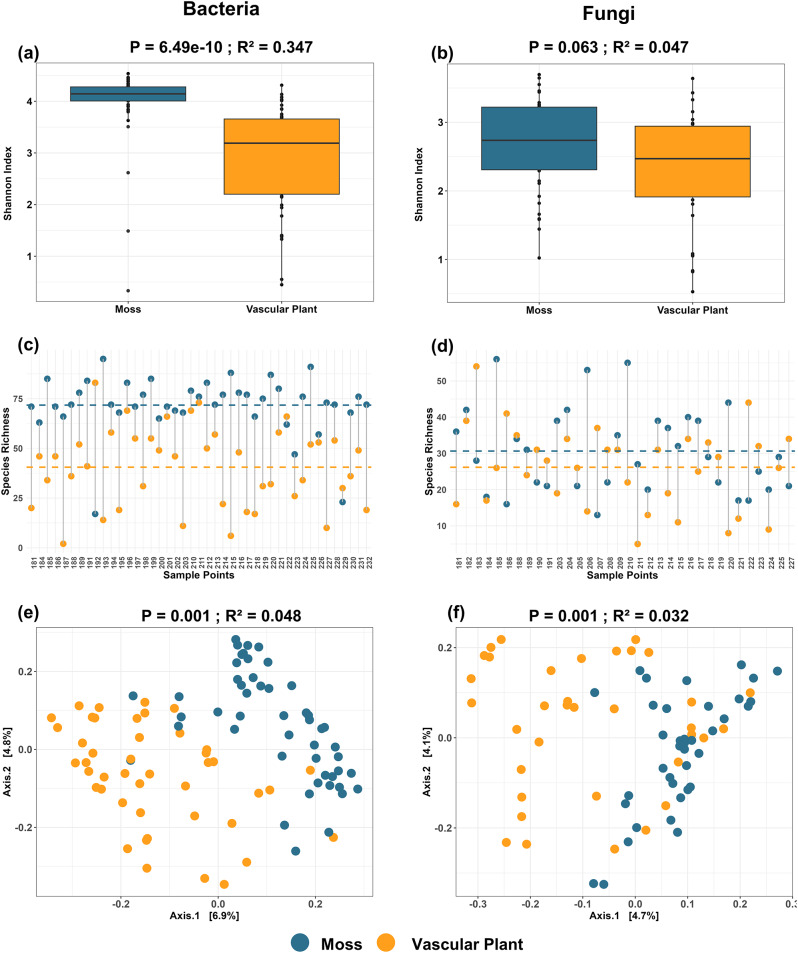
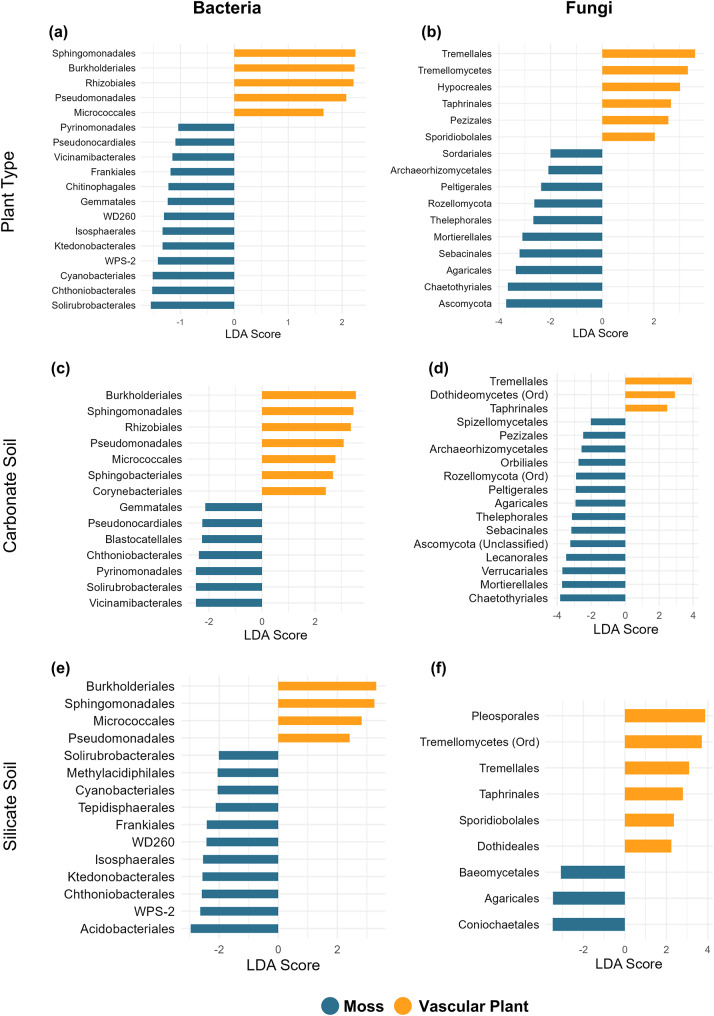
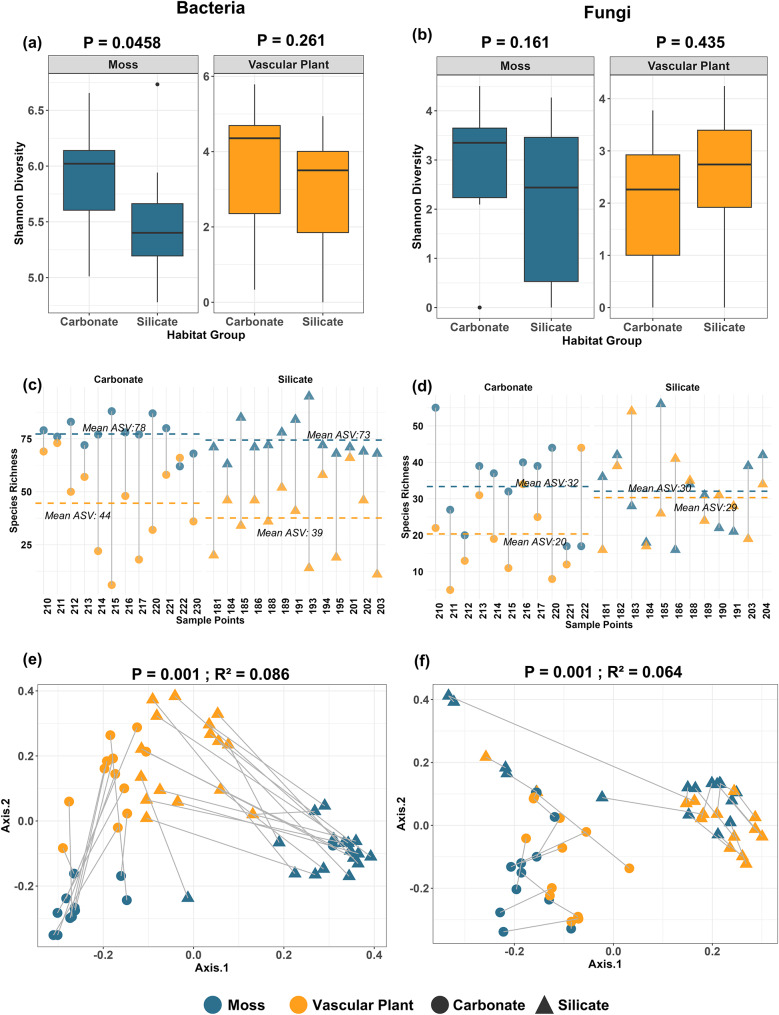
The decline in plant biodiversity is evident at global scale, but little is known about the loss of microbial diversity associated with diverse plant phyla and their influencing factors. This study investigates the microbial diversity associated with mosses and co-occurring vascular plants in the Alpine ecosystem, focusing on 52 plant "twins" growing on contrasting soil types (carbonate and silicate). Despite co-occurring in the same soil, mosses harbored significantly higher microbial richness and diversity than vascular plants. Across all samples, mosses supporting a total of 3,435 bacterial ASVs and 1,174 fungal ASVs. In contrast, vascular plants hosted a total of 1,760 bacterial ASVs and 911 fungal ASVs. Plant phyla strongly influenced microbial community composition, with vascular plants exhibiting a selective microbial assembly strategy, while mosses showed greater environmental influence. Soil type significantly influenced microbial composition in both plant types, with carbonate soils supporting greater bacterial richness, particularly in mosses. Linear discriminant analysis effect size (LEfSe) analysis highlighted consistent enrichments of Proteobacteria, i.e., Sphingomonadales, Rhizobiales, Burkholderiales and, Pseudomonadales, in vascular plants across soil types, whereas mosses displayed distinct microbial enrichment patterns between carbonate and silicate soils, suggesting a higher environmental connectedness. Our findings demonstrated that plant phyla are a major determinant of the phyllosphere microbiota, and that mosses represent a currently untapped source of microbial biodiversity. This study highlights the importance of considering both host traits and environmental factors for protecting microbial biodiversity and implementing them in global strategies for restoring biodiversity.
植物生物多样性的下降在全球范围内是显而易见的,但对于与不同植物门类相关的微生物多样性丧失及其影响因素却知之甚少。本研究调查了高山生态系统中与苔藓及共生维管植物相关的微生物多样性,重点关注生长在不同土壤类型(碳酸盐和硅酸盐)上的52对植物“孪生体”。尽管生长在同一土壤中,苔藓的微生物丰富度和多样性却显著高于维管植物。在所有样本中,苔藓共支持3435个细菌扩增子序列变体(ASVs)和1174个真菌ASVs。相比之下,维管植物共拥有1760个细菌ASVs和911个真菌ASVs。植物门类强烈影响微生物群落组成,维管植物表现出选择性的微生物组装策略,而苔藓则受环境影响更大。土壤类型对两种植物类型的微生物组成均有显著影响,碳酸盐土壤支持更高的细菌丰富度,尤其是在苔藓中。线性判别分析效应大小(LEfSe)分析突出显示,在不同土壤类型的维管植物中,变形菌门(即鞘脂单胞菌目、根瘤菌目、伯克霍尔德菌目和假单胞菌目)持续富集,而苔藓在碳酸盐和硅酸盐土壤之间表现出不同的微生物富集模式,表明其与环境的联系更为紧密。我们的研究结果表明,植物门类是叶际微生物群的主要决定因素,苔藓代表了目前尚未开发的微生物生物多样性来源。本研究强调了在保护微生物生物多样性以及将其纳入全球生物多样性恢复战略时,同时考虑宿主特征和环境因素的重要性。