Lambert Yann, Métras Raphaëlle, Sanna Alice, Galindo Muriel, Hiwat Hélène, Marchesini Paola, Lazrek Yassamine, Musset Lise, Vreden Stephen, Suárez-Mutis Martha Cecilia, Lapouble Oscar Mesones, Adenis Antoine, Nacher Mathieu, Boëlle Pierre-Yves, Poletto Chiara, Douine Maylis
Centre d'Investigation Clinique (Inserm 1424), Institut Santé des Populations en Amazonie, Centre Hospitalier de Cayenne, Cayenne, French Guiana.
UA17 Santé des Populations en Amazonie (Inserm), Cayenne, French Guiana.
Lancet Reg Health Am. 2025 May 15;47:101123. doi: 10.1016/j.lana.2025.101123. eCollection 2025 Jul.
Malaria elimination in mobile and hard-to-reach populations calls for novel, tailored interventions. In French Guiana, the malaria burden is high among the population working in illegal gold mining. Between April 2018 and March 2020, we implemented , a new intervention targeting gold miners, and relying on the distribution of kits for the self-diagnosis and self-treatment of malaria. In this study, we evaluate the impact of Malakit on malaria transmission.
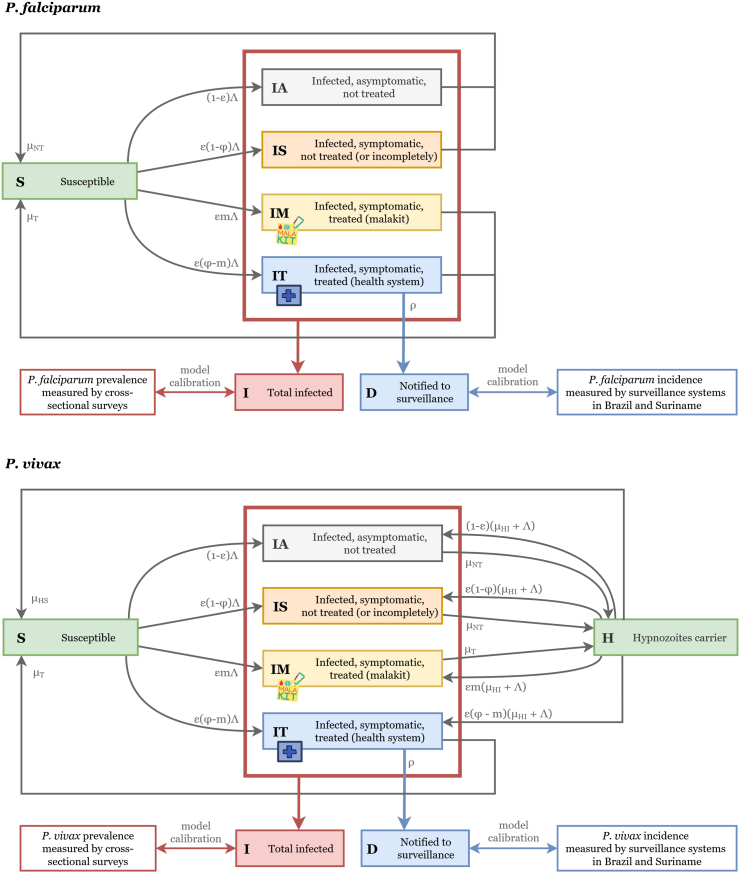
We fitted mathematical models of the transmission of () and () to surveillance data from Brazil and Suriname and to prevalence data from cross-sectional surveys to estimate the change in treatment coverages and reproduction numbers between the pre-intervention (2014-2018) and intervention (2018-2020) periods. Using counterfactual scenario analysis, we estimated the impact of the intervention on malaria incidence.
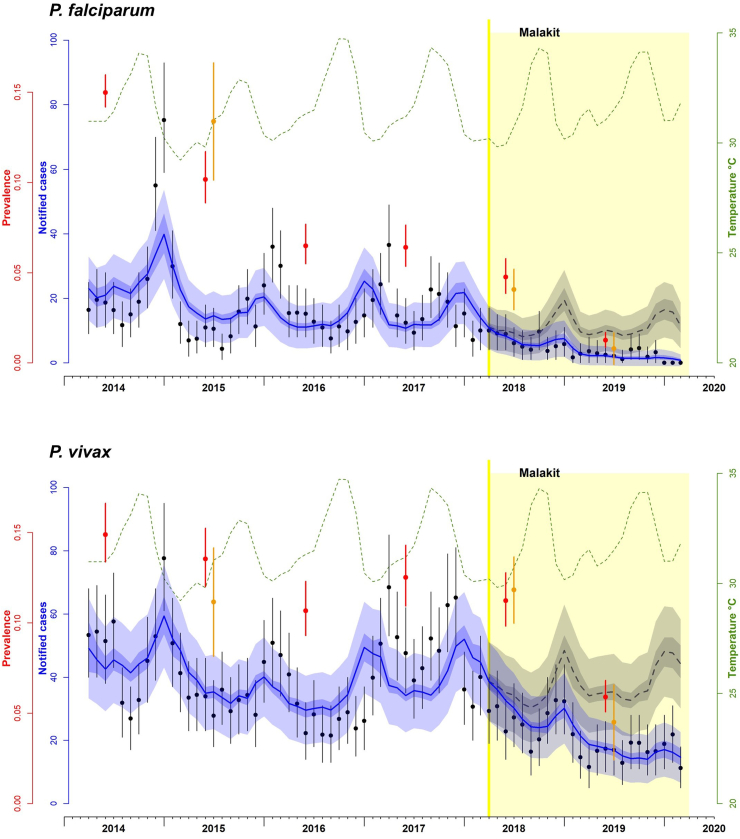
Treatment coverage increased in the intervention compared to the pre-intervention period, the effect being stronger for malaria (from 20.6% [95% CrI 17.0, 25.7] to 81.7% [95% CrI 67.9, 96.4]) than malaria (from 22.3% [95% CrI 19.3, 25.7] to 47.3% [95% CrI 42.6, 52.3]). Concomitantly, the mean reproduction number decreased from 0.96 (95% CrI 0.93, 1.00) to 0.34 (95% CrI 0.22, 0.46), for , and from 1.13 (95% CrI 1.10, 1.16) to 0.86 (95% CrI 0.82, 0.90) for . We estimated that between 2018 and 2020 Malakit helped avert a total of 1231 (95% CrI 589, 1870) and 2406 (95% CrI 1191, 3621) symptomatic infections by and , respectively, corresponding to a 44.2% reduction of the overall malaria incidence (95% CrI -52.5, -34.5).
Malakit had a significant impact on malaria transmission by improving the access to treatment for the population working in illegal gold mining in French Guiana. Building on the regional efforts of the past fifteen years, Malakit contributed to another step towards malaria elimination in the Guiana Shield.
European Union, Global Fund, MoH of Brazil, Cayenne Hospital, Health Regional Agency of French Guiana.
在流动且难以到达的人群中消除疟疾需要新颖、量身定制的干预措施。在法属圭亚那,非法金矿开采从业者中的疟疾负担很重。2018年4月至2020年3月期间,我们实施了一项针对金矿开采者的新干预措施,该措施依靠分发疟疾自我诊断和自我治疗试剂盒。在本研究中,我们评估了Malakit对疟疾传播的影响。
我们将恶性疟原虫和间日疟原虫传播的数学模型与来自巴西和苏里南的监测数据以及横断面调查的患病率数据进行拟合,以估计干预前(2014 - 2018年)和干预期间(2018 - 2020年)治疗覆盖率和繁殖数的变化。使用反事实情景分析,我们估计了该干预措施对疟疾发病率的影响。
与干预前相比,干预期间治疗覆盖率有所提高,对恶性疟的效果更强(从20.6%[95%可信区间17.0,25.7]增至81.7%[95%可信区间67.9,96.4]),而对间日疟的效果较弱(从22.3%[95%可信区间19.3,25.7]增至47.3%[95%可信区间42.6,52.3])。同时,恶性疟的平均繁殖数从0.96(95%可信区间0.93,1.00)降至0.34(95%可信区间0.22,0.46),间日疟的平均繁殖数从1.13(95%可信区间1.10,1.16)降至0.86(95%可信区间0.82,0.90)。我们估计,在2018年至2020年期间,Malakit分别帮助避免了1231例(95%可信区间589,1870)和2406例(95%可信区间1191,3621)由恶性疟原虫和间日疟原虫引起的有症状感染,相当于总体疟疾发病率降低了44.2%(95%可信区间 - 52.5, - 34.5)。
Malakit通过改善法属圭亚那非法金矿开采从业者获得治疗的机会,对疟疾传播产生了重大影响。基于过去十五年的区域努力,Malakit为圭亚那地盾地区朝着消除疟疾又迈进了一步。
欧盟、全球基金、巴西卫生部、卡宴医院、法属圭亚那卫生区域局。