Busch Felix, Hoffmann Lena, Xu Lina, Zhang Long Jiang, Hu Bin, García-Juárez Ignacio, Toapanta-Yanchapaxi Liz N, Gorelik Natalia, Gorelik Valérie, Rodriguez-Granillo Gaston A, Ferrarotti Carlos, Cuong Nguyen N, Thi Chau A P, Tuncel Murat, Kaya Gürsan, Solis-Barquero Sergio M, Mendez Avila Maria C, Ivanova Nevena G, Kitamura Felipe C, Hayama Karina Y I, Puntunet Bates Monserrat L, Torres Pedro Iturralde, Ortiz-Prado Esteban, Izquierdo-Condoy Juan S, Schwarz Gilbert M, Hofstaetter Jochen G, Hide Michihiro, Takeda Konagi, Peric Barbara, Pilko Gašper, Thulesius Hans O, Lindow Thomas, Kolawole Israel K, Olatoke Samuel Adegboyega, Grzybowski Andrzej, Corlateanu Alexandru, Iaconi Oana-Simina, Li Ting, Domitrz Izabela, Kepczynska Katarzyna, Mihalcin Matúš, Fašaneková Lenka, Zatonski Tomasz, Fulek Katarzyna, Molnár András, Maihoub Stefani, da Silva Gama Zenewton A, Saba Luca, Sountoulides Petros, Makowski Marcus R, Aerts Hugo J W L, Adams Lisa C, Bressem Keno K, Navarro Álvaro Aceña, Águas Catarina, Aineseder Martina, Alomar Muaed, Al Sliman Rashid, Anand Gautam, Angkurawaranon Salita, Aoki Shuhei, Arkoh Samuel, Ashraf Gizem, Astri Yesi, Bakhshi Sameer, Bayramov Nuru Y, Billis Antonis, Bitencourt Almir G V, Bolejko Anetta, Bollas Becerra Antonio J, Bwambale Joe, Capela Andreia, Cau Riccardo, Chacon-Acevedo Kelly R, Chaunzwa Tafadzwa L, Chojniak Rubens, Clements Warren, Cuocolo Renato, Dahlblom Victor, Sousa Kelienny de Meneses, Villarrubia Jorge Esteban, Desai Vijay B, Dhakal Ajaya K, Dignum Virginia, Andrade Rubens G Feijo, Ferraioli Giovanna, Ganguly Shuvadeep, Garg Harshit, Savevska Cvetanka Gjerakaroska, Radovikj Marija Gjerakaroska, Gkartzoni Anastasia, Gorospe Luis, Griffin Ian, Hadamitzky Martin, Ndahiro Martin Hakorimana, Hering Alessa, Hochhegger Bruno, Huseynova Mehriban R, Ishida Fujimaro, Jha Nisha, Jiang Lili, Kader Rawen, Kavnoudias Helen, Klein Clément, Kolostoumpis George, Koshy Abraham, Kruger Nicholas A, Löser Alexander, Lucijanic Marko, Mantziari Despoina, Margue Gaelle, McFadden Sonyia, Miyake Masahiro, Morakote Wipawee, Ngabonziza Issa, Nguyen Thao T, Niehues Stefan M, Nortje Marc, Palaian Subish, Pentara Natalia V, de Almeida Rui P Pereira, Poma Gianluigi, Purwoko Mitayani, Pyrgidis Nikolaos, Rafailidis Vasileios, Rainey Clare, Ribeiro João C, Agudelo Nicolás Rozo, Sado Keina, Saidman Julia M, Saturno-Hernandez Pedro J, Suryadevara Vidyani, Schulz Gerald B, Soric Ena, Soto-Pérez-Olivares Javier, Stanzione Arnaldo, Struck Julian Peter, Takaoka Hiroyuki, Tanioka Satoru, Huyen Tran T M, Truhn Daniel, van Dijk Elon H C, van Wijngaarden Peter, Wang Yuan-Cheng, Weidlich Matthias, Zhang Shuhang
Department of Diagnostic and Interventional Radiology, School of Medicine and Health, Klinikum rechts der Isar, TUM University Hospital, Technical University of Munich, Munich, Germany.
Department of Radiology, Charité-Universitätsmedizin Berlin, Corporate Member of Freie Universität Berlin and Humboldt Universität zu Berlin, Berlin, Germany.
JAMA Netw Open. 2025 Jun 2;8(6):e2514452. doi: 10.1001/jamanetworkopen.2025.14452.
The successful implementation of artificial intelligence (AI) in health care depends on its acceptance by key stakeholders, particularly patients, who are the primary beneficiaries of AI-driven outcomes.
To survey hospital patients to investigate their trust, concerns, and preferences toward the use of AI in health care and diagnostics and to assess the sociodemographic factors associated with patient attitudes.
DESIGN, SETTING, AND PARTICIPANTS: This cross-sectional study developed and implemented an anonymous quantitative survey between February 1 and November 1, 2023, using a nonprobability sample at 74 hospitals in 43 countries. Participants included hospital patients 18 years of age or older who agreed with voluntary participation in the survey presented in 1 of 26 languages.
Information sheets and paper surveys handed out by hospital staff and posted in conspicuous hospital locations.
The primary outcome was participant responses to a 26-item instrument containing a general data section (8 items) and 3 dimensions (trust in AI, AI and diagnosis, preferences and concerns toward AI) with 6 items each. Subgroup analyses used cumulative link mixed and binary mixed-effects models.
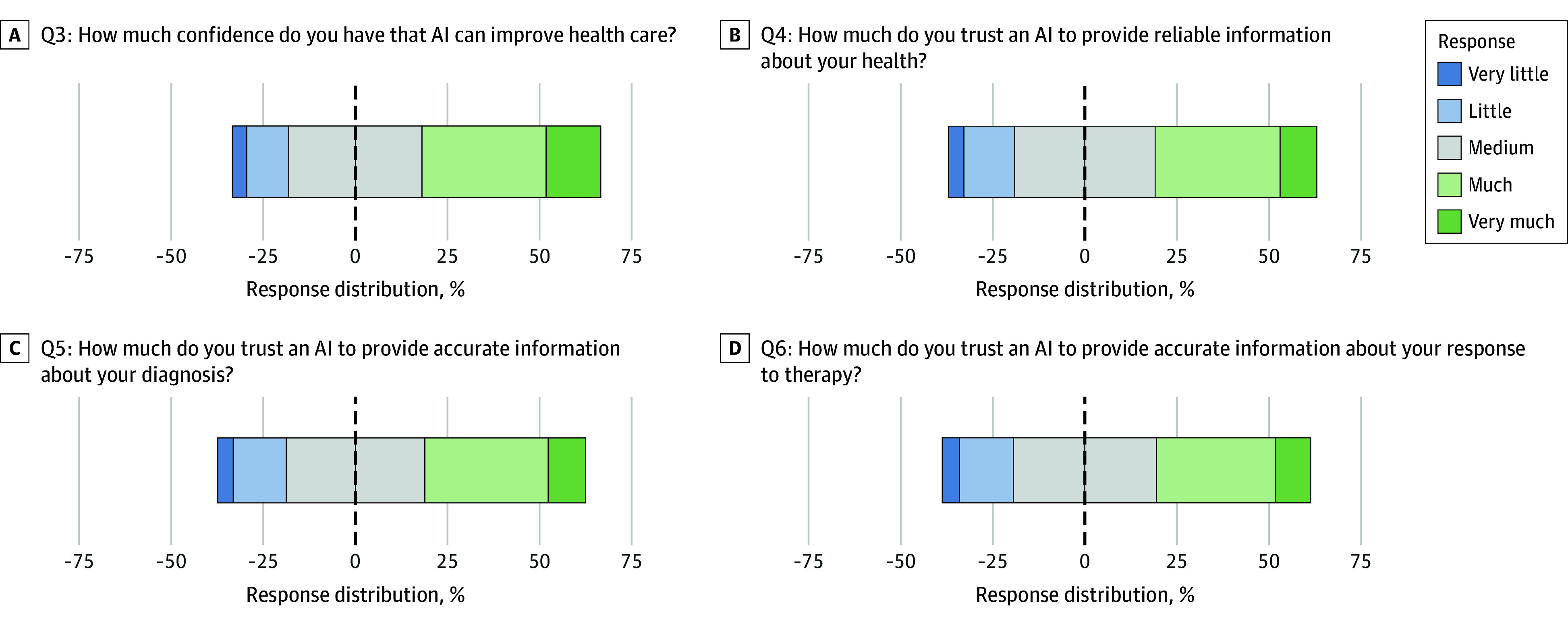
In total, 13 806 patients participated, including 8951 (64.8%) in the Global North and 4855 (35.2%) in the Global South. Their median (IQR) age was 48 (34-62) years, and 6973 (50.5%) were male. The survey results indicated a predominantly favorable general view of AI in health care, with 57.6% of respondents (7775 of 13 502) expressing a positive attitude. However, attitudes exhibited notable variation based on demographic characteristics, health status, and technological literacy. Female respondents (3511 of 6318 [55.6%]) exhibited fewer positive attitudes toward AI use in medicine than male respondents (4057 of 6864 [59.1%]), and participants with poorer health status exhibited fewer positive attitudes toward AI use in medicine (eg, 58 of 199 [29.2%] with rather negative views) than patients with very good health (eg, 134 of 2538 [5.3%] with rather negative views). Conversely, higher levels of AI knowledge and frequent use of technology devices were associated with more positive attitudes. Notably, fewer than half of the participants expressed positive attitudes regarding all items pertaining to trust in AI. The lowest level of trust was observed for the accuracy of AI in providing information regarding treatment responses (5637 of 13 480 respondents [41.8%] trusted AI). Patients preferred explainable AI (8816 of 12 563 [70.2%]) and physician-led decision-making (9222 of 12 652 [72.9%]), even if it meant slightly compromised accuracy.
In this cross-sectional study of patient attitudes toward AI use in health care across 6 continents, findings indicated that tailored AI implementation strategies should take patient demographics, health status, and preferences for explainable AI and physician oversight into account.
人工智能(AI)在医疗保健领域的成功应用取决于关键利益相关者的接受程度,尤其是患者,他们是人工智能驱动成果的主要受益者。
对医院患者进行调查,以了解他们对医疗保健和诊断中使用人工智能的信任、担忧及偏好,并评估与患者态度相关的社会人口统计学因素。
设计、背景和参与者:这项横断面研究于2023年2月1日至11月1日开展并实施了一项匿名定量调查,在43个国家的74家医院采用非概率抽样。参与者包括18岁及以上同意自愿参与以26种语言之一呈现的调查的医院患者。
医院工作人员发放并张贴在医院显眼位置的信息表和纸质调查问卷。
主要结局是参与者对一份包含26个条目的问卷的回答,该问卷包括一个一般数据部分(8个条目)和3个维度(对人工智能的信任、人工智能与诊断、对人工智能的偏好和担忧),每个维度各有6个条目。亚组分析采用累积链接混合模型和二元混合效应模型。
共有13806名患者参与,其中全球北方地区8951名(64.8%),全球南方地区4855名(35.2%)。他们的年龄中位数(四分位间距)为48(34 - 62)岁,男性6973名(50.5%)。调查结果显示,患者对医疗保健中人工智能总体上持较为积极的看法,57.6%的受访者(13502人中的7775人)表达了积极态度。然而,态度因人口统计学特征、健康状况和技术素养而存在显著差异。女性受访者(6318人中的3511人[55.6%])对医学中使用人工智能的积极态度低于男性受访者(6864人中的4057人[59.1%]),健康状况较差的参与者对医学中使用人工智能的积极态度低于健康状况非常好的患者(例如,199人中的小58人[29.2%]持相当负面的看法,而2538人中的134人[5.3%]持相当负面的看法)。相反,更高的人工智能知识水平和频繁使用技术设备与更积极的态度相关。值得注意的是,不到一半的参与者对与人工智能信任相关的所有项目都表达了积极态度。在人工智能提供治疗反应信息的准确性方面,信任程度最低(13480名受访者中的5637人[41.8%]信任人工智能)。患者更喜欢可解释的人工智能(12563人中的8816人[70.2%])和医生主导的决策(12652人中的9222人[72.9%]),即使这意味着准确性略有下降。
在这项对六大洲患者对医疗保健中使用人工智能态度的横断面研究中,结果表明,定制的人工智能实施策略应考虑患者的人口统计学特征、健康状况以及对可解释人工智能和医生监督的偏好。