Pal Madhumita, Branda Francesco, Alkhedaide Adel Qlayel, Sarangi Ashish K, Samal Himansu Bhusan, Tripathy Lizaranee, Barik Binapani, El-Bahy Salah M, Patel Alok, Mohapatra Ranjan K, Tuglo Lawrence Sena, Youssef Mona
Department of Electrical Engineering, Government College of Engineering, Keonjhar, Odisha, India.
Unit of Medical Statistics and Molecular Epidemiology, Università Campus Bio-Medico di Roma, Rome, Italy.
Digit Health. 2025 Jun 4;11:20552076251344135. doi: 10.1177/20552076251344135. eCollection 2025 Jan-Dec.
This study aims to enhance the early diagnosis of Mpox through machine learning (ML) and deep learning (DL) models, integrating an ensemble approach to improve classification accuracy.
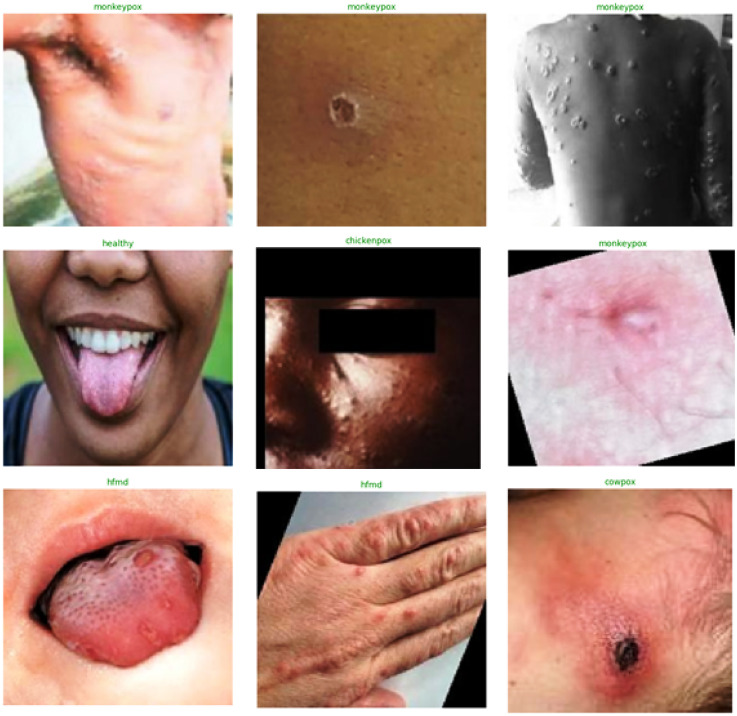
We used the Mpox Skin Lesion Dataset v2.0, comprising six skin lesion categories, including chickenpox, cowpox, Mpox, measles, hand-foot-mouth disease, and healthy skin. Four models-Logistic Regression, K-Nearest Neighbors, Vision Transformer (ViT), and ConvMixer-were evaluated based on their classification performance. An ensemble model combining ViT and ConvMixer predictions was developed to further improve accuracy and robustness. Performance metrics such as accuracy, precision, recall, F1-score, and AUC were used for evaluation.
The ViT model outperformed traditional ML models, achieving 93.03% accuracy in detecting Mpox lesions. The ensemble model further improved diagnostic performance, yielding balanced precision and recall across all lesion categories. The proposed approach demonstrated superior classification accuracy compared to previous studies, highlighting the efficacy of DL-based models in distinguishing Mpox from visually similar conditions.
The integration of ML and DL models in an ensemble framework significantly enhances Mpox detection. This AI-driven diagnostic approach offers a scalable, accurate, and efficient solution, particularly in resource-limited settings. Future research will focus on improving model interpretability, federated learning integration, and validation with real-world clinical data.
本研究旨在通过机器学习(ML)和深度学习(DL)模型加强猴痘的早期诊断,采用集成方法提高分类准确率。
我们使用了猴痘皮肤病变数据集v2.0,其包含六种皮肤病变类别,包括水痘、牛痘、猴痘、麻疹、手足口病和健康皮肤。基于分类性能对逻辑回归、K近邻、视觉Transformer(ViT)和卷积混合器这四种模型进行了评估。开发了一种结合ViT和卷积混合器预测的集成模型,以进一步提高准确性和稳健性。使用准确率、精确率、召回率、F1分数和AUC等性能指标进行评估。
ViT模型优于传统ML模型,在检测猴痘病变方面达到了93.03%的准确率。集成模型进一步提高了诊断性能,在所有病变类别中实现了平衡的精确率和召回率。与先前的研究相比,所提出的方法表现出更高的分类准确率,突出了基于DL的模型在区分猴痘与视觉上相似病症方面的有效性。
在集成框架中整合ML和DL模型可显著提高猴痘检测能力。这种由人工智能驱动的诊断方法提供了一种可扩展、准确且高效的解决方案,尤其在资源有限的环境中。未来的研究将专注于提高模型的可解释性、联邦学习集成以及使用真实世界临床数据进行验证。