Pimenta Silva Daniela, Bouça-Machado Raquel, Pona-Ferreira Filipa, Lobo Teresa, Cacho Ricardo, Anker Rebekka, Krakauer John W, Ferreira Joaquim J
Centro de Estudos Egas Moniz, Faculdade de Medicina, Universidade de Lisboa, Lisboa, Portugal.
Laboratory of Clinical Pharmacology and Therapeutics, Faculdade de Medicina, Universidade de Lisboa, Av. Prof. Egas Moniz, Lisbon, 1649-028, Portugal.
J Neuroeng Rehabil. 2025 Jun 11;22(1):131. doi: 10.1186/s12984-025-01640-w.
Exergaming is a new technology for implementing innovative rehabilitation interventions for neurological conditions. Our aim was to evaluate the feasibility, safety and efficacy of a novel exergaming experience called neuroanimation, in the form of MindPod Dolphin, added to an intensive physiotherapy program for Parkinson's disease (PD).
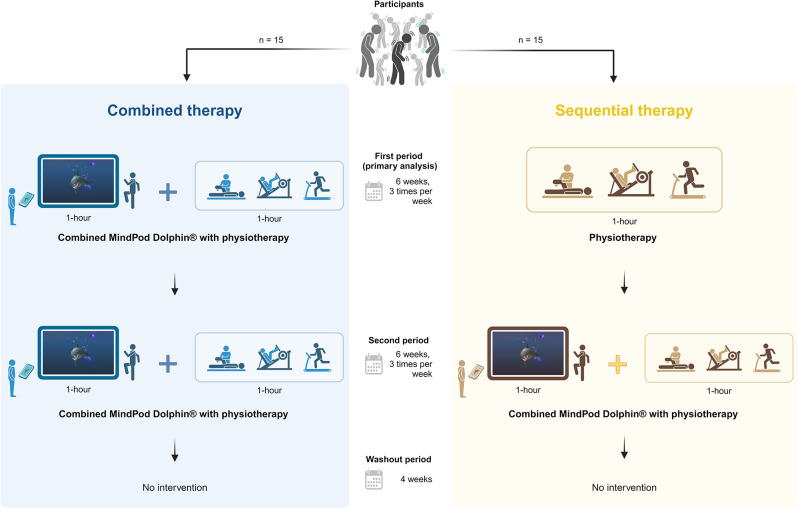
MindPod Dolphin provides a 2D oceanic environment where patients make high-amplitude 3D arm movements controlling an animated dolphin. We conducted a rater-blinded, randomized-controlled trial. Eligible people with PD were assigned into two groups: MindPod Dolphin over 12-weeks combined with physiotherapy (COM) or sequentially after 6-weeks of physiotherapy alone (SEQ). Sessions occurred three times/week. Assessments occurred at baseline, 6-week, 12-week, and 4-week post-intervention. The primary outcome was change from baseline to 6-week in the Timed Up and Go (TUG) test. Secondary outcomes were change, from baseline to each evaluation timepoint, in several motor, cognitive and quality of life measures. Participants' safety was assessed. Adherence, system usability and participants' satisfaction were used as measures of feasibility.
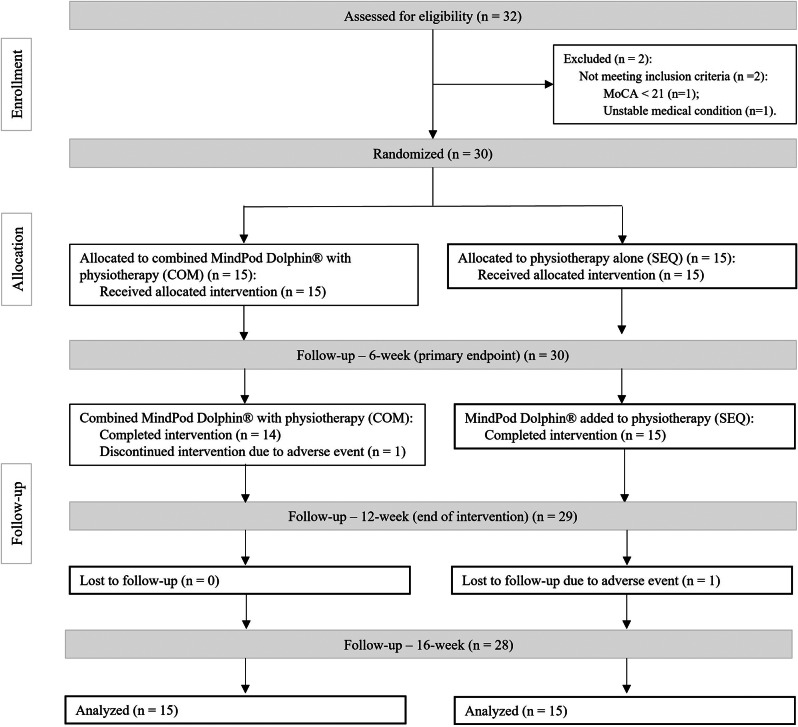
Thirty individuals were recruited. Baseline characteristics were similar between groups. Our primary outcome (change in TUG from baseline to 6-week) did not significantly differ between groups [median TUG change in COM = 0.243 [-1.873, 1.176] vs. SEQ=-0.016 [-0.810, 0.350], estimated difference = 0.002 (95%CI -1.103; 1.273); p = 0.983]. Both groups improved in motor and cognitive measures with a trend favoring COM. When compared to SEQ, COM improved significantly in TUG cognitive from baseline to 16-week (p = 0.048). A main effect of time was observed for TUG cognitive in COM, and mini-BEST in SEQ. Adverse events (n = 309) were mostly mild (55%). Overall, 20 participants (67%) adhered to the study protocol, with the COM being more compliant than the SEQ group. MindPod Dolphin was considered easy to use and over 80% of participants were at least moderately satisfied with it as an intervention.
Neuroanimation-based exergaming in PD was feasible, safe and effective in improving multiple secondary measures. The advantages of the exergame became evident at 12-weeks and beyond, suggesting that it had cumulative and delayed beneficial effects on cognitive and motor outcomes when added to a lead-in phase of intense physiotherapy.
ClinicalTrials.gov registration: NCT04699617.
运动游戏是一种用于为神经系统疾病实施创新康复干预的新技术。我们的目的是评估一种名为神经动画的新型运动游戏体验(以MindPod Dolphin的形式)添加到帕金森病(PD)强化物理治疗方案中的可行性、安全性和有效性。
MindPod Dolphin提供一个二维海洋环境,患者在其中进行大幅度的三维手臂运动来控制一只动画海豚。我们进行了一项评估者盲法的随机对照试验。符合条件的PD患者被分为两组:12周的MindPod Dolphin与物理治疗相结合(COM组)或在单独进行6周物理治疗后依次进行(SEQ组)。治疗每周进行三次。评估在基线、6周、12周和干预后4周进行。主要结局是从基线到6周的定时起立行走(TUG)测试的变化。次要结局是从基线到每个评估时间点,在多项运动、认知和生活质量指标上的变化。评估了参与者的安全性。依从性、系统可用性和参与者满意度被用作可行性指标。
招募了30名个体。两组之间的基线特征相似。我们的主要结局(从基线到6周的TUG变化)在两组之间没有显著差异[COM组TUG变化中位数=0.243[-1.873,1.176],SEQ组=-0.016[-0.810,0.350],估计差异=0.002(95%CI -1.103;1.273);p=0.983]。两组在运动和认知指标上均有改善,趋势上有利于COM组。与SEQ组相比,COM组从基线到16周在TUG认知方面有显著改善(p=0.048)。在COM组中观察到TUG认知的时间主效应,在SEQ组中观察到迷你BEST的时间主效应。不良事件(n=309)大多为轻度(55%)。总体而言,20名参与者(67%)遵守了研究方案,COM组比SEQ组更依从。MindPod Dolphin被认为易于使用,超过80%的参与者对其作为一种干预措施至少中度满意。
基于神经动画的运动游戏在PD中是可行、安全且有效地改善了多项次要指标。运动游戏的优势在12周及以后变得明显,这表明当添加到强化物理治疗的导入阶段时,它对认知和运动结局有累积和延迟的有益影响。
ClinicalTrials.gov注册:NCT04699617。