Lüdtke Thies, Steiner Fabian, Berger Thomas, Westermann Stefan
Department of Human Medicine, MSH Medical School Hamburg, Hamburg, Germany.
Institute of Sustainability Psychology, Leuphana University Lüneburg, Lüneburg, Germany.
Clin Psychol Eur. 2025 May 28;7(2):e12305. doi: 10.32872/cpe.12305. eCollection 2025 May.
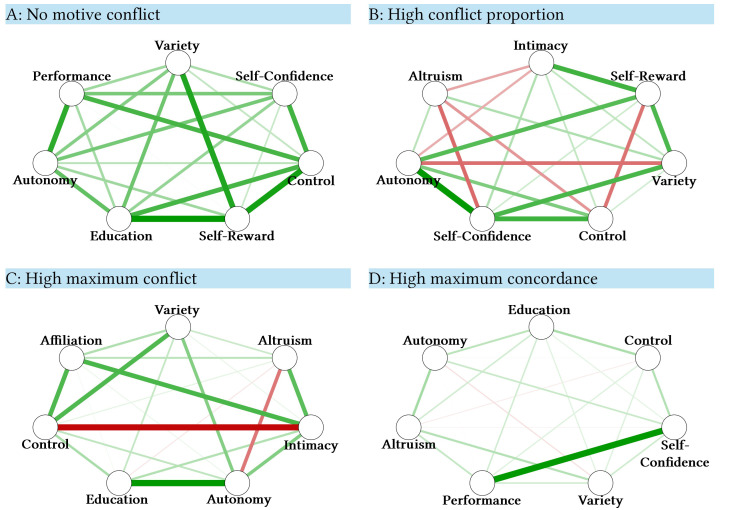
Case formulations and treatment planning mostly rely on self-reports, observations, and third-party reports. We propose that these data sources can be complemented by idiographic networks of motive interactions, which are empirically derived from everyday life using the Experience Sampling Method (ESM). In these networks, positive edges represent concordance of motives whereas negative edges indicate discordance. Based on consistency theory, which states that discordance emerges when the activity of one motive (e.g., 'affiliation') is incompatible with the activity of another motive (e.g., 'autonomy'), we hypothesized that discordance would be associated with subclinical depressive symptoms.
Fifty-one undergraduates completed a six-day ESM assessment period with 6 assessments of motive satisfaction per day. Based on the ESM data, idiographic networks of the seven most important motives per person were computed using mlVAR (https://doi.org/10.32614/CRAN.package.mlVAR). We extracted indices of motive dynamics from each person's network, namely the strength of negative edges compared to the overall network strength as well as the values of the single most negative and positive edges. These indices were then used to predict subclinical depressive symptoms, controlling for overall motive satisfaction.
Discordant, conflicting motive relationships made up only 6% of network strengths, indicating high concordance overall. Neither conflict index predicted subclinical depressive symptoms but maximum concordance was associated with lower subclinical depressive symptoms. Motive satisfaction was a significant predictor across models.
The applicability and clinical utility of the motive network approach was promising. Insufficient variance due to a healthy sample and the small number of observations limit the interpretability of findings.
病例制定和治疗计划大多依赖于自我报告、观察和第三方报告。我们认为,这些数据源可以通过动机互动的独特网络得到补充,这些网络是使用经验取样法(ESM)从日常生活中实证得出的。在这些网络中,正向边表示动机的一致性,而负向边表示不一致性。基于一致性理论,即当一种动机(如“归属”)的活动与另一种动机(如“自主”)的活动不相容时就会出现不一致,我们假设不一致会与亚临床抑郁症状相关。
51名本科生完成了为期6天的ESM评估期,每天对动机满意度进行6次评估。基于ESM数据,使用mlVAR(https://doi.org/10.32614/CRAN.package.mlVAR)计算每个人的七个最重要动机的独特网络。我们从每个人的网络中提取动机动态指标,即负向边的强度与整个网络强度的比较,以及单个最负向和正向边的值。然后使用这些指标来预测亚临床抑郁症状,并控制总体动机满意度。
不一致、冲突的动机关系仅占网络强度的6%,表明总体一致性较高。两个冲突指数均未预测亚临床抑郁症状,但最大一致性与较低的亚临床抑郁症状相关。动机满意度在所有模型中都是一个显著的预测因素。
动机网络方法的适用性和临床效用很有前景。由于样本健康和观察次数较少导致的方差不足限制了研究结果的可解释性。