Zheng Jiaqian, Mao Weiwen, Sang Mengqian, Pan Xinyu, Xie Yiluo, Xie Yichi
Department of Respiratory Medicine, Changzhou Geriatric Hospital Affiliated to Soochow University, Changzhou, China.
Department of Respiratory Medicine, Changzhou No.7 People's Hospital, Changzhou, China.
Front Aging Neurosci. 2025 May 30;17:1617419. doi: 10.3389/fnagi.2025.1617419. eCollection 2025.
The present study explores the prognostic relevance of triglyceride-glucose-based indices in assessing post-stroke survival among affected individuals.
This study utilized a multifaceted analytical approach to assess how triglyceride-glucose-based indicators relate to death risk in stroke patients. This study was analyzed using a multivariate Cox proportional risk regression model incorporating sampling weights, while a restricted cubic spline function was introduced to assess trends in non-linear associations between exposure variables and outcomes. In addition, interaction terms were set and stratified analyses were conducted to verify the robustness and heterogeneity of the model results.
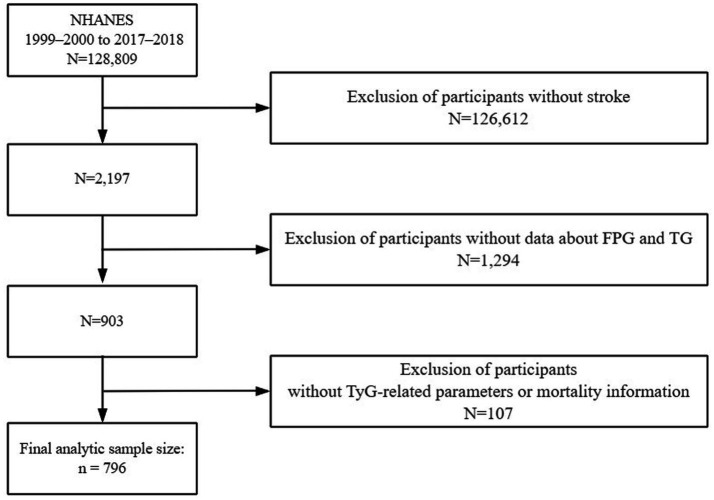
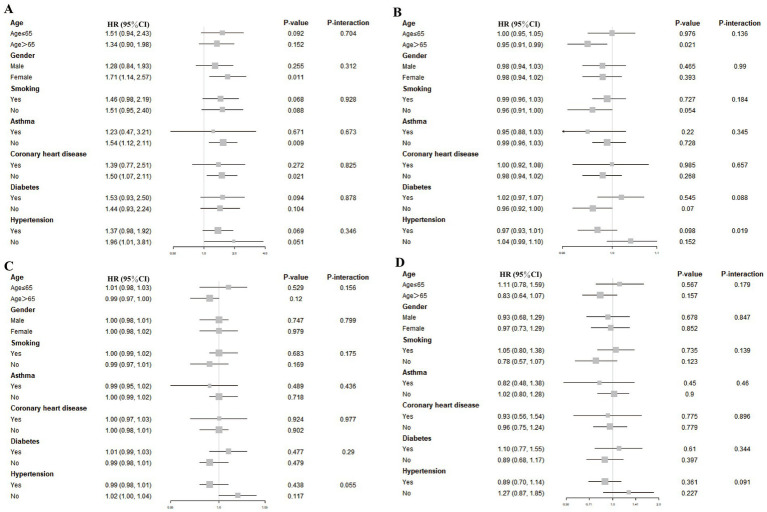
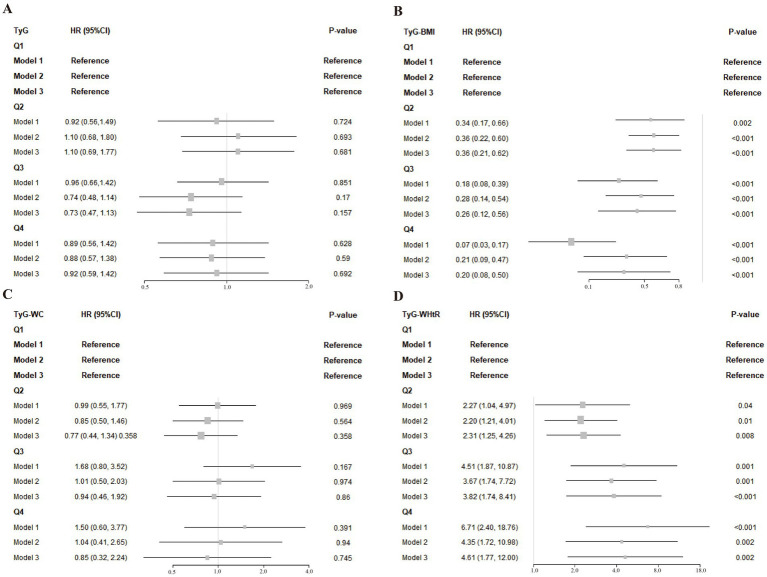
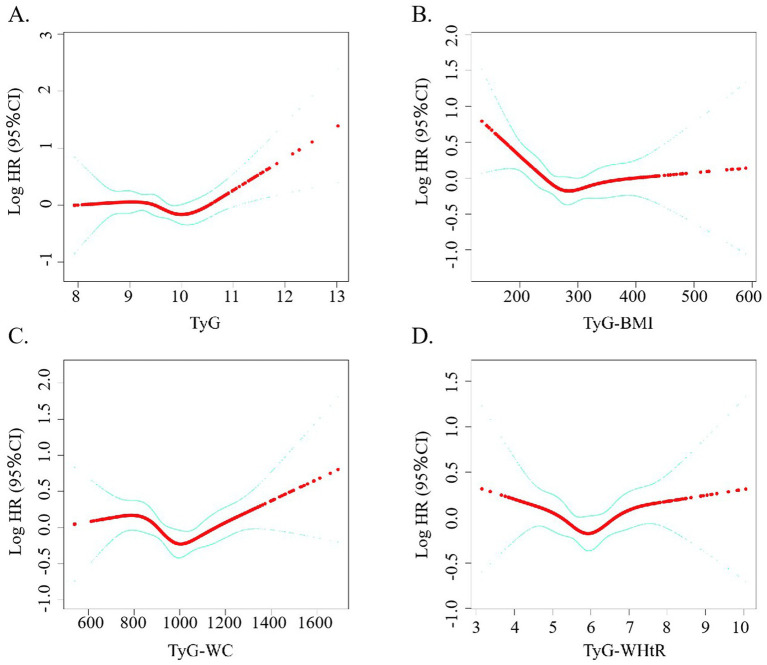
This research ultimately included 796 individuals diagnosed with stroke. When adjusting for a wide range of potential confounders, those in the top TyG-BMI quartile exhibited the most pronounced reduction in mortality risk compared to individuals in the lowest category, with a hazard ratio of 0.20 (95% CI: 0.08-0.50), highlighting its protective potential across TyG-BMI. In contrast, individuals falling within the fourth quartile of the TyG-WHtR index demonstrated the strongest positive correlation with the risk of all-cause mortality (Hazard Ratio = 4.61, 95% CI: 1.77-12.00). Moreover, analysis using restricted cubic splines indicated a significant non-linear association between TyG-BMI levels and mortality outcomes ( < 0.05). No statistical interactions were observed between mortality outcomes and demographic or clinical variables including age, sex, smoking, asthma, coronary artery disease, diabetes, or hypertension across any TyG-related indices ( > 0.05).
The study outcomes suggest that stroke patients with reduced TyG-BMI and elevated TyG-WHtR levels tend to face increased mortality risks. Nonetheless, addressing obesity may be crucial in exploring potential causal pathways.
本研究探讨基于甘油三酯 - 葡萄糖的指标在评估中风患者生存预后方面的相关性。
本研究采用多方面分析方法,评估基于甘油三酯 - 葡萄糖的指标与中风患者死亡风险之间的关系。使用纳入抽样权重的多变量Cox比例风险回归模型对本研究进行分析,同时引入受限立方样条函数来评估暴露变量与结果之间非线性关联的趋势。此外,设置交互项并进行分层分析,以验证模型结果的稳健性和异质性。
本研究最终纳入796名被诊断为中风的个体。在调整了一系列潜在混杂因素后,与最低类别个体相比,处于TyG - BMI四分位数最高组的个体死亡率风险降低最为显著,风险比为0.20(95%置信区间:0.08 - 0.50),突出了其在TyG - BMI范围内的保护潜力。相比之下,处于TyG - WHtR指数第四四分位数的个体与全因死亡率风险的正相关性最强(风险比 = 4.61,95%置信区间:1.77 - 12.00)。此外,使用受限立方样条的分析表明TyG - BMI水平与死亡率结果之间存在显著的非线性关联(<0.05)。在任何与TyG相关的指数中,未观察到死亡率结果与人口统计学或临床变量(包括年龄、性别、吸烟、哮喘、冠状动脉疾病、糖尿病或高血压)之间存在统计学交互作用(>0.05)。
研究结果表明,TyG - BMI降低和TyG - WHtR水平升高的中风患者往往面临更高的死亡风险。尽管如此,解决肥胖问题可能对探索潜在因果途径至关重要。