Kilindimo Said, Turner Forrest, Musa Raya, Russell Collin, Dozois Adeline, Sawe Hendry
Muhimbili University of Heath and Allied Sciences, Tanzania.
Carolinas Medical Center, USA.
Afr J Emerg Med. 2025 Sep;15(3):100879. doi: 10.1016/j.afjem.2025.05.003. Epub 2025 Jun 2.
Sepsis carries a disproportionately high mortality in Sub-Saharan Africa. Current international guidelines for management of septic shock advocate for initial fluid resuscitation followed by vasopressors if there is ongoing concern for hypoperfusion. Emerging data suggest patients in sub-Saharan Africa who receives large fluid boluses may have increased mortality and thus earlier initiation of vasopressors may have clinical benefit. Little data exists on the perceptions, availability and use of vasopressors in Tanzania, which may impact the feasibility of this strategy. We aimed to describe the perception, availability and use of vasopressor in Tanzanian emergency care settings, including its barriers.
We conducted a cross-sectional web-based survey among clinicians and nurses from 19 different hospitals throughout Tanzania (national, zonal, regional and district hospitals). Collected data was kept by the principal investigator on a password encrypted computer whereby descriptive statistics were used to summarize the results.
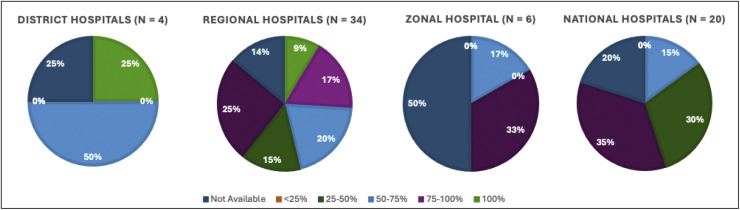
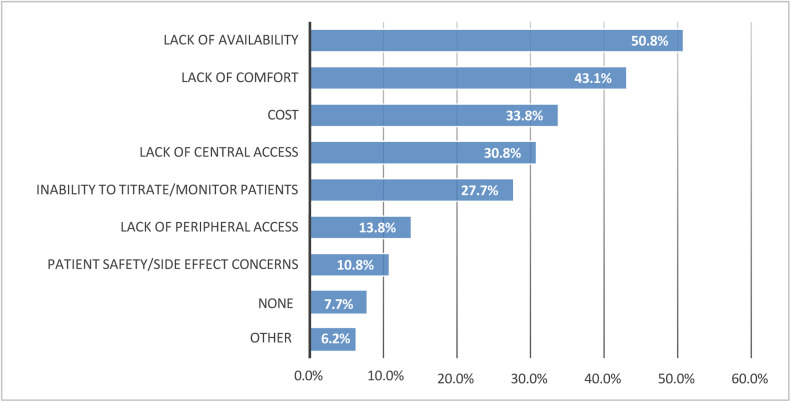
Sixty-five healthcare providers completed the survey of whom the majority 53 (81.5 %), work in the emergency medicine department and 50 (76.9 %) reported treating at least one patient with septic shock per week. However, three quarters of respondents from district hospitals and nearly half of those from regional hospitals had access to vasopressors in <50 % of the time. The most common reported barriers to vasopressor use were lack of availability (50.8 %), and lack of comfort or knowledge (43.1 %). Overall, most respondents perceived that vasopressor use is generally safe and helpful for treating septic shock.
Nearly all Tanzanian healthcare providers in emergency care settings reported that they had limited access to vasopressors to treat septic shock, as it was not consistently available. In addition to unavailability, lack of knowledge on vasopressor use was also reported as barrier. Our findings suggest that ensuring availability of vasopressors and education in the use thereof would improve sepsis care in Tanzanian hospitals.
在撒哈拉以南非洲地区,脓毒症导致的死亡率高得不成比例。当前国际脓毒性休克管理指南提倡初始进行液体复苏,若持续存在灌注不足问题,则随后使用血管活性药物。新出现的数据表明,在撒哈拉以南非洲地区接受大量液体冲击的患者可能死亡率会增加,因此更早开始使用血管活性药物可能具有临床益处。关于坦桑尼亚血管活性药物的认知、可及性和使用情况的数据很少,这可能会影响该策略的可行性。我们旨在描述坦桑尼亚急诊护理环境中血管活性药物的认知、可及性和使用情况,包括其障碍。
我们对坦桑尼亚各地19家不同医院(国家级、地区级、区域级和区级医院)的临床医生和护士进行了基于网络的横断面调查。收集的数据由主要研究者保存在一台加密密码的计算机上,使用描述性统计来总结结果。
65名医疗保健提供者完成了调查,其中大多数53人(81.5%)在急诊科工作,50人(76.9%)报告每周至少治疗一名脓毒性休克患者。然而,区级医院四分之三的受访者以及区域级医院近一半的受访者在不到50%的时间里能够获得血管活性药物。报告的使用血管活性药物最常见障碍是无法获得(50.8%)以及缺乏信心或知识(43.1%)。总体而言,大多数受访者认为使用血管活性药物通常是安全的,对治疗脓毒性休克有帮助。
几乎所有坦桑尼亚急诊护理环境中的医疗保健提供者都报告称,他们获得用于治疗脓毒性休克的血管活性药物的机会有限,因为其供应不稳定。除了无法获得外,对血管活性药物使用缺乏了解也被报告为障碍。我们的研究结果表明,确保血管活性药物的可及性以及开展其使用方面的教育将改善坦桑尼亚医院的脓毒症护理。