Metz Daniel C G, Weinersmith Kelly L, Beagle Alexis S, Dixit Rudra M, Fragel Christina G, Cressler Clayton E
School of Biological Sciences, University of Nebraska-Lincoln, Lincoln, Nebraska, USA.
Department of Biology, Franklin and Marshall College, Lancaster, Pennsylvania, USA.
Ecol Lett. 2025 Jun;28(6):e70135. doi: 10.1111/ele.70135.
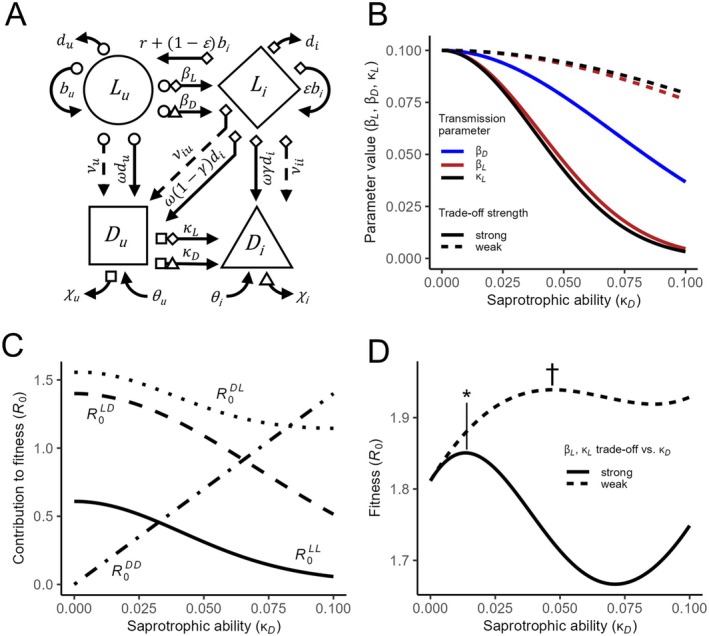
The ability to parasitize living hosts as well as decompose dead organic matter is both common and widespread across prokaryotic and eukaryotic taxa. These parasitic decomposers have long been considered merely accidental or facultative parasites. However, this is often untrue: in many cases, parasitism is integral to the ecology and evolution of these organisms. Combining life cycle information from the literature with a generalised eco-evolutionary model, we define four distinct life history strategies followed by parasitic decomposers. Each strategy has a unique fitness expression, life cycle, ecological context, and set of evolutionary constraints. Correctly classifying parasitic decomposers is essential for understanding their ecology and epidemiology and directly impacts efforts to manage important medical and agricultural pathogens.
寄生生活宿主以及分解死亡有机物质的能力在原核生物和真核生物分类群中既常见又广泛。这些寄生性分解者长期以来一直被认为仅仅是偶然或兼性寄生虫。然而,这往往是不正确的:在许多情况下,寄生是这些生物生态和进化的组成部分。我们将文献中的生命周期信息与一个广义的生态进化模型相结合,定义了寄生性分解者遵循的四种不同的生活史策略。每种策略都有独特的适合度表现、生命周期、生态背景和一系列进化限制。正确分类寄生性分解者对于理解它们的生态学和流行病学至关重要,并且直接影响管理重要医学和农业病原体的努力。