Mattelin Valérie, Van Landuyt Josefien, Kerkhof Frederiek-Maarten, Minnebo Yorick, Boon Nico
Centre for Microbial Ecology and Technology (CMET), Universiteit Gent, Ghent, Belgium.
KYTOS, Ghent, Belgium.
Microbiol Spectr. 2025 Aug 5;13(8):e0197324. doi: 10.1128/spectrum.01973-24. Epub 2025 Jun 23.
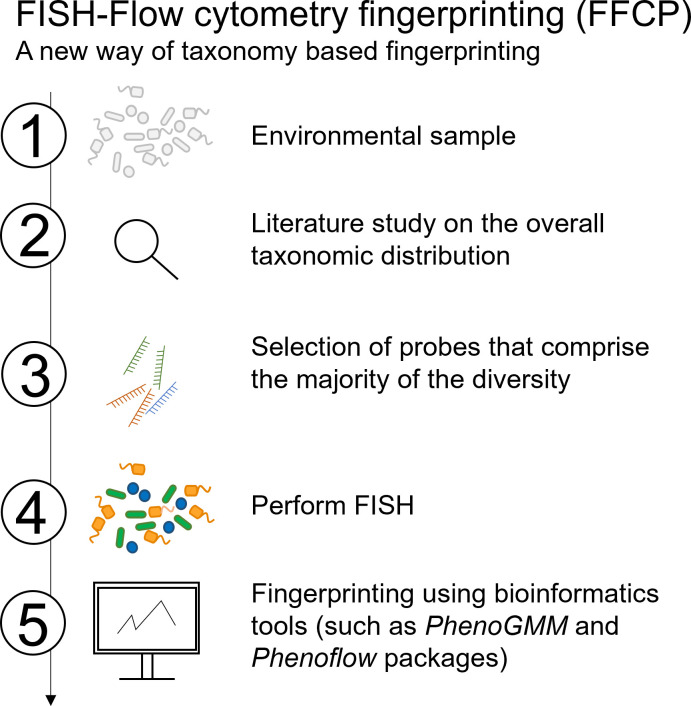
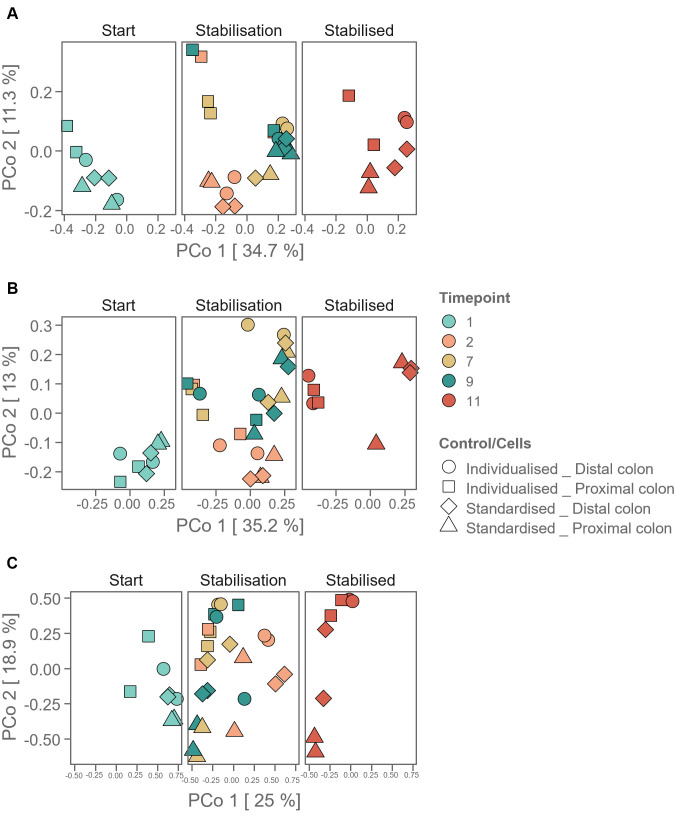
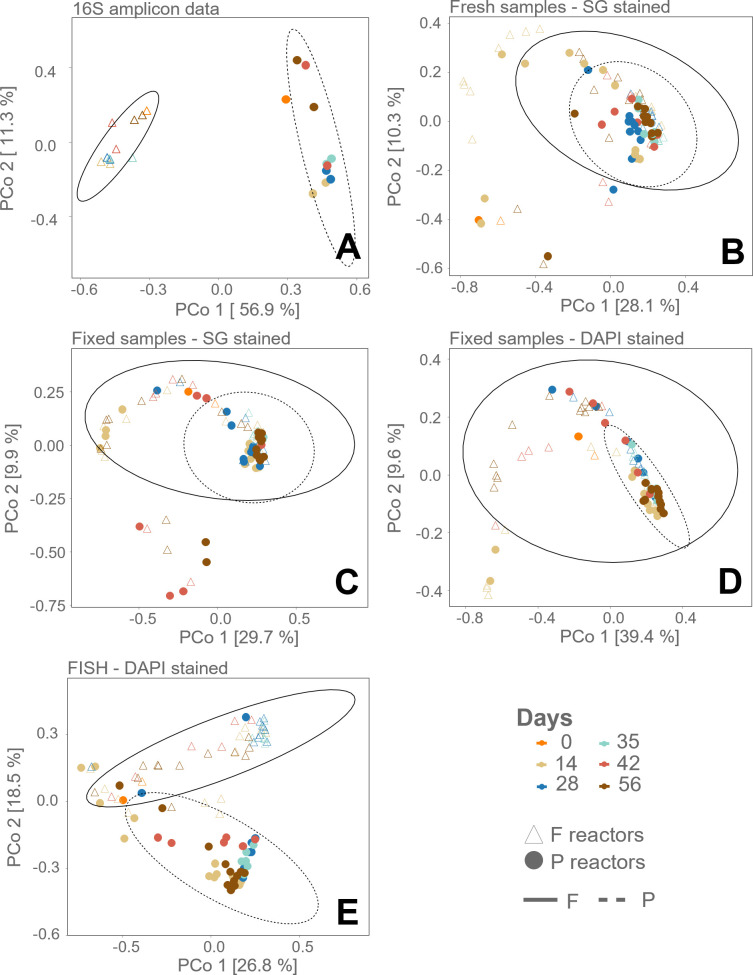
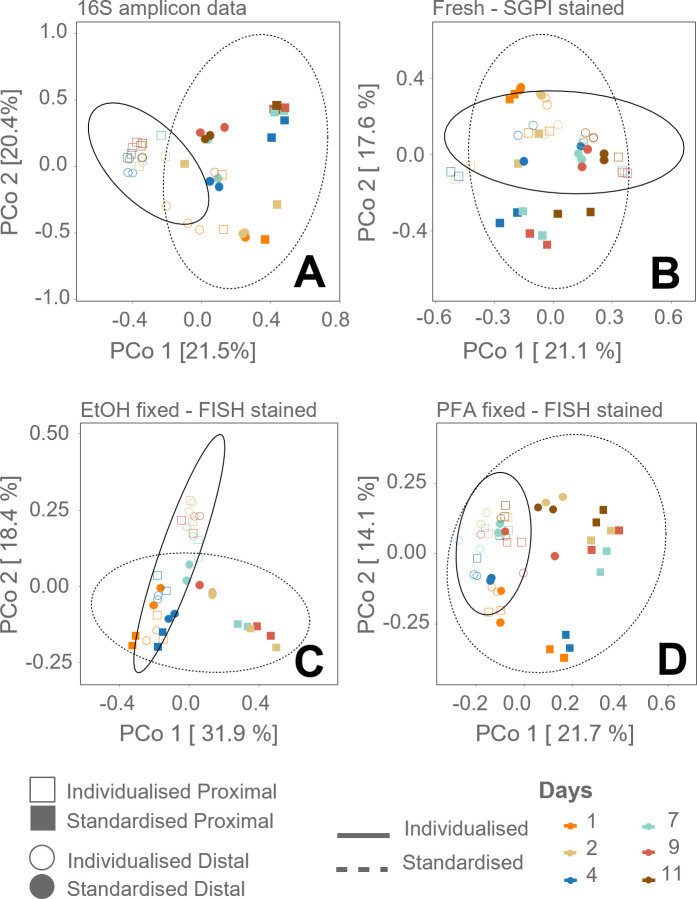
Flow cytometry is a powerful tool to monitor microbial communities, as it allows tracking both changes in the subpopulations and cell numbers at high throughput and a low sample cost. This information can be combined in a phenotypic fingerprint that can be leveraged for diversity analysis. However, as isogenic individuals can manifest phenotypic diversity, for example, due to differing physiological state and phenotypic plasticity, combining the phenotypic information with taxonomic information adds an extra dimension for describing the dynamics of a microbial community. In this research, taxonomic information was incorporated in the microbial fingerprint through fluorescent hybridization (FISH) at a single-cell level. To validate this concept and explore its versatility, two ecosystems with different micro-biodiversity were considered. In the first environment, marine bacteria were monitored for plastic biodegradation in a trickling filter, and in the second, an simulated human gut microbiome was followed over time. Samples were prepared using different (staining) methods, including FISH, and beta diversity analysis was used to evaluate the level of distinction between differently treated groups in both environments. As a reference to correlate increased distinction with the incorporation of taxonomic information, 16S rRNA gene sequencing was used. Finally, a predictive algorithm was trained to correctly classify samples in the differently treated groups. The results showed that the implementation of FISH in flow cytometry provides more information on a single-cell level to answer specific scientific questions, like distinguishing between phenotypically similar communities or following a specific taxonomic group over time.
Understanding microbial communities is crucial for elucidating their role in maintaining ecosystem health and stability. Researchers are increasingly interested in studying microbial communities by looking at not just their genetic makeup but also their physical traits and functions. In our study, we used common techniques like fluorescence hybridization and flow cytometry, along with advanced data analysis, to better understand these communities. This combination allowed us to gather and use data more effectively, demonstrating that these easy-to-use methods, when paired with proper analysis, can enhance our understanding of changing microbial ecosystems.
流式细胞术是监测微生物群落的强大工具,因为它能够在高通量且样本成本低的情况下追踪亚群变化和细胞数量。这些信息可整合到一个表型指纹中,用于多样性分析。然而,由于同基因个体可能表现出表型多样性,例如由于生理状态和表型可塑性的差异,将表型信息与分类信息相结合为描述微生物群落动态增加了一个额外维度。在本研究中,通过单细胞水平的荧光杂交(FISH)将分类信息纳入微生物指纹。为了验证这一概念并探索其通用性,考虑了两个具有不同微生物多样性的生态系统。在第一个环境中,监测滴滤池中海洋细菌对塑料的生物降解,在第二个环境中,随时间跟踪模拟的人类肠道微生物群。使用包括FISH在内的不同(染色)方法制备样本,并使用β多样性分析来评估两个环境中不同处理组之间的区分程度。作为将增加的区分度与分类信息纳入相关联的参考,使用了16S rRNA基因测序。最后,训练了一种预测算法以正确分类不同处理组中的样本。结果表明,在流式细胞术中实施FISH可在单细胞水平提供更多信息,以回答特定的科学问题,如区分表型相似的群落或随时间跟踪特定的分类群。
了解微生物群落对于阐明它们在维持生态系统健康和稳定中的作用至关重要。研究人员越来越有兴趣通过不仅观察微生物群落的基因组成,还观察它们的物理特征和功能来研究微生物群落。在我们的研究中,我们使用了荧光杂交和流式细胞术等常用技术,以及先进的数据分析,以更好地了解这些群落。这种结合使我们能够更有效地收集和使用数据,表明这些易于使用的方法与适当的分析相结合,可以增强我们对不断变化的微生物生态系统的理解。