Ying Jia, Cattell Renee, Huang Chuan
Department of Radiology and Imaging Sciences, Emory University School of Medicine, Atlanta, Georgia, United States of America.
Department of Biomedical Engineering, Stony Brook University, Stony Brook, New York, United States of America.
PLoS One. 2025 Jun 24;20(6):e0316076. doi: 10.1371/journal.pone.0316076. eCollection 2025.
Breast density (BD) is a significant risk factor for breast cancer, yet current assessment methods lack automation, quantification, and cross-platform consistency. This study aims to evaluate the reliability and cross-platform consistency of MagDensity, a novel magnetic resonance imaging (MRI)-based quantitative BD measure, across different imaging platforms.
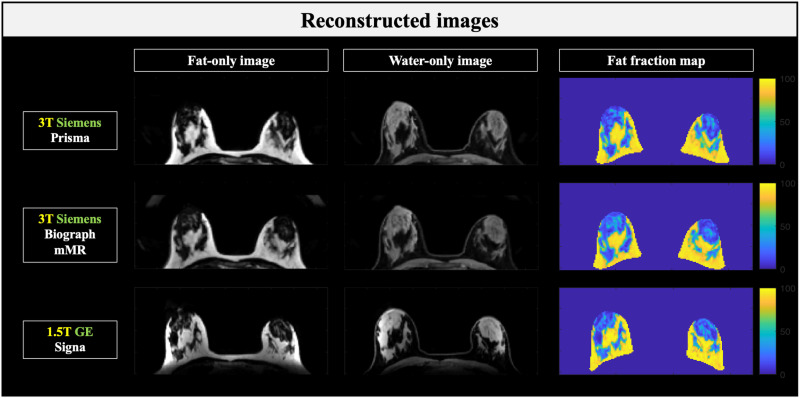
Ten healthy volunteers participated in this prospective study, undergoing fat-water MRI scans on three scanners: 3T Siemens Prisma, 3T Siemens Biograph mMR, and 1.5T GE Signa. Great effort was made to schedule all scans within a narrow three-hour window on the same day to minimize any potential intra- or inter-day variations, requiring substantial logistical coordination. BD was assessed using the MagDensity technique, which included combining magnitude and phase images, applying a fat-water separation technique, employing an automated whole-breast segmentation algorithm, and quantifying the volumetric water fraction. Agreement between measures across scanners was analyzed using mean differences, two-tailed t-tests, Pearson's correlation, and Bland-Altman analysis.
MagDensity measures obtained from the two 3T Siemens scanners demonstrated no statistically significant differences, with high correlation (Pearson's r > 0.99) and negligible mean differences (< 0.2%). Cross-platform comparison between the 3T Siemens and the 1.5T GE scanners showed larger mean differences (< 4.2%). However, after applying linear calibration, these variations were reduced to within ±0.2%, with strong inter-scanner correlation maintained (Pearson's r > 0.97).
MagDensity showed strong intra-vendor consistency and promising cross-platform reliability after leave-one-out calibration. While full standardization remains a long-term goal, these findings provide clear evidence that scanner-related variability can be effectively mitigated through calibration. This technique offers a step further toward more consistent MRI-based BD quantification and may help enable broader clinical implementation.
乳腺密度(BD)是乳腺癌的一个重要风险因素,但目前的评估方法缺乏自动化、量化和跨平台一致性。本研究旨在评估一种基于磁共振成像(MRI)的新型定量BD测量方法MagDensity在不同成像平台上的可靠性和跨平台一致性。
10名健康志愿者参与了这项前瞻性研究,在三台扫描仪上进行了脂肪-水MRI扫描:3T西门子Prisma、3T西门子Biograph mMR和1.5T通用电气Signa。为了尽量减少任何潜在的日内或日间变化,我们付出了巨大努力,在同一天狭窄的三小时窗口内安排所有扫描,这需要大量的后勤协调。使用MagDensity技术评估BD,该技术包括结合幅度和相位图像、应用脂肪-水分离技术、采用自动全乳腺分割算法以及量化体积水分数。使用平均差异、双尾t检验、Pearson相关性和Bland-Altman分析来分析不同扫描仪测量结果之间的一致性。
从两台3T西门子扫描仪获得的MagDensity测量结果显示无统计学显著差异,具有高度相关性(Pearson's r>0.99)且平均差异可忽略不计(<0.2%)。3T西门子扫描仪和1.5T通用电气扫描仪之间的跨平台比较显示平均差异较大(<4.2%)。然而,应用线性校准后,这些变化减少到±0.2%以内,同时保持了扫描仪间的强相关性(Pearson's r>0.97)。
在留一法校准后,MagDensity显示出强大的厂商内一致性和有前景的跨平台可靠性。虽然全面标准化仍是一个长期目标,但这些发现提供了明确证据,表明通过校准可以有效减轻扫描仪相关的变异性。这项技术朝着基于MRI的更一致的BD量化又迈进了一步,可能有助于实现更广泛的临床应用。