Brentnall Adam R, Cohn Wendy F, Knaus William A, Yaffe Martin J, Cuzick Jack, Harvey Jennifer A
Queen Mary University of London, Centre for Cancer Prevention, Wolfson Institute of Preventive Medicine, Barts and The London School of Medicine and Dentistry, London, UK.
University of Virginia, Public Health Sciences, University of Virginia Health Sciences Center, Charlottesville, VA.
J Breast Imaging. 2019 Jun;1(2):99-106. doi: 10.1093/jbi/wbz006. Epub 2019 May 11.
Accurate breast cancer risk assessment for women attending routine screening is needed to guide screening and preventive interventions. We evaluated the accuracy of risk predictions from both visual and volumetric mammographic density combined with the Tyrer-Cuzick breast cancer risk model.
A case-control study (474 patient participants and 2243 healthy control participants) of women aged 40-79 years was performed using self-reported classical risk factors. Breast density was measured by using automated volumetric software and Breast Imaging and Reporting Data System (BI-RADS) density categories. Odds ratios (95% CI) were estimated by using logistic regression, adjusted for age, demographic factors, and 10-year risk from the Tyrer-Cuzick model, for a change from the 25 to 75 percentile of the adjusted percent density distribution in control participants (IQ-OR).
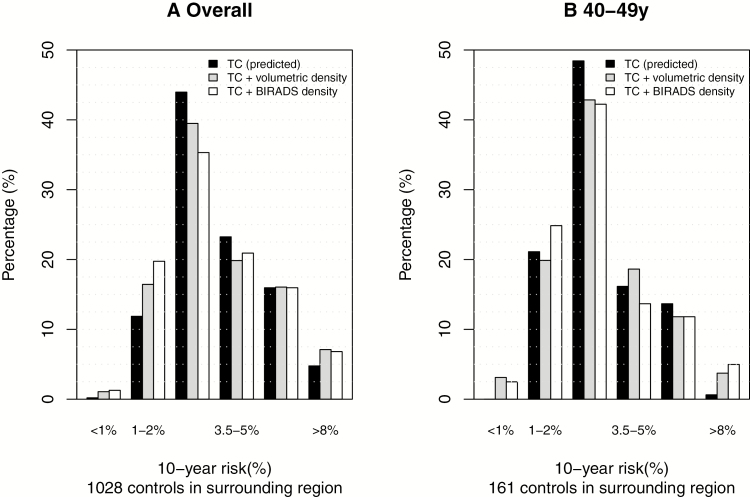
After adjustment for classical risk factors in the Tyrer-Cuzick model, age, and body mass index (BMI), BI-RADS density had an IQ-OR of 1.55 (95% CI = 1.33 to 1.80) compared with 1.40 (95% CI = 1.21 to 1.60) for volumetric percent density. Fibroglandular volume (IQ-OR = 1.28, 95% CI = 1.12 to 1.47) was a weaker predictor than was BI-RADS density (P = 0.014) or volumetric percent density (P = 0.065). In this setting, 4.8% of women were at high risk (8% + 10-year risk), using the Tyrer-Cuzick model without density, and 7.1% (BI-RADS) compared with 6.8% (volumetric) when combined with density.
The addition of volumetric and visual mammographic density measures to classical risk factors improves risk stratification. A combined risk could be used to guide precision medicine, through risk-adapted screening and prevention strategies.
需要对参加常规筛查的女性进行准确的乳腺癌风险评估,以指导筛查和预防干预措施。我们评估了视觉和体积乳腺X线密度与泰勒-库齐克乳腺癌风险模型相结合的风险预测准确性。
对40-79岁女性进行病例对照研究(474名患者参与者和2243名健康对照参与者),采用自我报告的经典风险因素。使用自动体积软件和乳腺影像报告和数据系统(BI-RADS)密度分类来测量乳腺密度。通过逻辑回归估计比值比(95%可信区间),针对对照参与者调整百分比密度分布从第25百分位数到第75百分位数的变化(四分位数间距比值比),对年龄、人口统计学因素以及泰勒-库齐克模型的10年风险进行了调整。
在对泰勒-库齐克模型中的经典风险因素、年龄和体重指数(BMI)进行调整后,BI-RADS密度的四分位数间距比值比为1.55(95%可信区间=1.33至1.80),而体积百分比密度为1.40(95%可信区间=1.21至1.60)。纤维腺体体积(四分位数间距比值比=1.28,95%可信区间=1.12至1.47)作为预测指标比BI-RADS密度(P=0.014)或体积百分比密度(P=0.065)弱。在这种情况下,不考虑密度因素时,使用泰勒-库齐克模型,4.8%的女性处于高风险(8%+10年风险),结合密度因素时,使用BI-RADS密度的为7.1%,使用体积密度的为6.8%。
在经典风险因素中加入体积和视觉乳腺X线密度测量可改善风险分层。通过风险适应性筛查和预防策略,综合风险可用于指导精准医学。