The George Institute for Global Health, UNSW Sydney, Sydney, NSW, Australia; National Centre for Non-Communicable Disease Control and Prevention, Chinese Centre for Disease Control and Prevention, Beijing, China.
National Centre for Non-Communicable Disease Control and Prevention, Chinese Centre for Disease Control and Prevention, Beijing, China.
Lancet Public Health. 2021 Dec;6(12):e907-e918. doi: 10.1016/S2468-2667(21)00231-0.
Falls in older people have become a major public health concern worldwide, but a comprehensive assessment of the burden of falls for older people in mainland China has not been done. We aimed to investigate the burden of falls among older people at the national and subnational level in mainland China, and explore the trends from 1990 to 2019, using data from the Global Burden of Diseases, Injuries, and Risk Factors Study (GBD) 2019.
Using data from GBD 2019, we estimated the burden of falls among people aged 60 years and older by sex and age group in terms of incidence, mortality, and disability-adjusted life-year (DALY) rates and assessed these indicators at the subnational level in 31 geographical units (hereafter called provinces). We investigated the overall trend in the burden of falls across these 31 provinces from 1990 to 2019, and assessed the change in the burden of falls by sex, age group (60-64, 65-69, 70-74, 75-79, and ≥80 years), and province between 1990 and 2019.
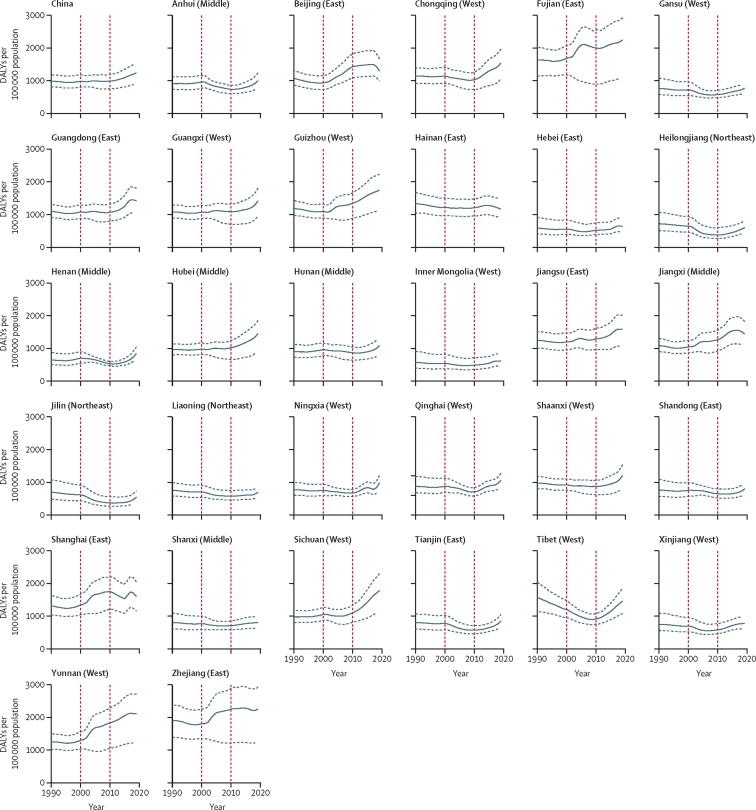
In 2019, in mainland China, the incidence rate of falls among people aged 60 years and older was 3799·4 (95% uncertainty interval [UI] 3062·4-4645·0) new falls per 100 000 population, and 39·2 deaths (21·8-48·8) per 100 000 population and 1238·9 DALYs (920·5-1553·2) per 100 000 population were due to falls. We found no significant difference in the burden of falls between males and females. The incidence, mortality, and DALY rates of falls for people aged 80 years and older were significantly higher than those in the other age groups, except for incidence rate, which was non-significantly different between the age 75-79 years group and the oldest age group. Large variations in the incidence and DALY rates of falls were observed across 31 provinces. Although between 1990 and 2019 we found no significant changes in overall mortality due to falls in all provinces and in DALY rates for 23 provinces (DALY rates significantly decreased in two provinces and increased in six provinces), we found large increases in the incidence rate of falls in both males (percentage change between 1990 and 2019: 82·9% [67·4-100]) and females (77·0% [63·3-91·8]). The percentage change in incidence rate of falls between 1990 and 2019 varied from 50·0% (42·2-59·5) for people aged 60-64 years to 123·8% (105·4-141·9) for people aged 80 years and older. All provinces had significant increases in the incidence rate of falls between 1990 and 2019, with Sichuan having the greatest increase (148·5% [125·5-171·4]) and Jilin the smallest increase (14·7% [3·6-26·1]).
Between 1990 and 2019, the incidence rate of falls increased substantially in older adults across mainland China, whereas the rates of mortality and DALY of falls among older people remained relatively stable, suggesting improvements in outcomes of falls. Nevertheless, falls remain an ongoing health burden for older people in mainland China, and there is an urgent need to introduce system-wide, integrated, and cost-effective measures to protect and support older people to minimise their risks and combat an increasing absolute burden as the population continues ageing.
Bill & Melinda Gates Foundation.
老年人跌倒已成为全球公共卫生的一个主要关注点,但对中国内地老年人跌倒的负担情况还没有进行全面评估。本研究旨在调查中国内地老年人跌倒的负担情况,并利用 2019 年全球疾病、伤害和危险因素研究(GBD)的数据,探讨 1990 年至 2019 年的变化趋势。
利用 GBD 2019 数据,我们根据性别和年龄组,评估了 60 岁及以上人群跌倒的发生率、死亡率和伤残调整生命年(DALY)率等指标,并在 31 个地理区域(以下简称“省份”)对这些指标进行了评估。我们调查了 1990 年至 2019 年这 31 个省份的跌倒负担总体趋势,并评估了 1990 年至 2019 年期间性别、年龄组(60-64 岁、65-69 岁、70-74 岁、75-79 岁和≥80 岁)和省份之间的跌倒负担变化。
2019 年,中国内地 60 岁及以上人群的跌倒发生率为 3799.4(95%不确定区间[UI] 3062.4-4645.0)例/10 万人,39.2 例死亡(21.8-48.8)/10 万人和 1238.9 DALY(920.5-1553.2)/10 万人归因于跌倒。我们发现男性和女性之间的跌倒负担没有显著差异。80 岁及以上人群的跌倒发生率、死亡率和 DALY 率均显著高于其他年龄组,除了 75-79 岁年龄组与最年长年龄组之间的发生率无显著差异。31 个省份的跌倒发生率和 DALY 率存在很大差异。虽然 1990 年至 2019 年期间,我们没有发现所有省份的跌倒总死亡率和 23 个省份的 DALY 率有显著变化(两个省份的 DALY 率显著下降,六个省份的 DALY 率上升),但我们发现男性(1990 年至 2019 年的百分比变化为 82.9%[67.4-100])和女性(77.0%[63.3-91.8])的跌倒发生率均显著增加。1990 年至 2019 年期间,跌倒发生率的百分比变化范围为 60-64 岁人群的 50.0%(42.2-59.5)至 80 岁及以上人群的 123.8%(105.4-141.9)。所有省份的跌倒发生率均有显著增加,其中四川增加幅度最大(148.5%[125.5-171.4]),吉林增加幅度最小(14.7%[3.6-26.1])。
1990 年至 2019 年期间,中国内地老年人跌倒的发生率显著增加,而老年人跌倒的死亡率和 DALY 率相对稳定,这表明跌倒的结局有所改善。然而,跌倒仍然是中国内地老年人的一个持续健康负担,需要引入系统的、综合的、具有成本效益的措施来保护和支持老年人,以尽量减少他们的风险,并应对人口老龄化带来的绝对负担的增加。
比尔及梅琳达·盖茨基金会。