Iodchik Andrey, Lusvardi Gigliola, Zambon Alfonso, Lee Poh Soo, Wiesmann Hans-Peter, Bernhardt Anne, Hintze Vera
Institute of Materials Science, Max Bergmann Center of Biomaterials, TU Dresden University of Technology, Budapester Str. 27, D-01069 Dresden, Germany.
Department of Chemical and Geological Sciences, University of Modena and Reggio Emilia, 41125 Modena, Italy.
Gels. 2025 Jun 1;11(6):425. doi: 10.3390/gels11060425.
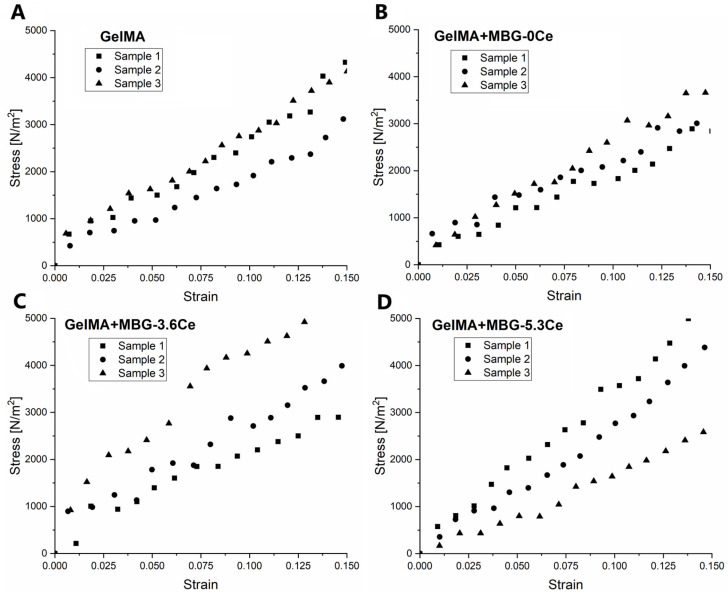
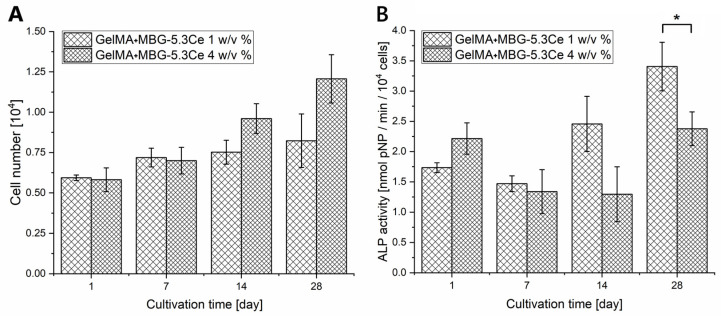
Delayed or non-healing of bone defects in an aging, multi-morbid population is still a medical challenge. Current replacement materials, like autografts, are limited. Thus, artificial substitutes from biodegradable polymers and bioactive glasses (BGs) are promising alternatives. Here, novel cerium-doped mesoporous BG microparticles (Ce-MBGs) with different cerium content were included in photocrosslinkable, methacrylated gelatin (GelMA) for promoting cellular functions of human mesenchymal stem cells (hBMSCs). The composites were studied for intrinsic morphology and Ce-MBGs distribution by scanning electron microscopy (SEM) and energy-dispersive X-ray spectroscopy (EDX). They were gravimetrically analyzed for swelling and stability, compressive modulus via Microsquisher and bioactivity by Fluitest calcium assay and inductively coupled plasma-optical emission spectrometry (ICP-OES), also determining silicon and cerium ion release. Finally, seeding, proliferation, and differentiation of hBMSCs was investigated. Ce-MBGs were evenly distributed within composites. The latter displayed a concentration-dependent but cerium-independent decrease in swelling, while mechanical properties were comparable. A MBG type-dependent bioactivity was shown, while an enhanced osteogenic differentiation of hBMSCs was achieved for Ce-MBG-composites and related to different ion release profiles. These findings show their strong potential in promoting bone regeneration. Still, future work is required, e.g., analyzing the expression of osteogenic genes, providing further evidence for the composites' osteogenic effect.
在老龄化、患有多种疾病的人群中,骨缺损的延迟愈合或不愈合仍然是一项医学挑战。目前的替代材料,如自体移植物,存在局限性。因此,由可生物降解聚合物和生物活性玻璃(BGs)制成的人工替代品是很有前景的选择。在此,将具有不同铈含量的新型铈掺杂介孔BG微粒(Ce-MBGs)纳入可光交联的甲基丙烯酸化明胶(GelMA)中,以促进人间充质干细胞(hBMSCs)的细胞功能。通过扫描电子显微镜(SEM)和能量色散X射线光谱(EDX)研究了复合材料的内在形态和Ce-MBGs分布。通过重量分析法分析了它们的溶胀和稳定性,通过Microsquisher测定了压缩模量,并通过Fluitest钙测定法和电感耦合等离子体发射光谱法(ICP-OES)分析了生物活性,同时还测定了硅和铈离子的释放。最后,研究了hBMSCs的接种、增殖和分化情况。Ce-MBGs均匀分布在复合材料中。后者的溶胀呈现浓度依赖性但与铈无关的降低,而机械性能相当。显示出了与MBG类型相关的生物活性,而Ce-MBG复合材料实现了hBMSCs增强的成骨分化,且这与不同的离子释放曲线有关。这些发现表明它们在促进骨再生方面具有强大的潜力。不过,仍需要开展进一步的工作,例如分析成骨基因的表达,为复合材料的成骨作用提供更多证据。