Fazel Anvari-Yazdi Abbas, Badea Ildiko, Chen Xiongbiao
Division of Biomedical Engineering, University of Saskatchewan, 57 Campus Dr, Saskatoon, SK S7K 5A9, Canada.
College of Pharmacy and Nutrition, University of Saskatchewan, Saskatoon, SK S7N 5E5, Canada.
Gels. 2025 Jun 9;11(6):441. doi: 10.3390/gels11060441.
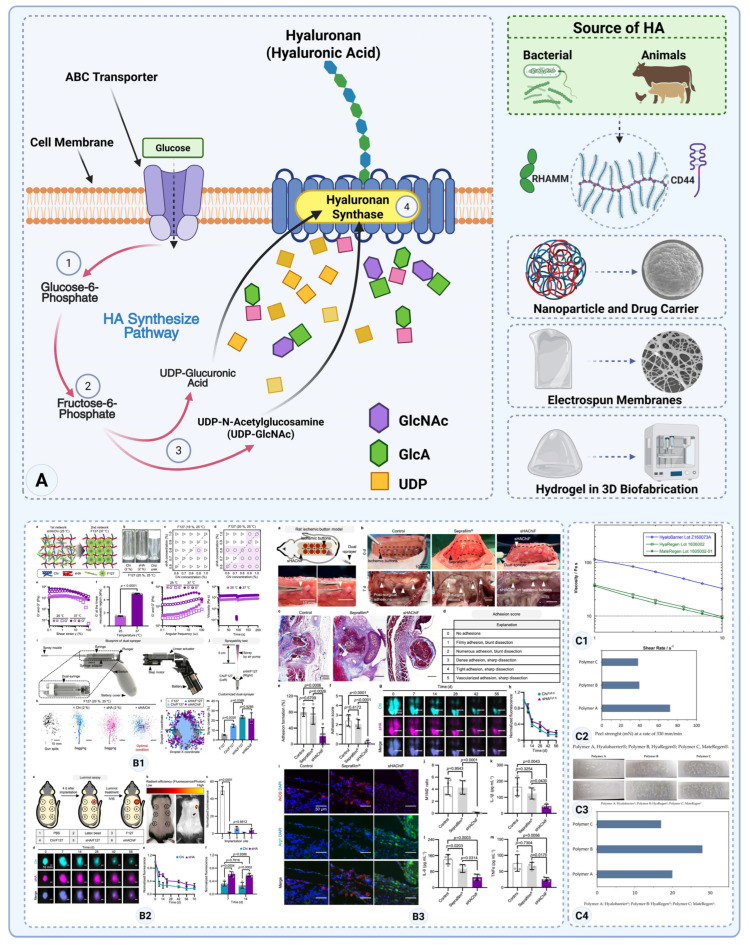
Postoperative adhesions (POAs) are a common and often serious complication following abdominal and gynecologic surgeries, leading to infertility, chronic pain, and bowel obstruction. To address these outcomes, the development of anti-adhesion barriers using biocompatible materials has emerged as a key area of biomedical research. This article presents a comprehensive overview of clinically relevant natural and synthetic biomaterials explored for POA prevention, emphasizing their degradation behavior, barrier integrity, and translational progress. Natural biopolymers-such as collagen, gelatin, fibrin, silk fibroin, and decellularized extracellular matrices-are discussed alongside polysaccharides, including alginate, chitosan, and carboxymethyl cellulose, focusing on their structural features and biological functionality. Synthetic polymers, including polycaprolactone (PCL), polyethylene glycol (PEG), and poly(lactic-co-glycolic acid) (PLGA), are also examined for their tunable degradation profiles (spanning days to months), mechanical robustness, and capacity for drug incorporation. Recent innovations, such as bioprinted and electrospun dual-layer membranes, are highlighted for their enhanced anti-fibrotic performance in preclinical studies. By consolidating current material strategies and fabrication techniques, this work aims to support informed material selection while also identifying key knowledge gaps-particularly the limited comparative data on degradation kinetics, inconsistent definitions of ideal mechanical properties, and the need for more research into cell-responsive barrier systems.
术后粘连(POA)是腹部和妇科手术后常见且往往较为严重的并发症,会导致不孕、慢性疼痛和肠梗阻。为解决这些问题,利用生物相容性材料开发抗粘连屏障已成为生物医学研究的一个关键领域。本文全面概述了为预防POA而探索的临床相关天然和合成生物材料,重点介绍了它们的降解行为、屏障完整性及转化进展。文中讨论了天然生物聚合物,如胶原蛋白、明胶、纤维蛋白、丝素蛋白和脱细胞细胞外基质,以及多糖,包括藻酸盐、壳聚糖和羧甲基纤维素,着重介绍了它们的结构特征和生物学功能。还研究了合成聚合物,包括聚己内酯(PCL)、聚乙二醇(PEG)和聚乳酸-乙醇酸共聚物(PLGA),考察了它们可调节的降解特性(从数天到数月)、机械强度以及药物包载能力。近期的创新成果,如生物打印和电纺双层膜,因其在临床前研究中增强的抗纤维化性能而受到关注。通过整合当前的材料策略和制造技术,这项工作旨在支持明智的材料选择,同时也识别关键的知识空白,特别是关于降解动力学的比较数据有限、理想机械性能的定义不一致,以及对细胞响应性屏障系统需要更多研究。