Utvić Nikola, Marković Lidija, Arsenijević Radenko, Aksović Nikola, Bjelica Bojan, Stojljković Stanimir, Bubanj Saša, Raveica Gabriela, Dobreci Daniel-Lucian, Voinea Nicolae-Lucian, Ciocan Vasile-Cătălin, Anghel Mihaela, Antohe Bogdan-Alexandru, Dobrescu Tatiana
Faculty of Sport and Physical Education, University of Priština-Kosovska Mitrovica, 38218 Leposavić, Serbia.
Faculty of Sport and Physical Education, University of Novi Sad, 21000 Novi Sad, Serbia.
Children (Basel). 2025 Jun 11;12(6):758. doi: 10.3390/children12060758.
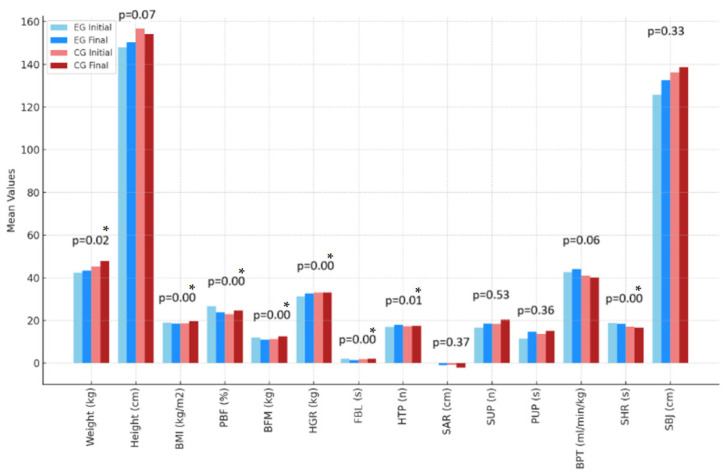
(1) Background: The aim of this study is to investigate whether the application of adaptive sports programs, initially designed for children with disabilities, can have a positive effect on physical fitness and body composition in healthy primary school children; (2) Methods: The sample comprised 80 participants, equally divided by gender (50% male, 50% female), with a mean age of 11.5 (SD = 0.03). They were divided into two groups, an experimental and a control group, with an even gender distribution. The research lasted 12 weeks, with additional classes allocated for the initial and the final measurements. The Eurofit test battery assessed physical fitness; (3) Results: ANCOVA revealed significant group differences in body composition variables within the total sample and gender distribution ( < 0.001). Significant differences were observed in handgrip strength (HGR), flamingo balance test (FBL), shuttle run 10 × 5 m (SHR) ( < 0.001), and also hand tapping (HTP) ( = 0.01). Participants in the experimental group outperformed the control group, highlighting the effectiveness of the intervention program. Specifically, boys in the experimental group showed significant improvements in HGR and SHR ( < 0.001), while girls improved significantly in HGR, FBL, and SHR ( < 0.001); (4) Conclusions: The experimental program, which incorporates sports elements for disabled individuals, led to significant improvements in the physical fitness parameters of children.
(1) 背景:本研究旨在调查最初为残疾儿童设计的适应性运动项目对健康小学生的身体素质和身体成分是否能产生积极影响;(2) 方法:样本包括80名参与者,按性别平均分配(男性50%,女性50%),平均年龄11.5岁(标准差=0.03)。他们被分为两组,实验组和对照组,性别分布均匀。研究持续12周,在初始和最终测量时安排了额外课程。使用欧洲体适能测试组合评估身体素质;(3) 结果:协方差分析显示,在总样本和性别分布中,身体成分变量存在显著的组间差异(<0.001)。在握力(HGR)、火烈鸟平衡测试(FBL)、10×5米往返跑(SHR)(<0.001)以及手部敲击(HTP)(=0.01)方面观察到显著差异。实验组参与者的表现优于对照组,突出了干预项目的有效性。具体而言,实验组中的男孩在HGR和SHR方面有显著改善(<0.001),而女孩在HGR、FBL和SHR方面有显著改善(<0.001);(4) 结论:纳入针对残疾人运动元素的实验项目使儿童的身体素质参数有显著改善。