Moldovan Diana, Kacso Ina, Avram Lucreția, Crisan Dana, Condor Ariana, Bondor Cosmina, Rusu Crina, Potra Alina, Tirinescu Dacian, Ticala Maria, Maslyennikov Yuriy, Bărar Andrada, Urs Alexandra, Donca Valer
Department of Nephrology, Faculty of Medicine, "Iuliu Hatieganu" University of Medicine and Pharmacy Cluj-Napoca, 400012 Cluj-Napoca, Romania.
Emergency County Hospital, 400006 Cluj-Napoca, Romania.
J Clin Med. 2025 Jun 10;14(12):4120. doi: 10.3390/jcm14124120.
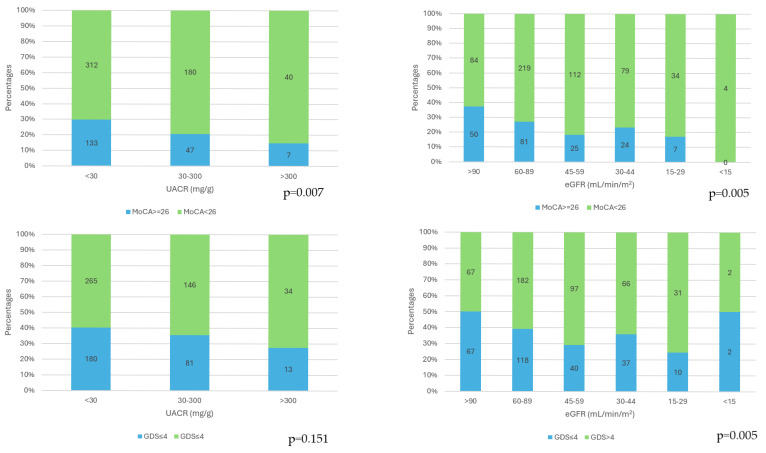
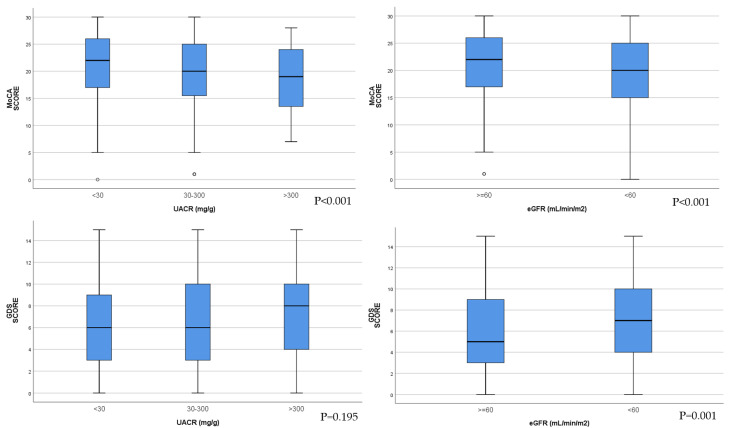
As societies rapidly age, the prevalence of mental health disorders and chronic kidney disease (CKD) is simultaneously rising, and data on the link between these conditions remain inconclusive. This study aimed to investigate the associations among cognitive impairment, depression, and kidney involvement in elderly patients. A cross-sectional analysis was conducted among hospitalized patients aged ≥65 years. Standardized tools such as the geriatric depression scale (GDS) and Montreal Cognitive Assessment (MoCA) were used to assess depression and cognitive impairment, and kidney function was evaluated using eGFR and albuminuria. Bivariate and multivariate logistic regressions were performed to identify associations. The study population consisted of 719 participants with a median age of 80 years. Kidney and mental health issues were highly prevalent: CKD was identified in 59.4%, cognitive impairment in 74%, and depression in 61.9% of patients. Patients with CKD were older and exhibited lower MoCA scores ( = 0.001), higher GDS scores ( = 0.007), reduced albumin ( < 0.001), lower hemoglobin levels ( < 0.001), and elevated C-reactive protein ( < 0.001). Increased albuminuria was associated with poorer cognition ( < 0.001) but showed no correlation with GDS scores. Additionally, worse cognitive scores ( = 0.001) and increased depression symptoms ( < 0.001) were correlated with declining estimated glomerular filtration rate (eGFR). Cognitive impairment and depressive symptoms are highly prevalent among elderly hospitalized patients. Cognitive decline correlates with increased albuminuria and reduced eGFR, while depression worsens with declining kidney function. These findings highlight the complex interplay between renal health and neuropsychiatric conditions in aging populations.
随着社会迅速老龄化,心理健康障碍和慢性肾脏病(CKD)的患病率同时上升,而关于这些病症之间联系的数据仍无定论。本研究旨在调查老年患者认知障碍、抑郁和肾脏受累之间的关联。对年龄≥65岁的住院患者进行了横断面分析。使用老年抑郁量表(GDS)和蒙特利尔认知评估量表(MoCA)等标准化工具评估抑郁和认知障碍,并使用估算肾小球滤过率(eGFR)和蛋白尿评估肾功能。进行了双变量和多变量逻辑回归以确定关联。研究人群包括719名参与者,中位年龄为80岁。肾脏和心理健康问题非常普遍:59.4%的患者被诊断为CKD,74%的患者有认知障碍,61.9%的患者有抑郁。CKD患者年龄较大,MoCA评分较低( = 0.001),GDS评分较高( = 0.007),白蛋白降低( < 0.001),血红蛋白水平较低( < 0.001),C反应蛋白升高( < 0.001)。蛋白尿增加与认知较差相关( < 0.001),但与GDS评分无相关性。此外,较差的认知评分( = 0.001)和抑郁症状增加( < 0.001)与估算肾小球滤过率(eGFR)下降相关。认知障碍和抑郁症状在老年住院患者中非常普遍。认知能力下降与蛋白尿增加和eGFR降低相关,而抑郁随着肾功能下降而加重。这些发现突出了老年人群中肾脏健康与神经精神疾病之间的复杂相互作用。