Alqahtani Amera N
Department of Biological Sciences, College of Science, University of Jeddah, Jeddah, Saudi Arabia.
J Adv Vet Anim Res. 2025 Mar 23;12(1):19-32. doi: 10.5455/javar.2025.l868. eCollection 2025 Mar.
This study investigates the effects of dietary nano-zinc (ZnNPs), probiotics (P), and their combined use such as growth promoters, antibacterial agents, and organic antioxidants on the growth performance, carcass characteristics, blood biochemistry, meat quality, and cecal microbiota of broiler chicks.
The trial was conducted from 7 to 35 days of age using a randomized complete trial design with 240 unsexed Ross 308 chicks (initial body weight 104.37 ± 0.16 gm). The chicks were allocated into four treatment groups, each containing 60 chicks, with six replicates (4×6×10). The treatments were as follows: a control group fed a standard diet and three experimental groups receiving diets supplemented with ZnNPs (3.0 cm³/kg), probiotics (P, 2.0 cm³/kg), or a combination of ZnNPs + P (3.0 + 2.0 cm³/kg).
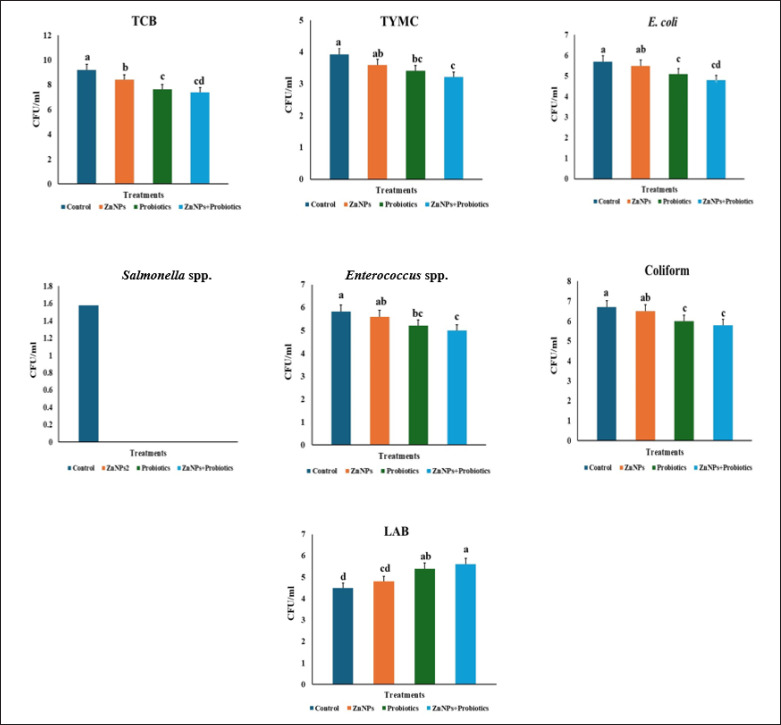
The study revealed that ZnNPs and probiotics exhibited significant antibacterial activity against harmful bacteria and mold, effectively suppressing microbial growth at concentrations ranging from 50 to 95 µg/ml. The inclusion of ZnNPs and probiotics in the diets resulted in improved growth performance, with a higher body weight compared to the control group ( < 0.05). All carcass characteristics were positively influenced by the treatments, showing significant improvements compared to the control group ( < 0.05). Furthermore, the levels of malondialdehyde (MDA) were significantly reduced in the ZnNPs and probiotics-treated groups, suggesting enhanced antioxidant activity ( < 0.05). Blood biochemical indicators, including immunoglobulin concentrations, were higher in the treated groups, pointing to an improved immune response. The meat quality of the broilers also significantly improved in terms of texture, juiciness, and tenderness. Additionally, the number of harmful cecal microorganisms decreased in the supplemented groups, leading to a healthier gut microbiota and overall improved animal health.
The study shows that dietary supplementation with ZnNPs and probiotics has a positive impact on broiler growth, carcass traits, meat quality, blood parameters, and microbial status. These results suggest that incorporating ZnNPs and probiotics into broiler diets can be an effective strategy for enhancing productivity, meat quality, and overall health status, ultimately improving the sustainability of poultry production systems.
本研究调查日粮中纳米锌(ZnNPs)、益生菌(P)及其组合作为生长促进剂、抗菌剂和有机抗氧化剂对肉鸡生长性能、胴体特性、血液生化、肉质和盲肠微生物群的影响。
试验于7至35日龄进行,采用随机完全试验设计,选用240只未区分性别的罗斯308雏鸡(初始体重104.37±0.16克)。将雏鸡分为四个处理组,每组60只,重复六次(4×6×10)。处理如下:对照组饲喂标准日粮,三个试验组分别饲喂添加ZnNPs(3.0立方厘米/千克)、益生菌(P,2.0立方厘米/千克)或ZnNPs + P组合(3.0 + 2.0立方厘米/千克)的日粮。
研究表明,ZnNPs和益生菌对有害细菌和霉菌具有显著的抗菌活性,在50至95微克/毫升的浓度范围内能有效抑制微生物生长。日粮中添加ZnNPs和益生菌可提高生长性能,与对照组相比体重更高(<0.05)。所有胴体特性均受到处理的积极影响,与对照组相比有显著改善(<0.05)。此外,ZnNPs和益生菌处理组的丙二醛(MDA)水平显著降低,表明抗氧化活性增强(<0.05)。处理组的血液生化指标,包括免疫球蛋白浓度较高,表明免疫反应改善。肉鸡的肉质在质地、多汁性和嫩度方面也有显著改善。此外,添加组中有害盲肠微生物数量减少,导致肠道微生物群更健康,动物整体健康状况改善。
研究表明,日粮中添加ZnNPs和益生菌对肉鸡生长、胴体性状、肉质、血液参数和微生物状态有积极影响。这些结果表明,将ZnNPs和益生菌纳入肉鸡日粮可以是提高生产力、肉质和整体健康状况的有效策略,最终改善家禽生产系统的可持续性。