Chen Wen Hsin, Bloom Rosaleen D, Brandford Arica, Han Gang, Horel Scott, Sanchez Marivel, Mcknight Jason, Bolin Jane L
From Department of Health Policy and Management, School of Public Health, Texas A&M University, College Station, Texas.
College of Nursing, Texas A&M University, College Station, Texas.
J Adv Pract Oncol. 2025 May 4:1-13. doi: 10.6004/jadpro.2025.16.7.14.
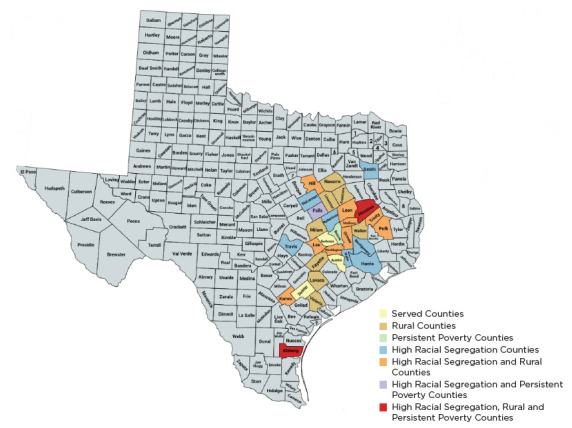
This study aimed to investigate the correlation between geographical factors, including rurality, persistent poverty counties, racial residential segregation, and adherence to colorectal cancer (CRC) screening among low-income uninsured and underinsured individuals in Texas.
Utilizing retrospective survey data collected by the A&M Texas Cancer Screening program from 2011 to 2022, linear mixed-effects models were employed. The models examined CRC screening adherence within the recommended time frame as the primary outcome, with geographical county-level characteristics (rurality, racial residential segregation, and persistent poverty) as the main predictors, controlling for other sociodemographic variables.
The linear mixed-effects analysis revealed that individuals residing in counties characterized by high racial residential segregation (OR = 0.54, 95% CI = 0.36-0.79) or persistent poverty (OR = 0.65, 95% CI = 0.45-0.92) were less likely to self-report having undergone any type of CRC screening within the recommended time frame compared to those in counties with lower racial residential segregation and non-persistent poverty. Conversely, residents of rural counties were more likely to report being up to date with CRC screening compared to their urban counterparts (OR = 1.8, 95% CI = 1.27-2.55).
The findings underscore the need for more targeted CRC screening promotion strategies tailored to low-income, uninsured populations residing in disadvantaged areas such as rural and persistent poverty counties, as well as those characterized by high racial residential segregation.
本研究旨在调查德克萨斯州低收入未参保和参保不足个体的农村地区、持续贫困县、种族居住隔离等地理因素与结直肠癌(CRC)筛查依从性之间的相关性。
利用德克萨斯农工大学癌症筛查项目在2011年至2022年期间收集的回顾性调查数据,采用线性混合效应模型。这些模型将在推荐时间范围内的CRC筛查依从性作为主要结果,将县级地理特征(农村地区、种族居住隔离和持续贫困)作为主要预测因素,并控制其他社会人口学变量。
线性混合效应分析显示,与种族居住隔离程度较低和非持续贫困县的个体相比,居住在种族居住隔离程度高(OR = 0.54,95% CI = 0.36 - 0.79)或持续贫困(OR = 0.65,95% CI = 0.45 - 0.92)县的个体在推荐时间范围内自我报告进行任何类型CRC筛查的可能性较小。相反,与城市居民相比,农村县的居民更有可能报告及时进行了CRC筛查(OR = 1.8,95% CI = 1.27 - 2.55)。
研究结果强调需要针对居住在农村和持续贫困县等弱势地区以及种族居住隔离程度高的低收入未参保人群制定更有针对性的CRC筛查推广策略。