Maiden Nor Afiqah, Atan Safiah, Mui-Yun Wong
Production Development Division, Malaysian Rubber Board, Selangor, Malaysia.
Institute of Plantation Studies, Universiti Putra Malaysia, Serdang, Selangor, Malaysia.
Front Microbiol. 2025 Jun 17;16:1553350. doi: 10.3389/fmicb.2025.1553350. eCollection 2025.
The rubber tree () is susceptible to various fungal pathogens with being one of the most harmful. This fungus causes white root disease in rubber trees which can potentially lead to massive tree losses if left untreated. The use of elicitor proteins in enhancing host plant resistance represents a sustainable approach for disease control by reducing the use of chemical fungicides. Although cerato-platanin proteins (CPs) are recognized elicitors in many pathosystems, CP from has not been functionally characterized, leaving its role in rubber-pathogen interactions unknown.
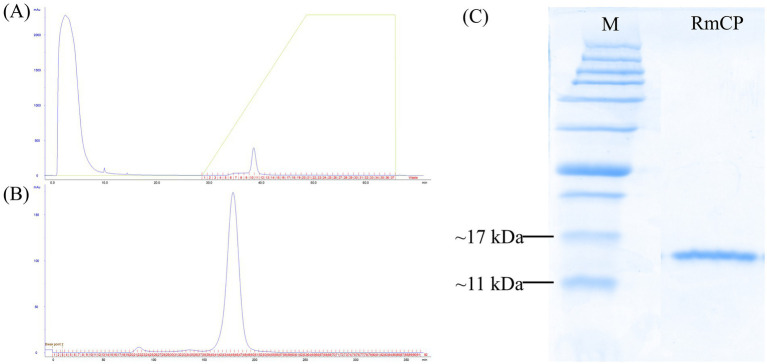
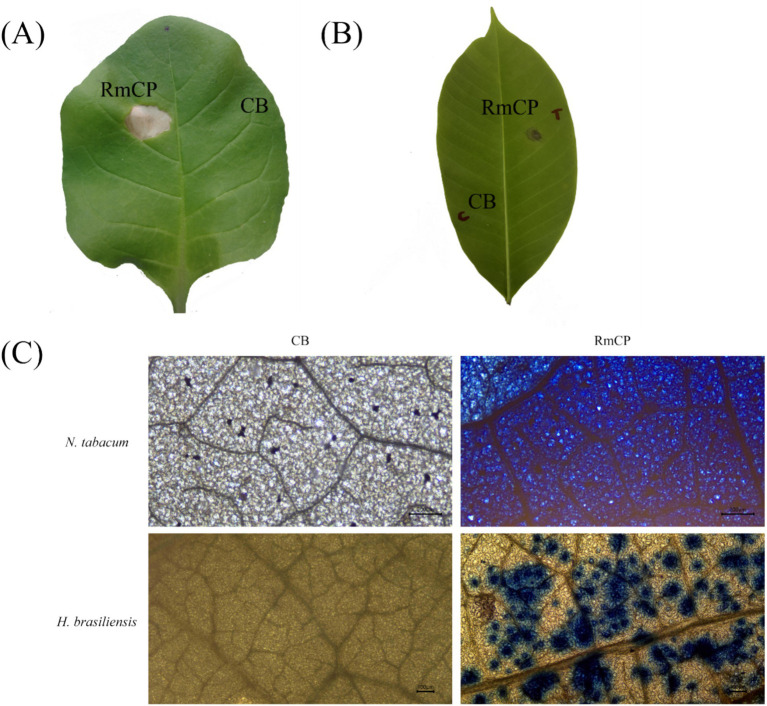
The coding sequence of the CP homolog RmCP was heterologously expressed in and purified to homogeneity by two-steps purification method, namely, affinity and size-exclusion chromatography. Bioactivity was assessed by infiltrating micromolar concentrations of RmCP into leaves of the host () and a model non-host ().
Cell death (Trypan blue), reactive-oxygen species (DAB/NBT), callose deposition (aniline blue) and transcription of four defense-related genes () were monitored over 72 h. Purified RmCP migrated as a single band between 11 and 17 kDa band. Infiltration induced localized necrosis in within 48 h and in detached rubber leaves within 72 h. Both hosts accumulated H₂O₂ and O₂, and deposited callose. Additionally, significant up-regulation of and (early signaling), followed by strong induction of downstream effector genes, and was observed in . These findings identify RmCP as the first basidiomycete CP shown to activate multilayer innate immunity in a latex-producing perennial.
The study extends the functional spectrum of the CP family beyond ascomycete models and provides a biochemically defined platform for developing protein-based priming agents to combat white-root disease in rubber plantations.
橡胶树( )易受多种真菌病原体侵害,其中 是最具危害性的病原体之一。这种真菌会引发橡胶树的白根病,如果不加以治疗,可能会导致大量树木死亡。通过减少化学杀菌剂的使用,利用激发子蛋白增强宿主植物抗性是一种可持续的病害控制方法。尽管在许多病理系统中,角质层-铂蛋白(CPs)被认为是激发子,但来自 的CP尚未进行功能表征,其在橡胶-病原体相互作用中的作用尚不清楚。
CP同源物RmCP的编码序列在 中进行异源表达,并通过两步纯化方法(即亲和色谱和尺寸排阻色谱)纯化至同质。通过将微摩尔浓度的RmCP渗入宿主( )和模式非宿主( )的叶片中来评估生物活性。
在72小时内监测细胞死亡(台盼蓝)、活性氧(DAB/NBT)、胼胝质沉积(苯胺蓝)以及四个防御相关基因( )的转录。纯化后的RmCP在11至17 kDa条带之间迁移为单一条带。渗入在48小时内诱导 出现局部坏死,在72小时内诱导离体橡胶叶出现局部坏死。两种宿主都积累了H₂O₂和O₂,并沉积了胼胝质。此外,在 中观察到 和 (早期信号)显著上调,随后下游效应基因 和 被强烈诱导。这些发现确定RmCP是第一个被证明能激活多年生产胶植物多层先天免疫的担子菌CP。
该研究将CP家族的功能谱扩展到子囊菌模型之外,并为开发基于蛋白质的引发剂以对抗橡胶种植园中的白根病提供了一个生化定义的平台。