de Vries Laila, Kylén Maya, Svensson Tony, Sturge Jodi, Lipson-Smith Ruby, Schmidt Steven M, Pessah-Rasmussen Hélène, Elf Marie
School of Health and Welfare, Dalarna University, Falun, Sweden.
Faculty of Health Science, Kristianstad University, Kristianstad, Sweden.
Health Expect. 2025 Aug;28(4):e70339. doi: 10.1111/hex.70339.
The transition to undertaking rehabilitation in the home or local neighbourhood calls for an extensive understanding of which aspects of the built environment are important for people with stroke.
This qualitative study aims to explore how home and local neighbourhood environments support or hinder rehabilitation for people who have had a stroke from the perspectives of various stakeholders.
Through a purposive selection method, data were collected through semi-structured interviews with 16 stakeholders: people with stroke (n = 3), significant others (n = 3), healthcare professionals (n = 4), care managers (n = 3) and architects (n = 3). Content analysis was used to identify patterns and create themes.
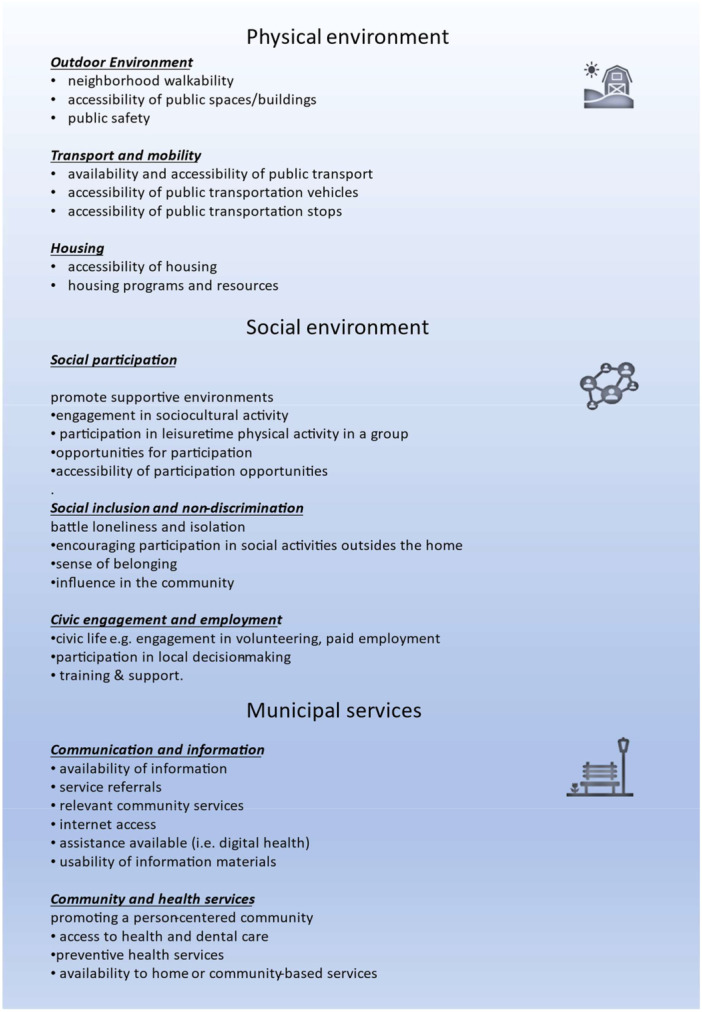
Sixteen stakeholders, including 12 women and 4 men aged 30-74, participated in this study. Our findings identify areas linked to the WHO age-friendly environment framework, which addresses environmental limitations relevant to stroke rehabilitation. The categories used and factors identified: (1) Outdoor environments: accessibility, safety and supportiveness. (2) Transport and mobility: accessible and reach central services. (3) Housing: adaptations, layout and accessibility. (4) Social participation: spaces that are varied and flexible. (5) Social inclusion and non-discrimination: shared decision-making. (6) Civic engagement and employment: supporting environments. (7) Communication and information: digital accessibility. (8) Community and health services: patient-centred approach and access to varied rehabilitation.
This study brings together multiple perspectives from key stakeholders with experience within stroke care. By integrating insights, these findings highlight how built environmental factors in the home and local neighbourhood can support the transition to home-based rehabilitation, which can improve recovery and return to everyday life. In turn, this study contributes to the innovative development of home and neighbourhood environments to influence and support stroke rehabilitation. Linking the findings to the WHO framework increases our understanding of a supportive environment for people with stroke, but also for people with other long-term conditions.
This qualitative study is part of a comprehensive research project '(Built Environments to support rehabilitation for people with stroke, B-SURE)', which aims to investigate how factors in the built environment influence stroke rehabilitation and to develop built environment solutions. B-SURE has a participatory methodology that essentially includes and involves the stakeholders in the multiple stages of the study and ensures an iterative and collaborative process.
向在家中或当地社区进行康复的转变需要深入了解建筑环境的哪些方面对中风患者很重要。
这项定性研究旨在从不同利益相关者的角度探讨家庭和当地社区环境如何支持或阻碍中风患者的康复。
通过目的抽样法,对16名利益相关者进行半结构化访谈收集数据,包括中风患者(n = 3)、重要他人(n = 3)、医疗保健专业人员(n = 4)、护理经理(n = 3)和建筑师(n = 3)。采用内容分析法识别模式并创建主题。
16名利益相关者参与了本研究,包括12名女性和4名年龄在30 - 74岁之间的男性。我们的研究结果确定了与世界卫生组织友好型年龄环境框架相关的领域,该框架涉及与中风康复相关的环境限制。所使用的类别和确定的因素包括:(1)户外环境:可达性、安全性和支持性。(2)交通与出行:可达并能到达中心服务设施。(3)住房:适应性、布局和可达性。(4)社会参与:多样且灵活的空间。(5)社会包容与非歧视:共同决策。(6)公民参与和就业:支持性环境。(7)沟通与信息:数字可达性。(8)社区和卫生服务:以患者为中心的方法和获得多样化康复服务的机会。
本研究汇集了中风护理领域关键利益相关者的多种观点。通过整合这些见解,这些研究结果突出了家庭和当地社区的建筑环境因素如何支持向居家康复的转变,这有助于改善康复效果并回归日常生活。反过来,本研究有助于家庭和社区环境的创新发展,以影响和支持中风康复。将研究结果与世界卫生组织框架相联系,不仅增加了我们对中风患者支持性环境的理解,也加深了对其他长期疾病患者支持性环境的理解。
这项定性研究是综合研究项目“支持中风患者康复的建筑环境(B - SURE)”的一部分,该项目旨在调查建筑环境中的因素如何影响中风康复,并开发建筑环境解决方案。B - SURE采用参与式方法,本质上在研究的多个阶段纳入并让利益相关者参与其中,并确保一个迭代和协作的过程。
