Roy Anne-Sophie, Aberkane Fatima Zohra, Cisse Sekhou, Guibert Aurélie, Richard Damien, Lerouzic Marie, Suor-Cherer Sorphon, Boisard Séverine, Guilet David, Benarbia Mohammed El Amine Benarbia, Mallem Mohamed Yassine
Nutrition, PathoPhysiology and Pharmacology (NP3) Unit, 101 Rte de Gachet, Oniris, 44300, Nantes, France.
Nor-Feed SAS, 3 Rue Amedeo Avogadro, Beaucouzé, 49070, France.
BMC Vet Res. 2025 Jul 11;21(1):459. doi: 10.1186/s12917-025-04904-8.
Animal welfare encompasses both its physical and mental states. This latter could be altered by several psychological-related disorders including stress and anxiety. To address these issues, Melissa officinalis, a Lamiaceae plant, ensuring the anxiolytic-type effects, is widely used. In this study, the main aim was to explore the effect of a commercial hydro-alcoholic Melissa officinalis extract (MOE) and its major compound rosmarinic acid (RA) on dogs' behavior and metabolome. To do so, twenty healthy beagle dogs were randomly assigned to 4 dietary supplements (5 dogs/group): the first group received a placebo supplemented with maltodextrose (200 mg/kg), the second group was supplemented with MOE (200 mg/kg), the third group received RA at a dose of 10.6 mg/kg, and the fourth group was administered α-casozepine (AC) at a dose of 225 mg in capsule form. Dogs' behavior was monitored after 4 weeks of treatment using a standardized evaluation grid developed by Oniris. In addition, 4-hydroxybyturic acid (GHB) was quantified to study the effect of the supplementations on the metabolites of γ-aminobutyric acid (GABA) biosynthetic pathway. Moreover, the impact of all supplementations on dogs' metabolome was assessed using untargeted metabolomics at the end of the supplementation period.
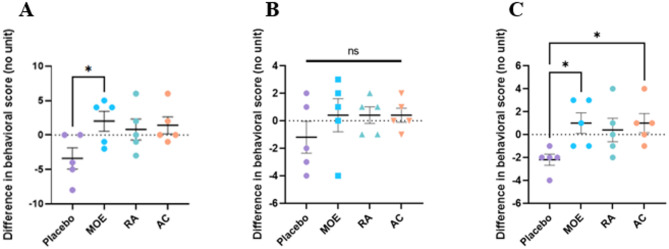
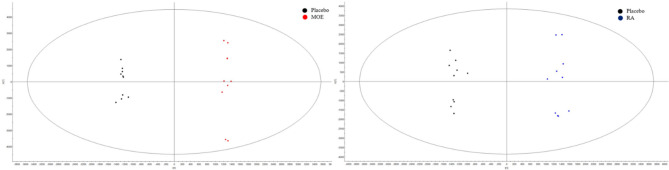
Results demonstrated significant differences between the mean behavioral score of placebo group (-3.4) compared to MOE (2.0), RA (1.4), and AC (0.8) groups. In addition, GHB measurement revealed a decrease in its quantity in all supplemented groups compared to the control. Moreover, untargeted metabolomics uncovered several metabolic pathways, that were impacted by MOE supplementation linked to lipids and bile acids metabolism. Furthermore, RA supplementation impacted fatty acids and lipids metabolism pathways while supplementation with AC affected pathways linked to lysine and sphingolipids metabolism.
Our study demonstrated a calming effect of MOE on beagles and proposes a novel hypothesis that sheds new light on its potential mechanism of action. This study underlines metabolomics as an effective tool for gaining deep insights into the metabolic changes associated with supplementation.
动物福利涵盖其生理和心理状态。后者可能会因包括压力和焦虑在内的几种与心理相关的紊乱而改变。为了解决这些问题,广泛使用唇形科植物蜜蜂花,它具有抗焦虑作用。在本研究中,主要目的是探讨市售的蜜蜂花水醇提取物(MOE)及其主要化合物迷迭香酸(RA)对犬行为和代谢组的影响。为此,将20只健康的比格犬随机分为4组膳食补充剂(每组5只犬):第一组接受补充有麦芽糊精(200mg/kg)的安慰剂,第二组补充MOE(200mg/kg),第三组接受剂量为10.6mg/kg的RA,第四组以胶囊形式给予剂量为225mg的α-卡索匹坦(AC)。在治疗4周后,使用由奥尼里斯开发的标准化评估网格监测犬的行为。此外,对4-羟基丁酸(GHB)进行定量,以研究补充剂对γ-氨基丁酸(GABA)生物合成途径代谢物的影响。此外,在补充期结束时,使用非靶向代谢组学评估所有补充剂对犬代谢组的影响。
结果表明,安慰剂组(-3.4)的平均行为评分与MOE组(2.0)、RA组(1.4)和AC组(0.8)相比存在显著差异。此外,GHB测量显示,与对照组相比,所有补充组中其含量均降低。此外,非靶向代谢组学发现了几条代谢途径,MOE补充剂对其有影响,这些途径与脂质和胆汁酸代谢有关。此外,RA补充剂影响脂肪酸和脂质代谢途径,而AC补充剂影响与赖氨酸和鞘脂代谢有关的途径。
我们的研究证明了MOE对比格犬有镇静作用,并提出了一个新的假设,为其潜在作用机制提供了新的线索。本研究强调代谢组学是深入了解与补充相关的代谢变化的有效工具。