
多功能三联体联盟:胆酸、牛磺酸和微生物群。
Versatile Triad Alliance: Bile Acid, Taurine and Microbiota.
机构信息
Department of Nutritional Sciences, University of Vienna, 1090 Vienna, Austria.
出版信息
Cells. 2022 Jul 29;11(15):2337. doi: 10.3390/cells11152337.
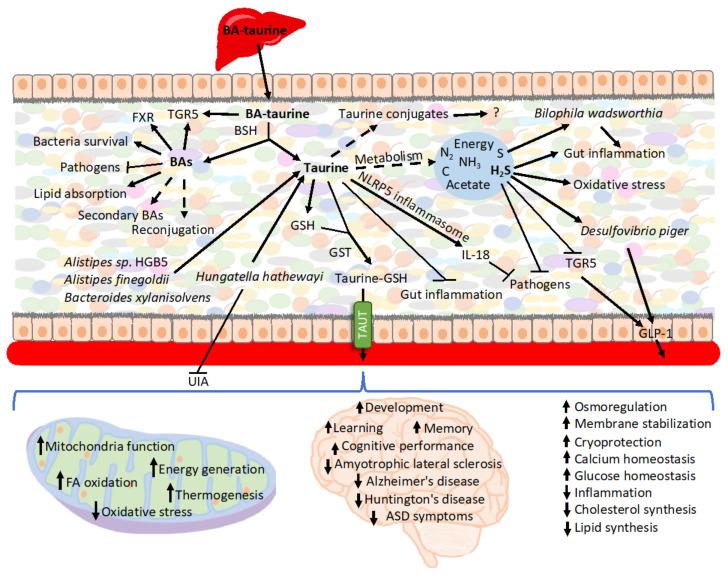
Taurine is the most abundant free amino acid in the body, and is mainly derived from the diet, but can also be produced endogenously from cysteine. It plays multiple essential roles in the body, including development, energy production, osmoregulation, prevention of oxidative stress, and inflammation. Taurine is also crucial as a molecule used to conjugate bile acids (BAs). In the gastrointestinal tract, BAs deconjugation by enteric bacteria results in high levels of unconjugated BAs and free taurine. Depending on conjugation status and other bacterial modifications, BAs constitute a pool of related but highly diverse molecules, each with different properties concerning solubility and toxicity, capacity to activate or inhibit receptors of BAs, and direct and indirect impact on microbiota and the host, whereas free taurine has a largely protective impact on the host, serves as a source of energy for microbiota, regulates bacterial colonization and defends from pathogens. Several remarkable examples of the interaction between taurine and gut microbiota have recently been described. This review will introduce the necessary background information and lay out the latest discoveries in the interaction of the co-reliant triad of BAs, taurine, and microbiota.
牛磺酸是体内最丰富的游离氨基酸,主要来源于饮食,但也可以内源性地从半胱氨酸产生。它在体内发挥多种重要作用,包括发育、能量产生、渗透压调节、预防氧化应激和炎症。牛磺酸还是将胆汁酸(BAs)结合的重要分子。在胃肠道中,肠道细菌使 BAs 脱结合,导致未结合的 BAs 和游离牛磺酸水平升高。根据结合状态和其他细菌修饰,BAs 构成了一组相关但高度多样化的分子,每个分子在溶解度和毒性、激活或抑制 BAs 受体的能力以及对微生物组和宿主的直接和间接影响方面都具有不同的特性,而游离牛磺酸对宿主具有很大的保护作用,是微生物组的能量来源,调节细菌定植并抵御病原体。最近描述了几个关于牛磺酸和肠道微生物组相互作用的显著例子。这篇综述将介绍必要的背景信息,并阐述 BAs、牛磺酸和微生物组这一相互依赖的三联体相互作用的最新发现。

 Zotero 插件