Department of Biomedical Sciences, Seoul National University Graduate School, Seoul, Republic of Korea.
Department of Internal Medicine, Seoul National University Hospital, Seoul, South Korea.
BMC Public Health. 2023 Sep 28;23(1):1879. doi: 10.1186/s12889-023-16765-7.
An association between sleep behaviors and muscle-fat mass is continuously interesting topic.
Based on the survey on sleep behaviors (quality and duration), the poor quality of sleep was evaluated when the subject did not feel satisfied after sleep, while the good quality was evaluated as they feel refreshed. A total of 19,770 participants were divided into the four groups according to changes in sleep quality: Good-to-Good (those who continuously maintained good quality), Good-to-Poor (those who reported initial good quality but subsequently reported a poor quality), Poor-to-Poor (those who continuously maintained poor quality), and Poor-to-Good (those who reported improved quality of sleep). As changes in skeletal muscle and fat mass index [kg/m] were estimated by a validated prediction equation, multiple linear regression was used to calculate adjusted mean (adMean) of muscle and fat mass according to changes in sleep behavior.
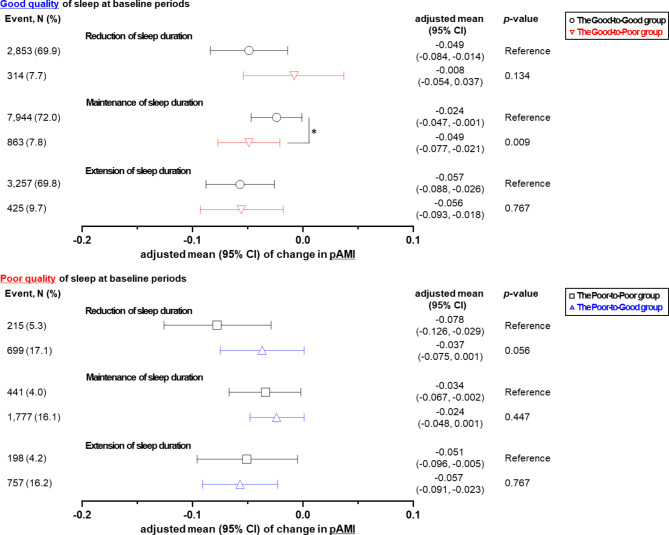
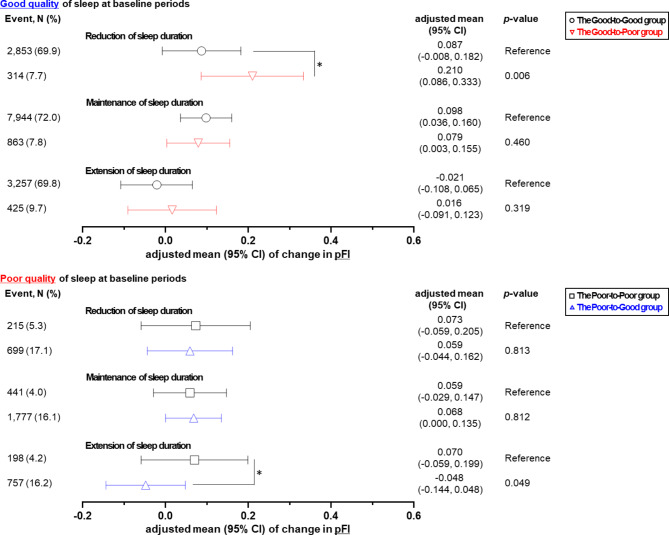
When sleep duration decreased and quality of sleep deteriorated (from good to poor), fat mass index significantly increased (adMean: 0.087 for the Good-to-Good group and 0.210 for the Good-to-Poor group; p-value = 0.006). On the other hand, as the quality of sleep deteriorated, skeletal muscle mass more decreased despite the maintained sleep duration (adMean: -0.024 for the Good-to-Good group and - 0.049 for the Good-to-Poor group; p-value = 0.009).
Our results showed that changes in sleep quality and duration affect changes in muscle and fat mass. Thus, we suggest maintaining a good quality of sleep, even if sleep duration is reduced, to preserve muscle mass and inhibit the accumulation of fat.
睡眠行为与肌肉-脂肪量之间的关系一直是一个很有趣的话题。
基于对睡眠行为(质量和时长)的调查,当被调查者在睡眠后仍感到不满意时,就会评估其睡眠质量较差,而当他们感到精神焕发时,就会评估其睡眠质量较好。共有 19770 名参与者根据睡眠质量的变化分为四组:一直保持良好睡眠质量(Good-to-Good,那些一直保持良好睡眠质量的人)、从好变差(Good-to-Poor,那些最初报告睡眠质量良好但随后报告睡眠质量差的人)、一直较差(Poor-to-Poor,那些一直保持较差睡眠质量的人)和从差变好(Poor-to-Good,那些报告睡眠质量改善的人)。由于通过验证的预测方程来估计骨骼肌和脂肪量指数[kg/m],因此使用多元线性回归来根据睡眠行为的变化来计算肌肉和脂肪量的调整均值(adMean)。
当睡眠持续时间减少且睡眠质量恶化(从好变差)时,脂肪量指数显著增加(Good-to-Good 组的 adMean 为 0.087,Good-to-Poor 组的 adMean 为 0.210;p 值=0.006)。另一方面,由于睡眠质量恶化,尽管睡眠持续时间保持不变,但骨骼肌量也会更多地减少(Good-to-Good 组的 adMean 为-0.024,Good-to-Poor 组的 adMean 为-0.049;p 值=0.009)。
我们的结果表明,睡眠质量和时长的变化会影响肌肉和脂肪量的变化。因此,我们建议即使睡眠时间减少,也要保持良好的睡眠质量,以保持肌肉量并抑制脂肪堆积。