Zhang Qin, Meng Liuqing, Lu Haoliang, Li Luoqing, Zeng Qinghui, Wang Dapeng, Wang Rui, Tong Tong, Liu Yongqiang, Yang Huizan
Guangxi Key Laboratory for Polysaccharide Materials and Modifications, School of Marine Sciences and Biotechnology, Guangxi Marine Microbial Resources Industrialization Engineering Technology Research Center, Guangxi Minzu University, 158 University Road, Nanning 530008, China.
Guangxi Key Laboratory for Aquatic Genetic Breeding and Healthy Aquaculture, Guangxi Academy of Fishery Sciences, 8 Qingshan Road, Nanning 530021, China.
Animals (Basel). 2025 Jun 28;15(13):1912. doi: 10.3390/ani15131912.
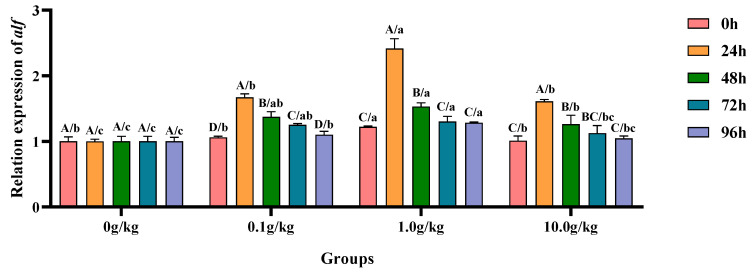
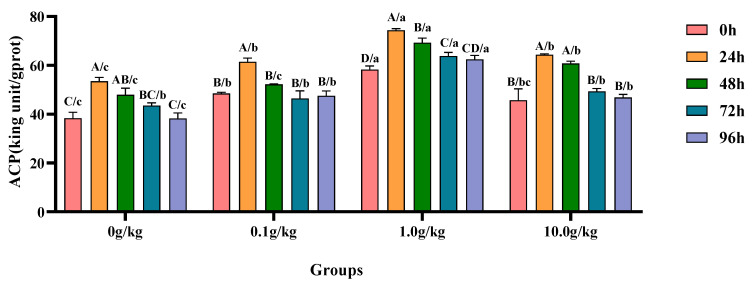
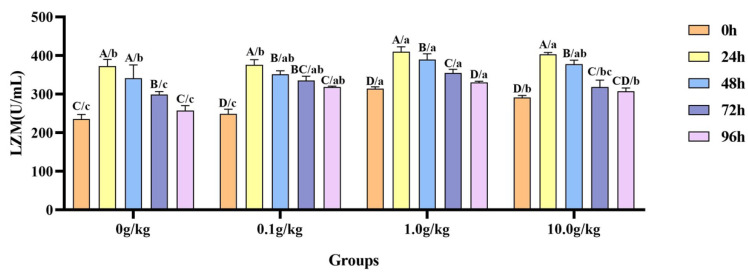
The objective of this study was to evaluate the effects of dietary supplementation with different levels of (0.0 g/kg, 0.1 g/kg, 1.0 g/kg, and 10.0 g/kg) on resistance to infection in red claw crayfish () (initial body weight of 0.13 ± 0.06 g). The investigation combined a 56-day feeding trial with a subsequent 7-day infection challenge to assess cumulative mortality, immune and antioxidant enzyme activities, and the relative expression of immune-related genes. During the infection test, the cumulative mortalities for the 0.1 g/kg, 1.0 g/kg, and 10.0 g/kg groups were 44.44%, 38.89%, and 38.89%, respectively, all significantly lower ( < 0.05) than that of the control group (58.33%). Compared with the control group, after infection with , the activities of acid phosphatase, alkaline phosphatase, catalase, and superoxide dismutase in the hepatopancreas and alkaline phosphatase, lysozyme in the hemolymph of red claw crayfish in the 1.0 g/kg group significantly increased ( < 0.05). The activities of aspartate aminotransferase and alanine aminotransferase in the hemolymph of red claw crayfish in the 1.0 g/kg group significantly decreased ( < 0.05). The relative expression levels of serine protease inhibitor, crustacean hyperglycemic hormone, anti-lipopolysaccharide factor, and superoxide dismutase genes in the hepatopancreas of red claw crayfish in the 1.0 g/kg group were significantly upregulated ( < 0.05). In conclusion, could significantly improve the antibacterial ability of red claw crayfish against . In this experimental context, the ideal addition level of is determined to be 1.0 g/kg.
本研究的目的是评估不同水平的(0.0克/千克、0.1克/千克、1.0克/千克和10.0克/千克)日粮添加物对红螯螯虾(初始体重为0.13±0.06克)抵抗感染的影响。该研究结合了为期56天的投喂试验以及随后为期7天的感染挑战,以评估累积死亡率、免疫和抗氧化酶活性以及免疫相关基因的相对表达。在感染试验期间,0.1克/千克、1.0克/千克和10.0克/千克组的累积死亡率分别为44.44%、38.89%和38.89%,均显著低于对照组(58.33%)(P<0.05)。与对照组相比,感染后,1.0克/千克组红螯螯虾肝胰腺中的酸性磷酸酶、碱性磷酸酶、过氧化氢酶和超氧化物歧化酶活性以及血淋巴中的碱性磷酸酶、溶菌酶活性显著增加(P<0.05)。1.0克/千克组红螯螯虾血淋巴中的天冬氨酸转氨酶和丙氨酸转氨酶活性显著降低(P<0.05)。1.0克/千克组红螯螯虾肝胰腺中丝氨酸蛋白酶抑制剂、甲壳动物高血糖激素、抗脂多糖因子和超氧化物歧化酶基因的相对表达水平显著上调(P<0.05)。总之,日粮添加物可显著提高红螯螯虾对的抗菌能力。在此实验条件下,日粮添加物的理想添加水平确定为1.0克/千克。