Potiris Anastasios, Moustakli Efthalia, Migka Fani, Zikopoulos Athanasios, Christodoulaki Chrysi, Papadopoulou Argyro, Kathopoulis Nikolaos, Theofanakis Charalampos, Panagopoulos Periklis, Domali Ekaterini, Drakakis Peter, Stavros Sofoklis
Third Department of Obstetrics and Gynecology, University General Hospital "ATTIKON", Medical School, National and Kapodistrian University of Athens, 12462 Athens, Greece.
Laboratory of Medical Genetics, Faculty of Medicine, School of Health Sciences, University of Ioannina, 45110 Ioannina, Greece.
Healthcare (Basel). 2025 Jun 20;13(13):1486. doi: 10.3390/healthcare13131486.
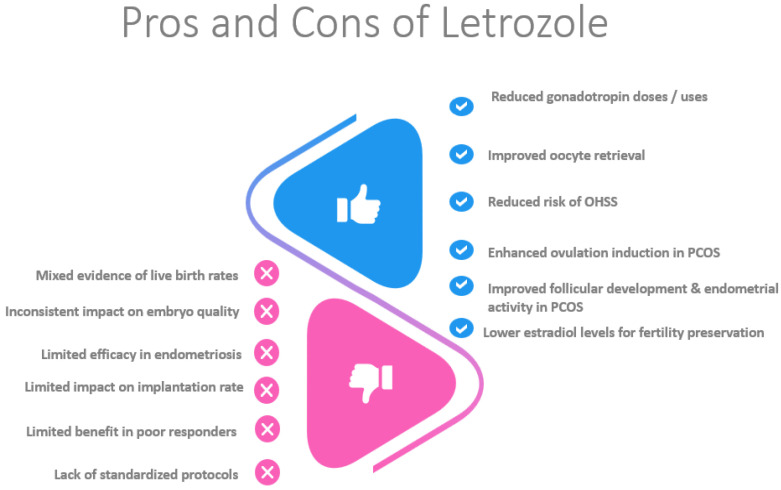
Infertility affects 8-12% of couples globally, with causes including hormonal and structural abnormalities. Letrozole, an aromatase inhibitor, is commonly used for ovulation induction, but its role in various assisted reproductive technologies (ARTs) and across different subgroups of infertile women remains unclear. This scoping review aimed to map the existing evidence on the use of letrozole in assisted reproductive cycles, focusing on reproductive outcomes and its application across different patient populations. A scoping review was conducted following the PRISMA-ScR guidelines. Twelve studies-including randomized controlled trials and retrospective cohorts-were identified through a structured search strategy. Studies comparing letrozole alone or in combination with gonadotropins/clomiphene to other stimulation protocols were included. Data were charted across multiple outcomes including oocyte yield, implantation, pregnancy, miscarriage, and live birth rates. Evidence suggests that letrozole-based protocols may enhance oocyte yield and improve reproductive outcomes in certain settings. The highest implantation rate (57%) was observed in natural cycles, while the letrozole-only group showed the highest clinical pregnancy (50.57%) and live birth rates (45.58%). Combination protocols achieved the highest ongoing pregnancy rate (58.3%), with the lowest miscarriage rate (14.86%) in the letrozole-only group. Letrozole appears to be a versatile agent in ART, especially for patients requiring reduced gonadotropin doses or estradiol modulation. This scoping review highlights the need for further research to clarify its optimal use across different infertility subgroups and ART modalities.
全球范围内,不孕影响着8%至12%的夫妇,其原因包括激素和结构异常。来曲唑是一种芳香化酶抑制剂,常用于诱导排卵,但其在各种辅助生殖技术(ART)以及不同亚组不孕女性中的作用仍不明确。本综述旨在梳理关于来曲唑在辅助生殖周期中应用的现有证据,重点关注生殖结局及其在不同患者群体中的应用。按照PRISMA-ScR指南进行了一项综述。通过结构化检索策略确定了12项研究,包括随机对照试验和回顾性队列研究。纳入了比较单独使用来曲唑或来曲唑与促性腺激素/克罗米芬联合使用与其他刺激方案的研究。对包括卵母细胞产量、着床、妊娠、流产和活产率在内的多个结局的数据进行了梳理。有证据表明,基于来曲唑的方案在某些情况下可能会提高卵母细胞产量并改善生殖结局。在自然周期中观察到最高着床率(57%),而仅使用来曲唑组的临床妊娠率(50.57%)和活产率最高(45.58%)。联合方案的持续妊娠率最高(58.3%),仅使用来曲唑组的流产率最低(14.86%)。来曲唑在辅助生殖技术中似乎是一种通用药物,尤其适用于需要减少促性腺激素剂量或调节雌二醇的患者。本综述强调需要进一步研究以阐明其在不同不孕亚组和辅助生殖技术模式中的最佳使用方法。