Yoseph Amanuel, Mussie Lakew, Belayineh Mehretu, Aguinaga-Ontoso Ines, Guillen-Grima Francisco, Mutwiri G
School of Public Health, College of Medicine and Health Sciences, Hawassa University, Hawassa P.O. Box 5, Ethiopia.
Adare General Hospital, Hawassa City Administration, Hawassa P.O. Box 5, Ethiopia.
Healthcare (Basel). 2025 Jun 23;13(13):1495. doi: 10.3390/healthcare13131495.
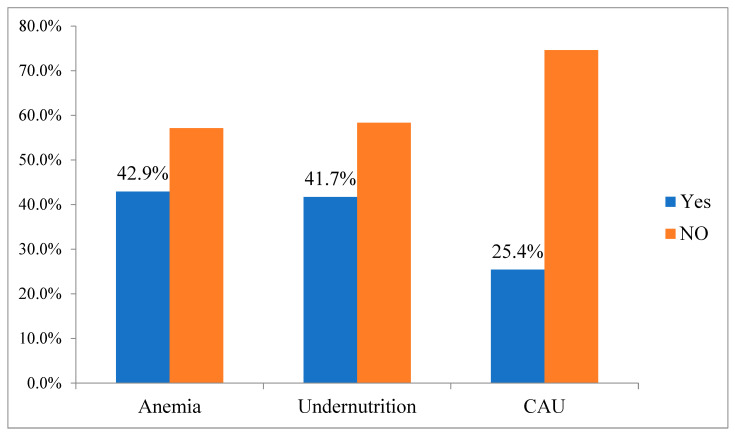
: Anemia and undernutrition are severe public health concerns in Ethiopia. These are the two most common nutritional disorders in pregnant women and frequently coexist. However, to our knowledge, there is little evidence of the coexistence of anemia and undernutrition among pregnant women. Therefore, this study aimed to examine the prevalence of coexisting anemia and undernutrition (CAU) and associated factors among pregnant women. : A community-based cross-sectional study was conducted from 1 to 25 June 2024, on 515 pregnant women in the Hawela Lida district of Sidama, Ethiopia. We utilized a multi-stage sampling method to choose eligible study participants. A pre-tested and structured questionnaire was used to collect data via the online Open Data Kit mobile tool. We controlled the effect of confounders and clustering by using a multi-level mixed-effect modified Poisson regression analysis model. : The prevalence of CAU among pregnant women was 25.4% (95% CI: 21.9-28.9). The prevalence of CAU was associated with household food insecurity (adjusted prevalence ratio [APR]: 2.17; 95% CI: 1.43-3.28), training on model family (APR: 0.66; 95% CI: 0.45-0.96), inadequate dietary diversity (APR: 1.51; 95% CI: 1.18-1.95), and having poor knowledge of nutrition (APR: 1.55; 95% CI: 1.06-2.26) at individual levels. Low community-level women's autonomy (APR: 6.19; 95% CI: 3.42-11.22) and community-level road accessibility (APR: 0.65; 95% CI: 0.43-0.98) were the identified determinants of CAU at the community level. : One in four pregnant women had CAU in the study area. Household food insecurity, inadequate dietary diversity, and poor nutrition knowledge were associated with an increased likelihood of CAU, while participation in model family training and improved road accessibility were associated with reduced CAU. We have also indicated that low community-level women's autonomy significantly increased the risk of CAU. Therefore, inter-sectorial collaboration should be required to comprehensively address CAU's determinants at different levels. Additionally, any CAU prevention and intervention programs should provide model family training explicitly targeting women with poor nutritional knowledge and low autonomy in healthcare decision-making.
贫血和营养不良是埃塞俄比亚严重的公共卫生问题。这是孕妇中最常见的两种营养失调情况,且经常同时存在。然而,据我们所知,几乎没有证据表明孕妇中贫血和营养不良会同时存在。因此,本研究旨在调查孕妇中贫血和营养不良并存(CAU)的患病率及其相关因素。
2024年6月1日至25日,在埃塞俄比亚锡达马州哈韦拉利达区对515名孕妇进行了一项基于社区的横断面研究。我们采用多阶段抽样方法选择符合条件的研究参与者。通过在线开放数据工具包移动应用程序,使用经过预测试的结构化问卷收集数据。我们使用多层次混合效应修正泊松回归分析模型来控制混杂因素和聚类效应。
孕妇中CAU的患病率为25.4%(95%置信区间:21.9 - 28.9)。CAU的患病率与家庭粮食不安全(调整患病率比[APR]:2.17;95%置信区间:1.43 - 3.28)、模范家庭培训(APR:0.66;95%置信区间:0.45 - 0.96)、饮食多样性不足(APR:1.51;95%置信区间:1.18 - 1.95)以及个人层面营养知识匮乏(APR:1.55;95%置信区间:1.06 - 2.26)相关。社区层面女性自主权低(APR:6.19;95%置信区间:3.42 - 11.22)和社区层面道路可达性(APR:0.65;95%置信区间:0.43 - 0.98)是社区层面CAU的确定决定因素。
在研究地区,四分之一的孕妇患有CAU。家庭粮食不安全、饮食多样性不足和营养知识匮乏与CAU可能性增加相关,而参与模范家庭培训和道路可达性改善与CAU减少相关。我们还指出,社区层面女性自主权低显著增加了CAU风险。因此,需要跨部门合作以全面解决不同层面CAU的决定因素。此外,任何CAU预防和干预项目都应提供明确针对营养知识匮乏且在医疗决策中自主权低的女性的模范家庭培训。