Di Gesto Cristian, Policardo Giulia Rosa, Bocci Benucci Sara, Çela Eriada, Grano Caterina
Department of Psychology, Sapienza University of Rome, Via dei Marsi, 78, 00185 Rome, Italy.
Department of Education, Languages, Intercultures, Literatures and Psychology, University of Florence, Via San Salvi, 12, 50135 Florence, Italy.
Healthcare (Basel). 2025 Jul 1;13(13):1575. doi: 10.3390/healthcare13131575.
BACKGROUND/OBJECTIVES: The COVID-19 pandemic has placed intensive care unit (ICU) nurses under intense psychological pressure, increasing emotional and psychological stress. Two constructs-difficulties in emotion regulation and psychological inflexibility (i.e., low contact with the present moment and a lack of committed action based on personal values)-have been associated with increased perceived stress levels but remain underexplored in this population.
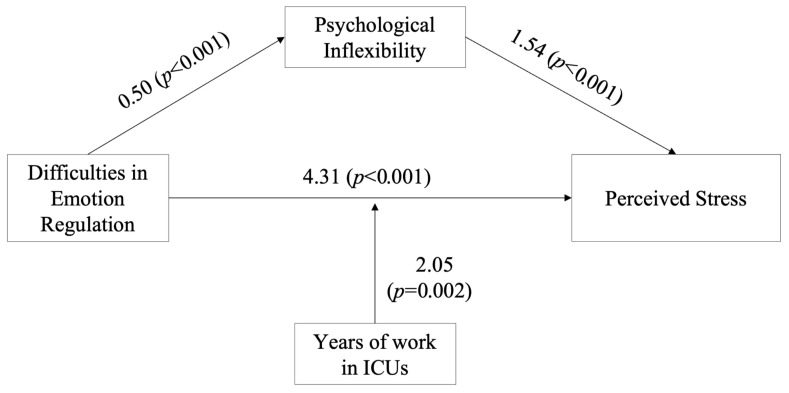
This study investigated whether psychological inflexibility mediates the relationship between emotion regulation difficulties and perceived stress in ICU nurses. It also examined whether years of ICU work experience moderate the direct relationship between emotion regulation difficulties and perceived stress.
A cross-sectional study was conducted with 210 ICU nurses (65.2% women; 34.8% men; mean age = 40.25 years ± 11.36) from Italian public hospitals. The participants completed the Difficulties in Emotion Regulation Scale, the Acceptance and Action Questionnaire-II, and the Perceived Stress Scale. A moderated mediation model was tested to examine whether psychological inflexibility mediates the relationship between emotion regulation difficulties and perceived stress and whether years of ICU work experience moderate the path between these variables.
Higher difficulties in emotion regulation predicted greater psychological inflexibility, which, in turn, predicted higher perceived stress. Psychological inflexibility fully mediated the relationship between emotion regulation difficulties and perceived stress. Additionally, years of ICU work experience significantly moderated the direct link between emotion regulation difficulties and perceived stress. This relationship was strongest for nurses with 1-15 years of ICU experience. The model explained 33% of the variance in perceived stress.
This study highlights the importance of the novel construct of psychological inflexibility in the context of healthcare professionals and its role in shaping perceived stress. Addressing psychological inflexibility through targeted interventions may help mitigate stress and promote well-being among ICU nurses.
背景/目的:新冠疫情使重症监护病房(ICU)护士承受巨大心理压力,导致情绪和心理应激增加。情绪调节困难和心理僵化这两个概念(即与当下接触较少以及缺乏基于个人价值观的坚定行动)与感知应激水平升高有关,但在这一人群中仍未得到充分研究。
本研究调查心理僵化是否在ICU护士的情绪调节困难与感知应激之间起中介作用。研究还考察了ICU工作年限是否调节情绪调节困难与感知应激之间的直接关系。
对来自意大利公立医院的210名ICU护士(65.2%为女性;34.8%为男性;平均年龄 = 40.25岁±11.36)进行了一项横断面研究。参与者完成了情绪调节困难量表、接纳与行动问卷-II和感知应激量表。测试了一个有调节的中介模型,以检验心理僵化是否在情绪调节困难与感知应激之间起中介作用,以及ICU工作年限是否调节这些变量之间的路径。
更高的情绪调节困难预示着更大的心理僵化,而心理僵化又预示着更高的感知应激。心理僵化完全中介了情绪调节困难与感知应激之间的关系。此外,ICU工作年限显著调节了情绪调节困难与感知应激之间的直接联系。这种关系在有1至15年ICU工作经验的护士中最为明显。该模型解释了感知应激中33%的变异。
本研究强调了心理僵化这一新概念在医疗保健专业人员背景下的重要性及其在塑造感知应激方面的作用。通过有针对性的干预来解决心理僵化问题,可能有助于减轻ICU护士的压力并促进其幸福感。