Hashe Nobom G, Fowler Lee, Norgren Susanne, Cornish Lesley A, Chown Lesley H, Goosen William E, Westraadt Johan E, Hadebe Nomsombuluko D E, Öhman-Mägi Caroline
Department of Physics, Nelson Mandela University (NMU), Port Elizabeth 6031, South Africa.
Department of Materials Science and Engineering, Uppsala University, 75121 Uppsala, Sweden.
Materials (Basel). 2025 Jul 3;18(13):3163. doi: 10.3390/ma18133163.
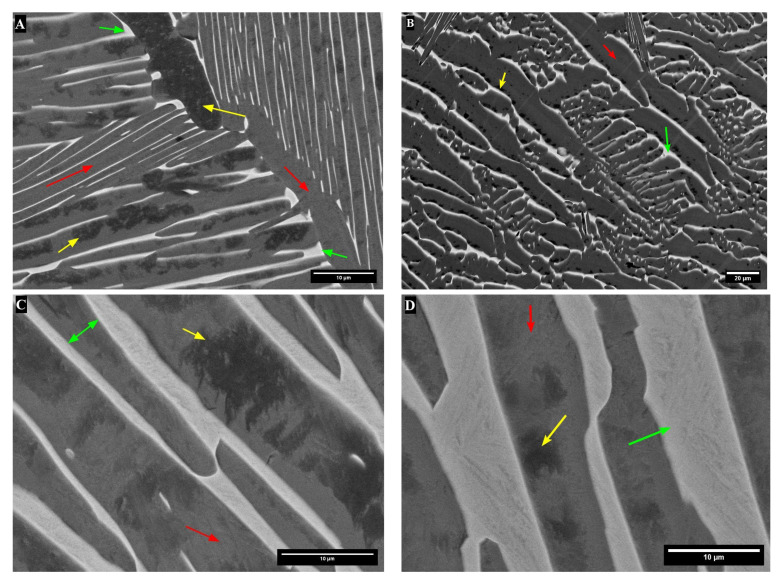
Alloys of Ti-10Ta-1.6Zr (wt%) with and without 3 wt% Cu made by arc-melting, heat-treated in two stages and quenched to have α + β microstructures were studied. These alloys were studied for potential replacement of Ti-6Al-4V alloys because Ta and Zr are more biocompatible than Al and V, and copper was added for potential antimicrobial properties. The heat-treated samples were investigated by SEM-EDX, transmission Kikuchi diffraction (TKD) and XRD. When studied at a higher magnification, the heat-treated alloys revealed a bi-lamellar microstructure, consisting of broad α lamellae and β transformed to fine α' lamellae with various orientations. The fraction β transformed to fine α' lamellae was higher in the alloy with Cu than that without Cu. Furthermore, copper was found to lower the solubility of tantalum in the β. The hardest alloy was the heat-treated alloy containing Cu, albeit with a wide standard deviation, probably due to the high fraction of martensitically transformed β.
研究了通过电弧熔炼制备的含3 wt% Cu和不含3 wt% Cu的Ti-10Ta-1.6Zr(重量百分比)合金,经过两阶段热处理并淬火以获得α + β微观结构。研究这些合金以潜在替代Ti-6Al-4V合金,因为Ta和Zr比Al和V具有更高的生物相容性,并且添加铜以获得潜在的抗菌性能。通过扫描电子显微镜-能谱仪(SEM-EDX)、透射菊池衍射(TKD)和X射线衍射(XRD)对热处理后的样品进行了研究。在更高放大倍数下研究时,热处理后的合金呈现出双片层微观结构,由宽α片层和转变为具有各种取向的细α'片层的β组成。含铜合金中转变为细α'片层的β比例高于不含铜的合金。此外,发现铜降低了钽在β中的溶解度。最硬的合金是含铜的热处理合金,尽管标准偏差较大,这可能是由于马氏体转变β的比例较高。