Aghaei Hamed, Askaripoor Taleb, Siadat Morteza, Saleh Elahe
Department of Occupational Health and Safety Engineering, TMS.C., Islamic Azad University, Tehran, Iran.
Department of Occupational Health Engineering and Safety, Damghan School of Public Health, Semnan University of Medical Sciences, Semnan, Iran.
PLoS One. 2025 Jul 14;20(7):e0328062. doi: 10.1371/journal.pone.0328062. eCollection 2025.
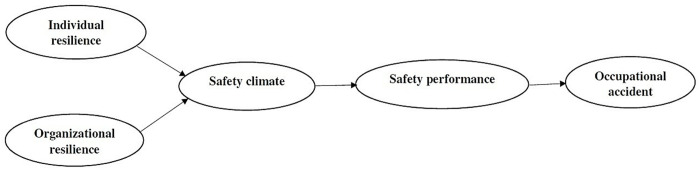
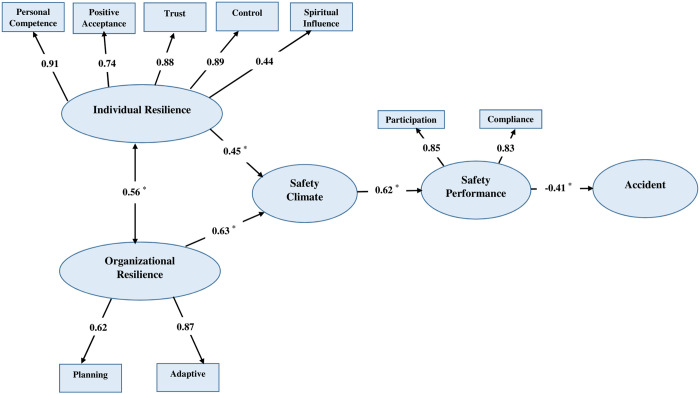
This study examined the impact of individual and organizational resilience on safety climate, safety performance, and the incidence of occupational accidents among hospital employees in Iran. The research aimed to determine whether resilience, at both individual and organizational levels, enhances safety climate and performance, thereby reducing occupational accidents. This cross-sectional study was conducted in 2024, involving 343 administrative and patient care staff from four government hospitals in Semnan, Iran. Validated questionnaires were used to collect the data. Structural equation modeling analyzed the relationships among the variables. The findings revealed that individual and organizational resilience positively influenced safety climate and performance, resulting in a reduction in occupational accidents. Personal competence emerged as the strongest indicator of individual resilience, while adaptive resilience significantly impacted organizational resilience. Safety climate was found to mediate the relationship between resilience and safety performance, underscoring its critical role in enhancing safety outcomes. This study emphasizes the importance of fostering both individual and organizational resilience to improve safety climate and performance in healthcare settings. Interventions focused on resilience and a positive safety climate are essential for reducing occupational accidents, especially in high-stress environments like hospitals.
本研究考察了个体和组织韧性对伊朗医院员工安全氛围、安全绩效及职业事故发生率的影响。该研究旨在确定个体和组织层面的韧性是否能改善安全氛围和绩效,从而减少职业事故。这项横断面研究于2024年开展,涉及伊朗塞姆南四所公立医院的343名行政和患者护理人员。研究使用经过验证的问卷收集数据。采用结构方程模型分析变量之间的关系。研究结果表明,个体和组织韧性对安全氛围和绩效产生积极影响,从而减少了职业事故。个人能力是个体韧性的最强指标,而适应性韧性对组织韧性有显著影响。研究发现安全氛围在韧性与安全绩效之间起中介作用,凸显了其在提升安全成果方面的关键作用。本研究强调培养个体和组织韧性对于改善医疗环境中的安全氛围和绩效的重要性。侧重于韧性和积极安全氛围的干预措施对于减少职业事故至关重要,尤其是在医院等高压力环境中。