Paterson Amy, Cheyne Ashleigh, Tulunay Harun, Orkin Chloe, Nutland Will, Dunning Jake, Stolow Jeni, Gobat Nina, Olliaro Piero, Rojek Amanda
Pandemic Sciences Institute, University of Oxford, Old Road Campus, Roosevelt Drive, Oxford, OX3 7DQ, UK.
Positively UK, 14 St. Marys House, Chillingworth Road, London, N7 8SH, UK.
BMC Med. 2025 Jul 15;23(1):422. doi: 10.1186/s12916-025-04243-3.
Stigma emerged as a prominent public health challenge in the global mpox outbreak that began in 2022, impeding outbreak control efforts and the well-being of affected individuals. Addressing stigma is important for improving infection prevention and control. Despite frequent mention in public and policy discourse, robust assessment of mpox stigma is lacking. This study investigated the causes, manifestations, and impacts of mpox-related stigma in the UK, focusing on anticipated stigma among directly and indirectly affected communities.
We conducted an online, mixed-methods cross-sectional survey to assess mpox stigma. We developed and content validated a new tool, the Stigma Survey and Community-based Assessment for New and Re-emerging outbreaks (Stigma-SCANR) for this purpose. Through quota sampling, the survey targeted populations most affected by mpox at the time of data collection (March-July 2024), including gay, bisexual, and other men who have sex with men (GBMSM), and healthcare workers. The survey primarily explored anticipated stigma. Respondents with previous mpox diagnoses were asked about personal experiences of stigma.
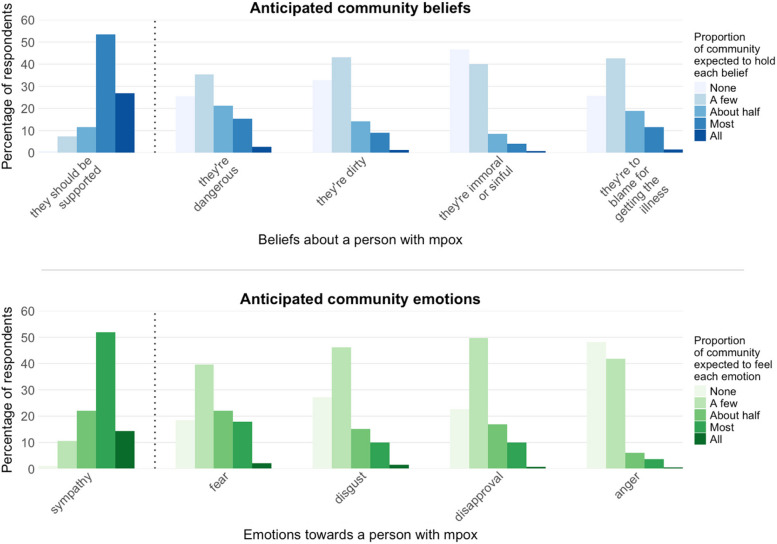
Of 479 respondents who initiated the survey, 437 (91%) were included in analyses. In modules related to drivers of stigma, pre-existing prejudices towards associated groups such as GBMSM and migrants were emphasised, alongside fear and misinformation. On average, respondents anticipated higher levels of negative judgement and unwarranted avoidance compared to other forms of social stigma, particularly from casual partners and the public. Among the 13 respondents who reported a previous mpox diagnosis, 11 (85%) had experienced mpox-related stigma. Nearly a quarter of respondents (24%) said they would not, or were unlikely to, tell a recent sexual partner about an mpox diagnosis. Feelings of shame were considered the most common barrier to care-seeking (299 respondents, 68%).
This analysis of mpox stigma in the UK offers insights for international outbreak response, particularly in countries with similarly affected communities. Lessons learnt may also be transferable to other disease outbreaks. We propose practical recommendations for reducing stigma in future outbreaks, including peer support initiatives, distributing accessible information about safe timelines for returning to socialising and work or school, and co-designing public communications and contact tracing programmes with affected community members.
在始于2022年的全球猴痘疫情中,污名化成为一个突出的公共卫生挑战,阻碍了疫情防控工作以及受影响个体的福祉。应对污名化对于改善感染预防和控制至关重要。尽管在公共和政策讨论中经常被提及,但对猴痘污名化的有力评估仍很缺乏。本研究调查了英国猴痘相关污名化的原因、表现和影响,重点关注直接和间接受影响社区中的预期污名化情况。
我们开展了一项在线的混合方法横断面调查,以评估猴痘污名化情况。为此,我们开发并通过内容验证了一种新工具,即新发和再发疫情污名调查与社区评估工具(Stigma-SCANR)。通过配额抽样,该调查针对数据收集时(2024年3月至7月)受猴痘影响最大的人群,包括男同性恋、双性恋和其他与男性发生性关系的男性(GBMSM)以及医护人员。该调查主要探究预期污名化情况。曾被诊断患有猴痘的受访者被问及污名化的个人经历。
在479名发起调查的受访者中,437名(91%)被纳入分析。在与污名化驱动因素相关的模块中,强调了对GBMSM和移民等相关群体的既有偏见,以及恐惧和错误信息。平均而言,与其他形式的社会污名相比,受访者预期会受到更高程度的负面评判和无端回避,尤其是来自偶然伴侣和公众的。在13名报告曾被诊断患有猴痘的受访者中,11名(85%)经历过与猴痘相关的污名化。近四分之一的受访者(24%)表示他们不会或不太可能告知近期的性伴侣自己被诊断患有猴痘。羞耻感被认为是寻求治疗最常见的障碍(299名受访者,68%)。
这项对英国猴痘污名化的分析为国际疫情应对提供了见解,尤其是在有类似受影响社区的国家。吸取的经验教训也可能适用于其他疾病疫情。我们提出了在未来疫情中减少污名化的实际建议,包括同伴支持倡议、分发关于恢复社交以及工作或上学安全时间线的易获取信息,以及与受影响社区成员共同设计公共宣传和接触者追踪计划。