Koivunen Veerakaisa, Mäkelä Lotta, Veija Tuukka, Lagus Heli, Isoherranen Kirsi, Venermo Maarit, Koljonen Virve
Department of Surgery, Hyvinkää Hospital, Hospital District of Helsinki and Uusimaa, Hyvinkää, Finland.
Department of Plastic Surgery, University of Helsinki and Helsinki University Hospital, Helsinki, Finland.
Int Wound J. 2025 Jul;22(7):e70726. doi: 10.1111/iwj.70726.
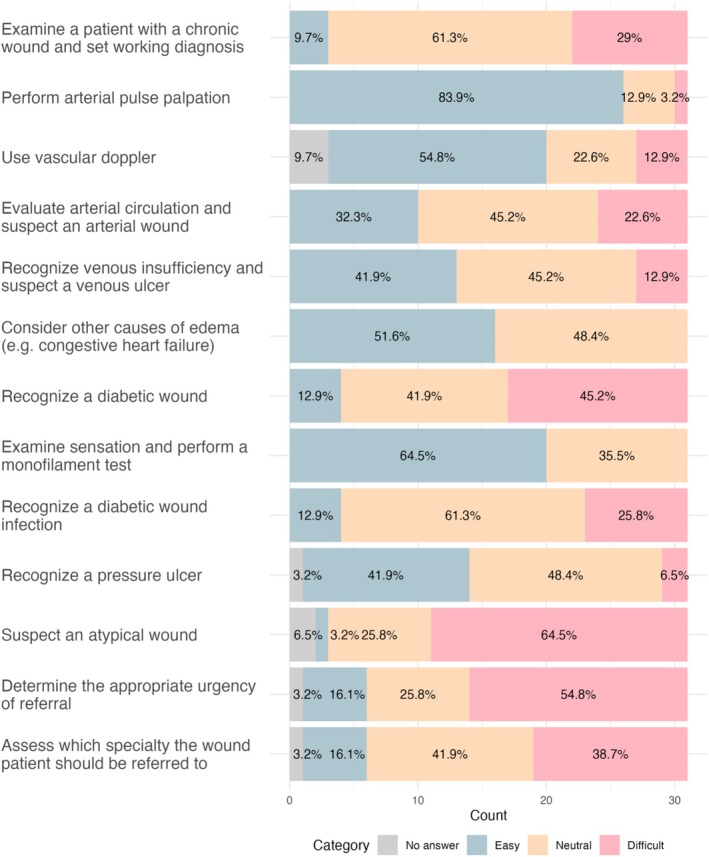
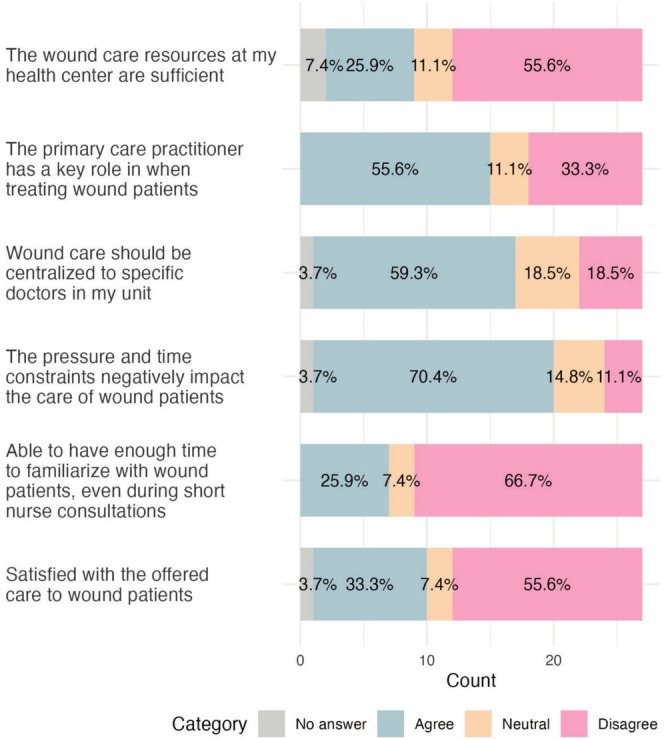
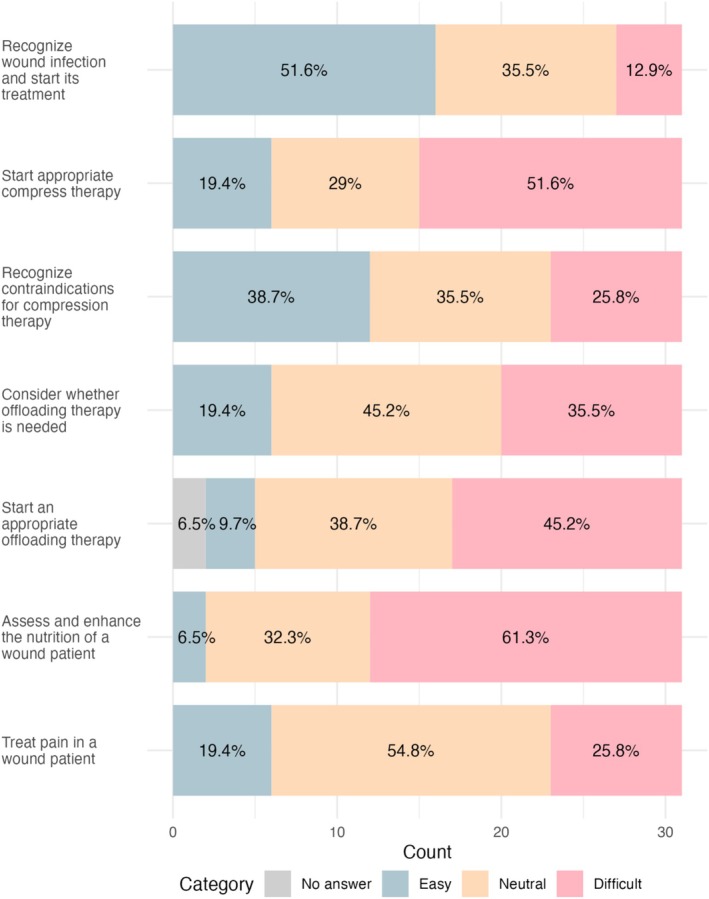
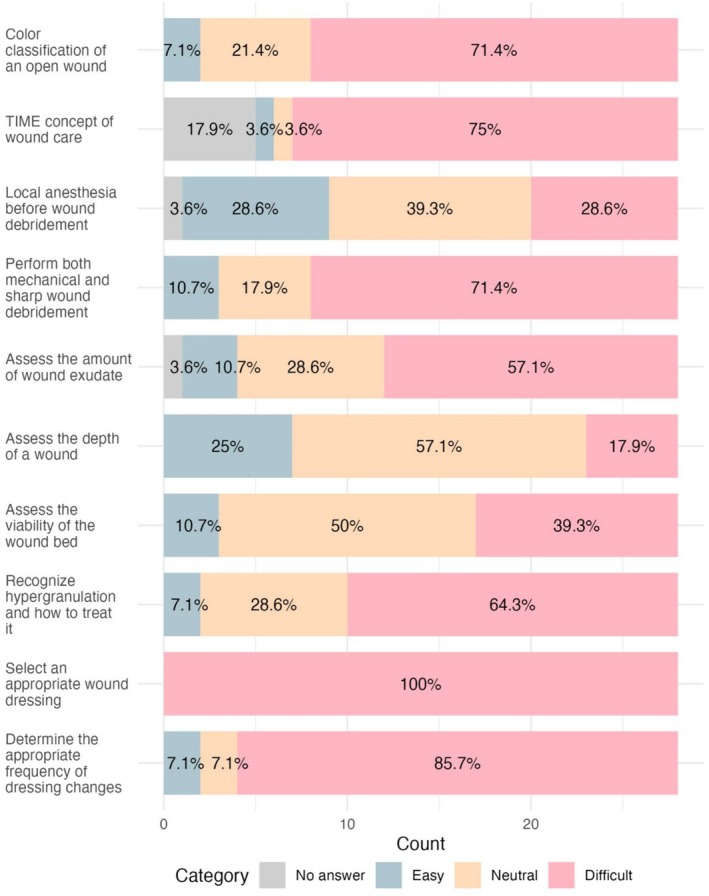
The aim of this study was to identify the competencies and challenges in the care of chronic wounds experienced by general practitioners. An online survey study targeted at primary care general practitioners in the City of Helsinki. The survey was created using REDCap and sent via email to the participants. Data were analysed with descriptive statistics. Thirty-two participated in the study. A third considered the primary diagnostics difficult (N = 9/31, 29.0%). The determination of the appropriate urgency (N = 17/31, 54.9%), specialty of referral (N = 12/31, 38.7%), compression therapy (N = 16/31, 51.6%), offloading (N = 14/31, 45.2%) and the nutritional support (N = 19, 61.3%) were challenging. Over half felt that insufficient resources (N = 15/27, 55.6%), pressure and time constraints (N = 19/27, 70.4%) complicate the care. The majority (N = 15/27, 55.6%) considered the role of a general practitioner to be crucial, but (N = 16/27, 59.3%) felt that improving wound care within primary care would yield better outcomes. General practitioners consider themselves skilled in wound aetiology diagnostics but not in treatment, where they estimated their skills as weak. Inadequate resources hinder the treatment of chronic wounds, and over half of respondents were unsatisfied with current care. Establishing primary care centres specialising in wound care could improve treatment.
本研究的目的是确定全科医生在慢性伤口护理方面的能力和挑战。一项针对赫尔辛基市基层医疗全科医生的在线调查研究。该调查使用REDCap创建,并通过电子邮件发送给参与者。数据采用描述性统计进行分析。32人参与了该研究。三分之一的人认为初步诊断困难(N = 9/31,29.0%)。确定适当的紧急程度(N = 17/31,54.9%)、转诊专科(N = 12/31,38.7%)、压迫疗法(N = 16/31,51.6%)、减压(N = 14/31,45.2%)和营养支持(N = 19,61.3%)具有挑战性。超过一半的人认为资源不足(N = 15/27,55.6%)、压力和时间限制(N = 19/27,70.4%)使护理变得复杂。大多数人(N = 15/27,55.6%)认为全科医生的作用至关重要,但(N = 16/27,59.3%)觉得在基层医疗中改善伤口护理会产生更好的结果。全科医生认为自己在伤口病因诊断方面有技能,但在治疗方面没有,他们估计自己在治疗方面的技能较弱。资源不足阻碍了慢性伤口的治疗,超过一半的受访者对当前护理不满意。建立专门的伤口护理基层医疗中心可以改善治疗。