Schumacher Tanner J, Gardner Zachary S, Rumbley Jon, Ronayne Conor T, Mereddy Venkatram R
Integrated Biosciences Graduate Program, University of Minnesota, Duluth, Minnesota, USA.
Integrated Biosciences Graduate Program, University of Minnesota, Duluth, Minnesota, USA; Department of Pharmacy Practice & Pharmaceutical Sciences, University of Minnesota, Duluth, Minnesota, USA.
J Biol Chem. 2025 Jul 16;301(8):110486. doi: 10.1016/j.jbc.2025.110486.
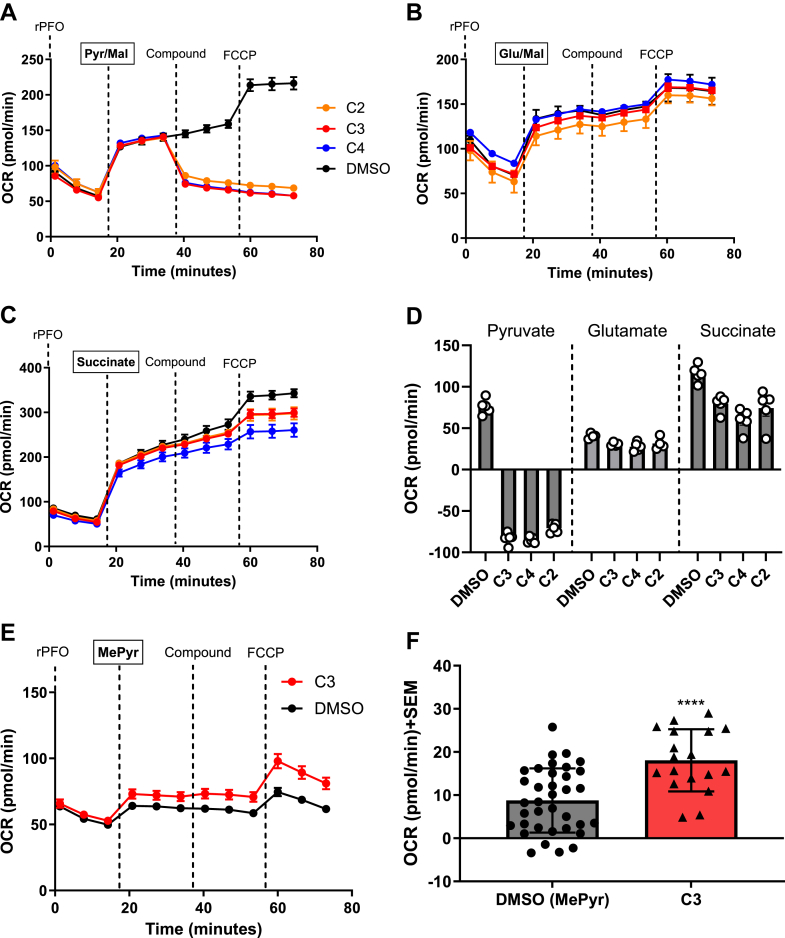
Reprogrammed metabolism of cancer cells offers a unique target for pharmacological intervention. The mitochondrial pyruvate (Pyr) carrier (MPC) plays important roles in cancer progression by transporting cytosolic Pyr into the mitochondria for use in the tricarboxylic acid cycle. In the current study, a series of novel fluoro-substituted aminocarboxycoumarin derivatives have been evaluated for their MPC inhibition properties. Our studies indicate that the aminocarboxycoumarin template elicits potent MPC inhibitory characteristics, and specifically, structure-activity relationship studies show that the N-methyl-N-benzyl structural template provides the optimal inhibitory capacity. Further respiratory experiments demonstrate that candidate compounds specifically inhibit Pyr-driven respiration without substantially affecting other metabolic fuels, consistent with MPC inhibition. Further, computational inhibitor docking studies illustrate that aminocarboxycoumarin-binding characteristics are nearly identical to that of classical MPC inhibitor UK5099 bound to human MPC, recently determined by cryo-EM. The lead candidate C5 elicits cancer cell proliferation inhibition specifically in monocarboxylate transporter 1-expressing murine breast cancer cells 4T1 and 67NR, consistent with its ability to accumulate intracellular lactate. In vivo tumor growth studies illustrate that C5 significantly reduces the tumor burden in two syngeneic murine tumor models with 4T1 and 67NR cells. These studies provide novel MPC inhibitors with potential for anticancer applications in monocarboxylate transporter 1-expressing breast cancer tumor models.
癌细胞重编程的代谢为药物干预提供了一个独特的靶点。线粒体丙酮酸(Pyr)载体(MPC)通过将胞质中的Pyr转运到线粒体中用于三羧酸循环,在癌症进展中发挥重要作用。在本研究中,对一系列新型氟取代氨基羧基香豆素衍生物的MPC抑制特性进行了评估。我们的研究表明,氨基羧基香豆素模板具有强大的MPC抑制特性,具体而言,构效关系研究表明,N-甲基-N-苄基结构模板具有最佳抑制能力。进一步的呼吸实验表明,候选化合物特异性抑制Pyr驱动的呼吸,而基本不影响其他代谢燃料,这与MPC抑制一致。此外,计算抑制剂对接研究表明,氨基羧基香豆素的结合特性与最近通过冷冻电镜确定的与人类MPC结合的经典MPC抑制剂UK5099几乎相同。先导候选物C5在表达单羧酸转运蛋白1的小鼠乳腺癌细胞4T1和67NR中特异性抑制癌细胞增殖,这与其积累细胞内乳酸的能力一致。体内肿瘤生长研究表明,C5在两种携带4T1和67NR细胞的同基因小鼠肿瘤模型中显著减轻肿瘤负担。这些研究为在表达单羧酸转运蛋白1的乳腺癌肿瘤模型中具有抗癌应用潜力的新型MPC抑制剂提供了依据。