
习语加工优势可由意外性来解释。
The Idiom Processing Advantage is Explained By Surprisal.
作者信息
Socolof Michaela, O'Donnell Timothy J, Wagner Michael
机构信息
Department of Brain and Cognitive Sciences, Massachusetts Institute of Technology.
Department of Linguistics, McGill University.
出版信息
Cogn Sci. 2025 Jul;49(7):e70085. doi: 10.1111/cogs.70085.
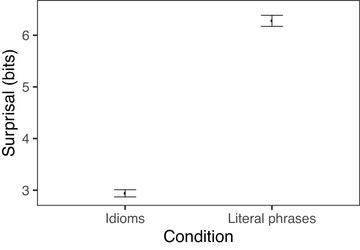
It has been repeatedly found that idioms are processed faster than syntactically matched literal phrases, in both comprehension and production. This has led to debate about whether idioms are accessed as chunks or built compositionally, with different studies attempting to measure the effect of compositionality on processing, with differing conclusions. This paper looks at idiom processing through the lens of information update, in particular surprisal theory, which is a standard theory of sentence processing. Compositionality is just one aspect of a word's predictability; we argue that surprisal, as an expectation-based theory, provides a more general unifying framework for understanding the idiom processing advantage. In this paper, comprehension and production experiments on verb-object idioms reveal that the idiom processing advantage can be largely explained by the fact that idioms have lower surprisal than matched literal phrases. The results indicate that the idiom advantage manifests primarily on the noun in verb-object idioms.
人们反复发现,在理解和产出方面,习语的处理速度比句法匹配的字面短语更快。这引发了关于习语是作为整体被提取还是通过组合方式构建的争论,不同的研究试图衡量组合性对处理过程的影响,得出了不同的结论。本文从信息更新的角度,特别是意外值理论来审视习语处理,意外值理论是句子处理的标准理论。组合性只是单词可预测性的一个方面;我们认为,作为一种基于预期的理论,意外值为理解习语处理优势提供了一个更通用的统一框架。本文对动宾习语的理解和产出实验表明,习语处理优势在很大程度上可以由习语的意外值低于匹配的字面短语这一事实来解释。结果表明,习语优势主要体现在动宾习语的名词上。




 Zotero 插件