Mandal Ahamadul Hoque, Sadhu Auroshree, Ghosh Surajit, Saha Nimai Chandra, Saha Shubhajit
Fisheries and Ecotoxicology Research Laboratory, Department of Zoology, The University of Burdwan, Burdwan, India.
School of Life Sciences, Swami Vivekananda University, Kolkata, West Bengal, India.
Sci Rep. 2025 Jul 20;15(1):26321. doi: 10.1038/s41598-025-11463-3.
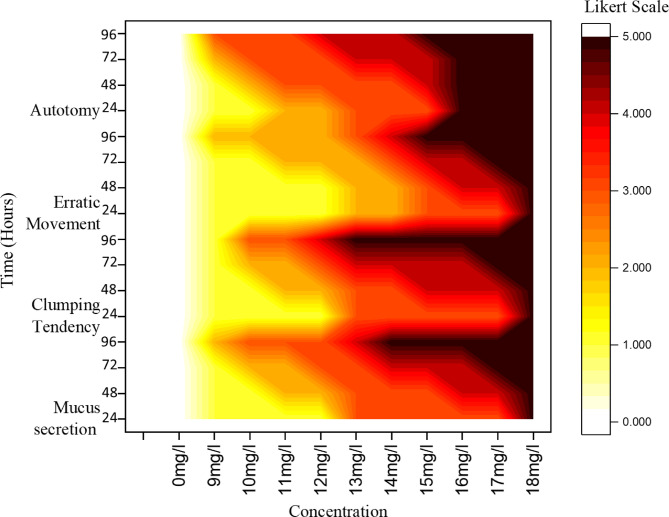
The present study evaluates the toxicological effects of carbosulfan by observing the mortality, behavioural responses, and alteration of oxidative biomarkers such as CAT, SOD, and MDA. The mortality rate of tubificid worms exposed to the toxicant differed substantially (p < 0.05) from the control group at all concentrations throughout the experiment. The p-value less than 0.05 indicates that the changes in these biomarkers were statistically significant. The severity of behavioural changes included irregular movement, decreased clumping proclivity, mucus production, and a surge in autotomy. Long-term exposure to two sub-lethal doses of CBSF (0.831 mg/L and 1.632 mg/L) resulted in the disintegration of longitudinal muscles of tubificid worms, the continuity of longitudinal muscle (LM) parallel to the gut, and ruptured mucus channel (MC) from the anterior portion of the worm. In addition, scanning electron microscope images revealed the alteration of epidermal lesions, setal anomalies, and clitellar swelling due to CBSF exposure. The oxidative stress biomarkers catalase (CAT), superoxide dismutase (SOD) and malonaldehyde (MDA) increased with increasing concentrations of CBSF, i.e., 0.831 mg/L and 1.632 mg/L. The maximum elevation of CAT, SOD and MDA was observed on the 14th day. In addition, IBRv2 analysis demonstrated that tissue biomarkers were extremely sensitive to the toxicity of CBSF, and extended exposure might result in major health consequences, such as acute toxicity in tubificid worms because of increased oxidative stress biomarkers. The log-normal curve of species sensitivity distribution (SSDs) depicted the ecotoxicological risk assessment through 96 h LC i.e., 8.31 mg/L. Strong interactions between CBSF and key stress biomarker enzymes were shown by molecular docking experiments, which interfered with the enzymes' activities and might have caused oxidative stress. Interactions with cytochrome c oxidase indicated disruption of the process by which cells produce energy. The findings highlight the need for more investigation to completely understand the sensitivity of tubificids to environmental pollutants and the long-term impacts of pesticide exposure on aquatic health and ecosystem stability.
本研究通过观察死亡率、行为反应以及氧化生物标志物(如过氧化氢酶(CAT)、超氧化物歧化酶(SOD)和丙二醛(MDA))的变化,评估了丁硫克百威的毒理学效应。在整个实验过程中,暴露于该毒物的颤蚓死亡率在所有浓度下均与对照组有显著差异(p < 0.05)。p值小于0.05表明这些生物标志物的变化具有统计学意义。行为变化的严重程度包括运动不规则、聚集倾向降低、黏液分泌以及自割现象激增。长期暴露于两个亚致死剂量的丁硫克百威(0.831 mg/L和1.632 mg/L)导致颤蚓纵肌解体、与肠道平行的纵肌连续性破坏以及从虫体前部破裂的黏液通道。此外,扫描电子显微镜图像显示,由于丁硫克百威暴露,表皮损伤、刚毛异常和环带肿胀发生了改变。氧化应激生物标志物过氧化氢酶(CAT)、超氧化物歧化酶(SOD)和丙二醛(MDA)随着丁硫克百威浓度的增加而增加,即0.831 mg/L和1.632 mg/L。在第14天观察到CAT、SOD和MDA的最大升高。此外,IBRv2分析表明,组织生物标志物对丁硫克百威的毒性极其敏感,长期暴露可能导致重大健康后果,如由于氧化应激生物标志物增加而导致颤蚓急性毒性。物种敏感度分布(SSD)的对数正态曲线通过96小时半数致死浓度(LC)即8.31 mg/L描绘了生态毒理学风险评估。分子对接实验表明丁硫克百威与关键应激生物标志物酶之间存在强烈相互作用,这干扰了酶的活性,可能导致了氧化应激。与细胞色素c氧化酶的相互作用表明细胞产生能量的过程受到了破坏。研究结果强调需要进行更多调查,以全面了解颤蚓对环境污染物的敏感性以及农药暴露对水生健康和生态系统稳定性的长期影响。