Saraiva Bruna Thamyres Ciccotti, Tebar William Rodrigues, Dos Santos Amanda Barbosa, Antunes Ewerton Pegorelli, Silva Stefany Carolaine Bezerra, Furuta Débora Toshimi, Ferrari Gerson, Delfino Leandro Dragueta, Christofaro Diego Giulliano Destro
Movement Sciences, School of Technology and Sciences, São Paulo State University (UNESP), Rua Roberto Simonsen, 305, Presidente Prudente (SP), CEP 19060-900, Brazil.
Health Sciences, University Hospital, Center of Clinical and Epidemiological Research, University of São Paulo (USP), Av. Prof. Lineu Prestes, 2565, São Paulo (SP), CEP 05508-000, Brazil.
BMC Pediatr. 2025 Jul 22;25(1):562. doi: 10.1186/s12887-025-05814-2.
Motor skills are essential for carrying out daily tasks and the practice of physical activities can help to increase these skills. Being combat sports, it can be an alternative practice with this objective. However, it is not known which is the ideal modality. Therefore, the aim was to analyze the effects of nine months of practicing Muay Thai (MT) and Judo on the motor skills of children and adolescents.
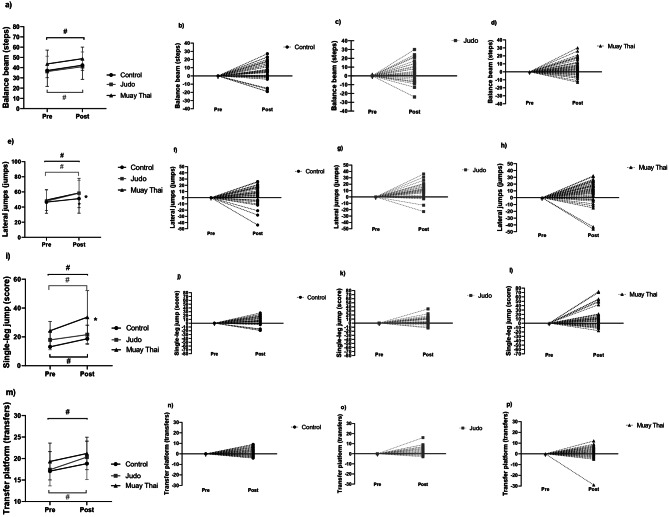
A sample of 109 young people from a Philanthropic Institution was distributed into: control (n = 36), Judo (n = 29) and MT (n = 44). The following motor skills tests were carried out: balance on the beam, side jumps, single-leg jump and transfer onto the platform. The intervention lasted nine months, twice a week for one hour.
After nine months, the Judo and Muay Thai groups showed increased values in lateral jumps (Judo p-value < 0.001; Muay Thai p-value < 0.001), and transfer platform (Judo p-value = 0.007; Muay Thai p-value < 0.001) from the pre-moment compared to the post-moment. In the single-leg jump, the Judo (p-value = 0.011) and MT (p-value < 0.001) groups were different compared to the control group.
The practice of combat sports was effective in causing improvements in the motor skills of young.
运动技能对于执行日常任务至关重要,体育活动的练习有助于提高这些技能。作为格斗运动,它可以作为实现这一目标的一种替代练习方式。然而,尚不清楚哪种是理想的运动形式。因此,本研究旨在分析九个月的泰拳(MT)和柔道练习对儿童和青少年运动技能的影响。
从一家慈善机构选取109名年轻人作为样本,分为:对照组(n = 36)、柔道组(n = 29)和泰拳组(n = 44)。进行了以下运动技能测试:平衡木上的平衡、侧向跳跃、单腿跳跃和转移到平台上。干预持续九个月,每周两次,每次一小时。
九个月后,与干预前相比,柔道组和泰拳组在侧向跳跃(柔道p值<0.001;泰拳p值<0.001)和转移平台(柔道p值 = 0.007;泰拳p值<0.001)方面的数值有所增加。在单腿跳跃方面,与对照组相比,柔道组(p值 = 0.011)和泰拳组(p值<0.001)存在差异。
格斗运动的练习有效地改善了年轻人的运动技能。