Biino Valentina, Giustino Valerio, Gallotta Maria Chiara, Bellafiore Marianna, Battaglia Giuseppe, Lanza Massimo, Baldari Carlo, Giuriato Matteo, Figlioli Flavia, Guidetti Laura, Schena Federico
Department of Human Sciences, Università degli Studi di Verona, Verona, Italy.
Department of Neurosciences, Biomedicine and Movement Sciences, Università degli Studi di Verona, Verona, Italy.
Front Sports Act Living. 2023 Dec 22;5:1310074. doi: 10.3389/fspor.2023.1310074. eCollection 2023.
Gross motor coordination (GMC) development could be influenced by age, gender, weight status, geographical area, living setting, home environment, socio-economic status, sports practice.
To verify whether practicing sports and practicing different sports could influence children's GMC level.
A total of 295 children aged 8-11 years were involved in the study and divided into 5 groups in relation to the sport they practiced: gymnastics group ( = 67; 51F, 16M), cycling group ( = 64; 15F, 49M), athletics group ( = 47; 22F, 25M), swimming group ( = 35; 20F, 15M), control group ( = 82; 42F, 40M). The four subtests of the Körperkoordinations Test für Kinder (KTK) assessed children's GMC level. The scores from each of the four subtests were summed into the KTK total raw score (RS) and then converted into a gender- and age-specific motor quotient (MQ).
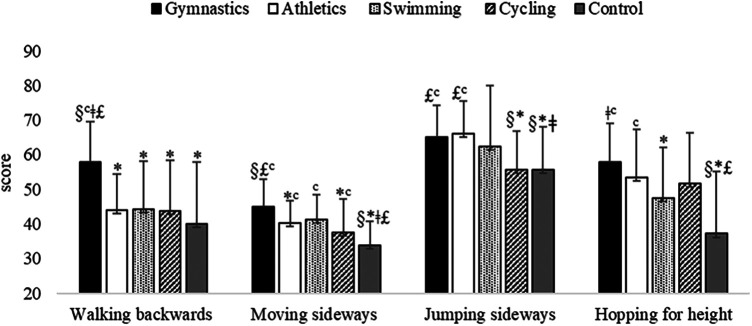
Children practicing sports showed significantly higher RS and MQ score than children of control group (203.14 ± 38.55 vs. 163.63 ± 43.50 and 98.56 ± 15.79 vs. 83.01 ± 16.71, respectively; < 0.001). Children practicing gymnastics had a significantly higher RS and MQ than children of cycling, swimming, and control groups ( < 0.05), children of control group had a significantly lower RS and MQ than children of all other groups ( < 0.05). Children practicing gymnastics performed better walking backwards subtest than all other children's groups ( < 0.001). Children of control group performed worse jumping sideways subtest than children of gymnastics, athletics and swimming groups ( < 0.01). Children practicing gymnastics performed better moving sideways subtest than children of athletics, cycling and control groups ( < 0.01); children of control group performed worse than children of all other groups ( < 0.01). Children of control group performed worse hopping for height subtest than children of gymnastics, athletics and cycling groups ( < 0.05); children practicing gymnastics performed better than children of swimming and control groups ( < 0.05).
The performance model and therefore the specialized training that each sport discipline required, could justified the differences in children's GMC level among sports groups. Thus, coaches should plan individualized interventions and choose activity contents to support children's GMC development.
粗大运动协调(GMC)发展可能受年龄、性别、体重状况、地理区域、生活环境、家庭环境、社会经济地位、体育锻炼的影响。
验证进行体育锻炼以及进行不同的体育锻炼是否会影响儿童的GMC水平。
共有295名8至11岁的儿童参与了该研究,并根据他们所进行的运动分为5组:体操组(=67;51名女性,16名男性)、自行车组(=64;15名女性,49名男性)、田径组(=47;22名女性,25名男性)、游泳组(=35;20名女性,15名男性)、对照组(=82;42名女性,40名男性)。通过儿童身体协调测试(KTK)的四个子测试评估儿童的GMC水平。将四个子测试中的每个得分相加得到KTK总原始得分(RS),然后转换为特定性别和年龄的运动商(MQ)。
进行体育锻炼的儿童的RS和MQ得分显著高于对照组儿童(分别为203.14±38.55和163.63±43.50,以及98.56±15.79和83.01±16.71;<0.001)。进行体操锻炼的儿童的RS和MQ显著高于自行车组、游泳组和对照组的儿童(<0.05),对照组儿童的RS和MQ显著低于所有其他组的儿童(<0.05)。进行体操锻炼的儿童在向后走子测试中的表现优于所有其他儿童组(<0.001)。对照组儿童在向侧方跳跃子测试中的表现比体操组、田径组和游泳组的儿童差(<0.01)。进行体操锻炼的儿童在向侧方移动子测试中的表现优于田径组、自行车组和对照组的儿童(<0.01);对照组儿童的表现比所有其他组的儿童差(<0.01)。对照组儿童在跳高单脚跳子测试中的表现比体操组、田径组和自行车组的儿童差(<0.05);进行体操锻炼的儿童的表现优于游泳组和对照组的儿童(<0.05)。
每种运动项目所需的表现模式以及专门训练,可以解释运动组之间儿童GMC水平的差异。因此,教练应制定个性化干预措施并选择活动内容以支持儿童的GMC发展。