Song Zhongqiang, Shen Jiahao, Liu Qiaoyi, Zhang Wanyue, Ren Ziqian, Yang Kaiwen, Li Xinle, Liu Jialei, Yan Fengming, Li Wenqiang, Xing Yuqing, Wu Lili
College of Science, Henan Agricultural University, Zhengzhou, Henan, China.
College of Computing, City University of Hong Kong, Hong Kong SAR, China.
Front Plant Sci. 2025 Jul 7;16:1609222. doi: 10.3389/fpls.2025.1609222. eCollection 2025.
Aphids are significant agricultural pests and vectors of plant viruses. Their Honeydew Excretion(HE) behavior holds critical importance for investigating feeding activities and evaluating plant resistance levels. Addressing the challenges of suboptimal efficiency, inadequate real-time capability, and cumbersome operational procedures inherent in conventional manual and chemical detection methodologies, this research introduces an end-to-end multi-target behavior detection framework. This framework integrates spatiotemporal motion features with deep learning architectures to enhance detection accuracy and operational efficacy.
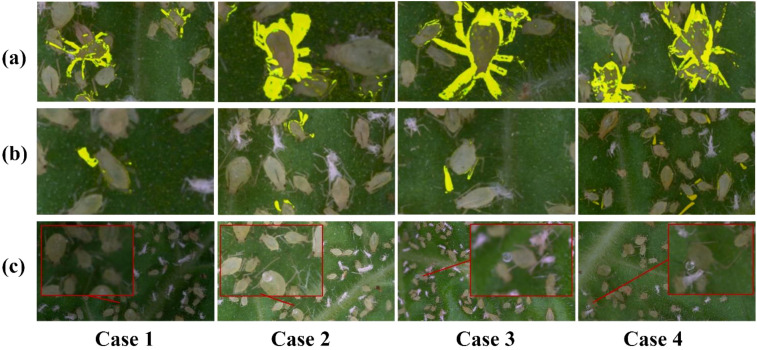
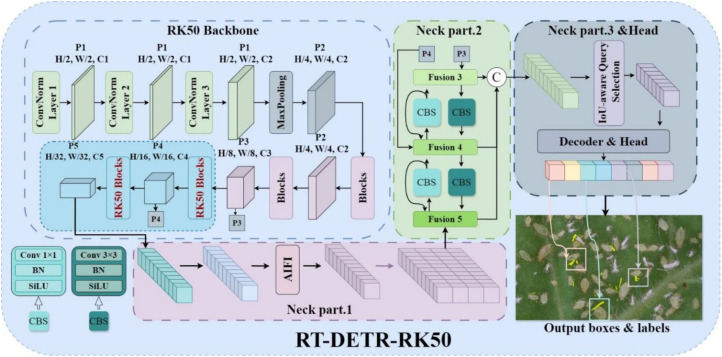
This study established the first fine-grained dataset encompassing aphid Crawling Locomotion(CL), Leg Flicking(LF), and HE behaviors, offering standardized samples for algorithm training. A rapid adaptive motion feature fusion algorithm was developed to accurately extract high-granularity spatiotemporal motion features. Simultaneously, the RT-DETR detection model underwent deep optimization: a spline-based adaptive nonlinear activation function was introduced, and the Kolmogorov-Arnold network was integrated into the deep feature stage of the ResNet50 backbone network to form the RK50 module. These modifications enhanced the model's capability to capture complex spatial relationships and subtle features.
Experimental results demonstrated that the proposed framework achieved an average precision of 85.9%. Compared with the model excluding the RK50 module, the mAP50 improved by 2.9%, and its performance in detecting small-target honeydew significantly surpassed mainstream algorithms. This study presents an innovative solution for automated monitoring of aphids' fine-grained behaviors and provides a reference for insect behavior recognition research. The datasets, codes, and model weights were made available on GitHub (https://github.com/kuieless/RAMF-Aphid-Honeydew-Excretion-Behavior-Recognition).
蚜虫是重要的农业害虫和植物病毒传播媒介。它们的蜜露排泄(HE)行为对于研究取食活动和评估植物抗性水平至关重要。针对传统手动和化学检测方法存在的效率低下、实时性不足和操作程序繁琐等挑战,本研究引入了一个端到端的多目标行为检测框架。该框架将时空运动特征与深度学习架构相结合,以提高检测精度和操作效能。
本研究建立了首个包含蚜虫爬行运动(CL)、腿部甩动(LF)和蜜露排泄行为的细粒度数据集,为算法训练提供标准化样本。开发了一种快速自适应运动特征融合算法,以准确提取高粒度的时空运动特征。同时,对RT-DETR检测模型进行了深度优化:引入了基于样条的自适应非线性激活函数,并将柯尔莫哥洛夫-阿诺德网络集成到ResNet50骨干网络的深度特征阶段,形成RK50模块。这些改进增强了模型捕捉复杂空间关系和细微特征的能力。
实验结果表明,所提出的框架平均精度达到85.9%。与不含RK50模块 的模型相比,mAP50提高了2.9%,其在检测小目标蜜露方面的性能显著超过主流算法。本研究为蚜虫细粒度行为的自动监测提供了创新解决方案,并为昆虫行为识别研究提供了参考。数据集、代码和模型权重可在GitHub(https://github.com/kuieless/RAMF-Aphid-Honeydew-Excretion-Behavior-Recognition)上获取。