Lam Jacob, Solsrud Emily, Hart Alexander, Moore Abigail, Pearlman Amy
Carver College of Medicine, University of Iowa, 200 Hawkins Dr, Iowa City, IA 52242-1009, USA.
Physical Medicine and Rehabilitation, University of Pittsburgh, Pittsburgh, PA, USA.
Ther Adv Urol. 2025 Jul 20;17:17562872251348009. doi: 10.1177/17562872251348009. eCollection 2025 Jan-Dec.
Men with chronic scrotal content pain (CSCP) commonly present to various providers within the healthcare system. Despite its prevalence, little research has been done to understand risk factors for the development of CSCP. In many cases, the cause of pain is unknown, and there are no widely accepted protocols for evaluation or management.
To characterize associated symptoms and concomitant concerns of those presenting with CSCP.
Retrospective review of validated questionnaires including the Chronic Orchialgia Symptom Index (COSI), the internal index of erectile function, the NIH-chronic prostatitis symptom index, the American Urological Association symptom index/international prostate symptom score, the hip dysfunction and osteoarthritis outcome score, the Oswestry low back pain questionnaire, the patient health questionnaire-9, the general anxiety disorder-7, and a comprehensive intake form on men presenting to a single urologist's office with CSCP was performed. The analysis included constructing linear best-fit lines between subjective chronic testicular pain rating and other numerical rating scales.
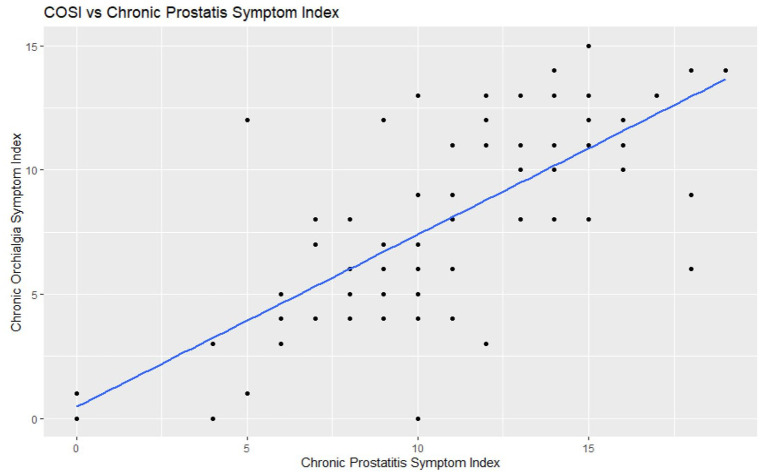
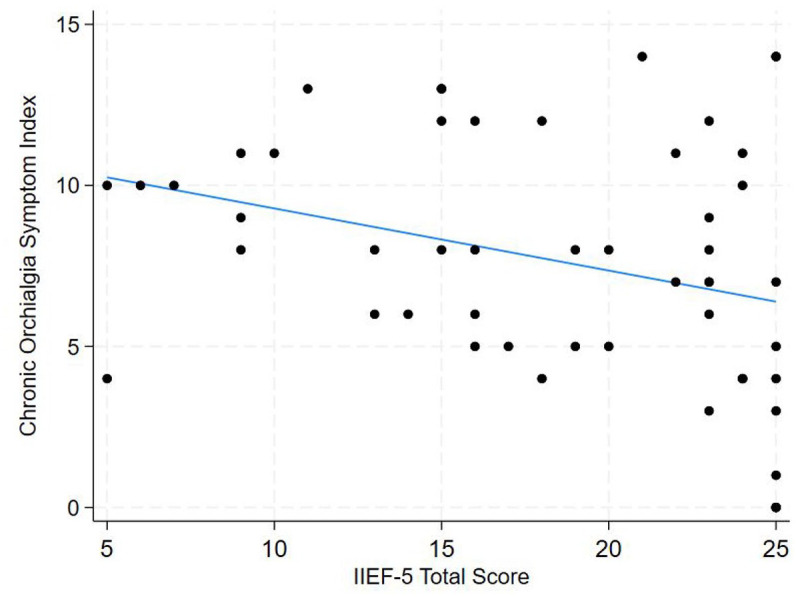
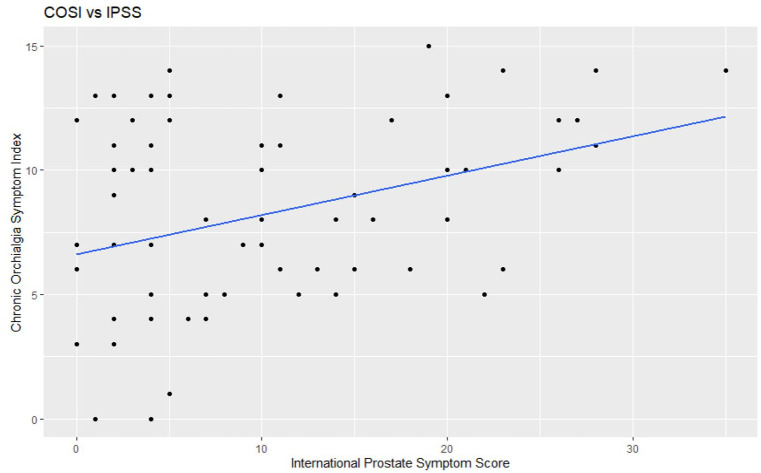
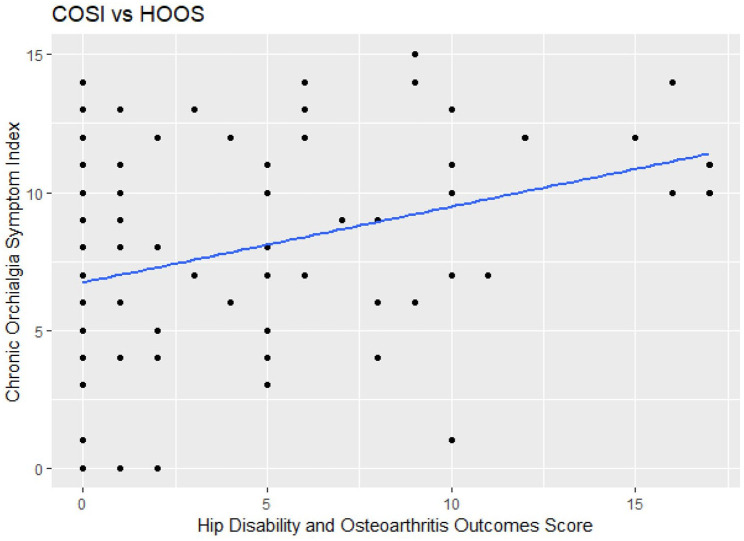
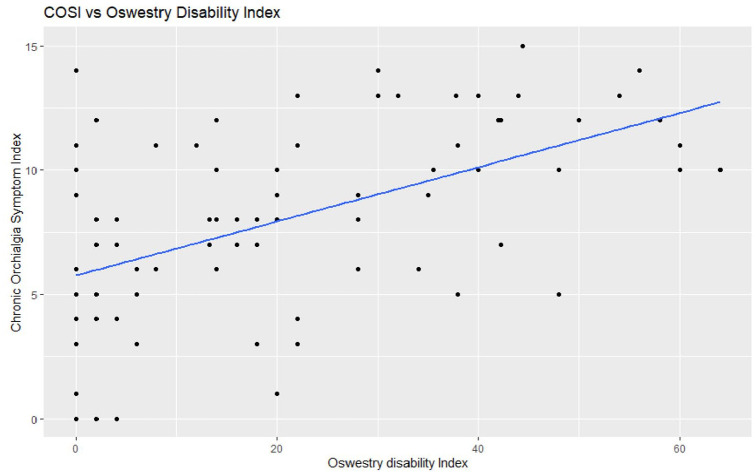
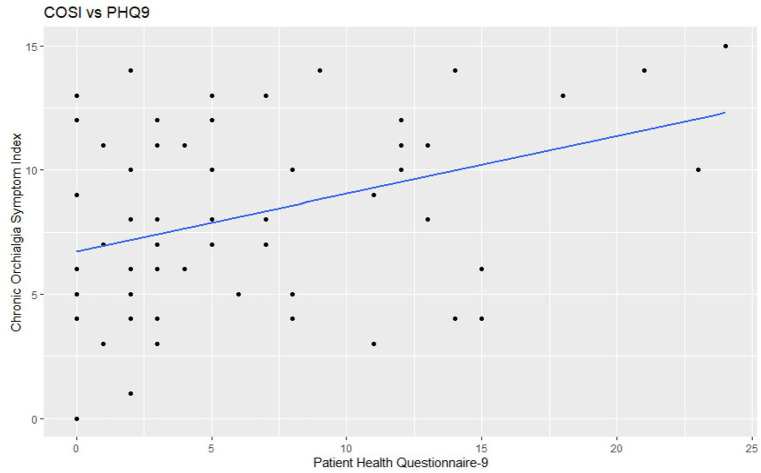
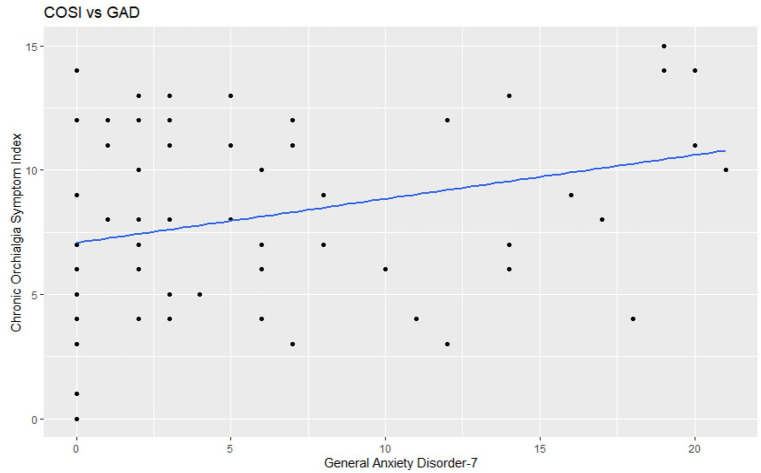
Questionnaires from 94 male patients were reviewed. The average pain subscore on the COSI was 8.00 out of 17. When assessing the association between pain and other domains, more severe chronic scrotal pain was associated with worse pain in and around the genitourinary system ( < 0.001), worse urinary symptoms ( = 0.001), worse hip ( = 0.001) and back ( < 0.001) symptoms, worse sexual function ( = 0.025), and worse anxiety ( = 0.019) and depression ( = 0.003) symptoms. Patients in our study were found to have a wide variety of presentations with differing aggravating and relieving factors, urological and surgical histories, and interventions.
Men presenting with CSCP may present with many co-occurring symptoms. More severe scrotal content pain may be associated with worse symptoms in multiple other domains. In order to create a personalized treatment plan, a more comprehensive understanding of these men is critical. Future studies should focus on further developing a standardized approach for assessing these patients and how directed interventions on associated symptoms may impact outcomes.
患有慢性阴囊内容物疼痛(CSCP)的男性通常会前往医疗系统中的不同医疗机构就诊。尽管其发病率较高,但对于CSCP发生的危险因素却鲜有研究。在许多情况下,疼痛的原因尚不清楚,并且对于评估或管理也没有广泛接受的方案。
描述CSCP患者的相关症状和伴随问题。
对经过验证的问卷进行回顾性研究,这些问卷包括慢性睾丸疼痛症状指数(COSI)、勃起功能内部指数、美国国立卫生研究院慢性前列腺炎症状指数、美国泌尿外科学会症状指数/国际前列腺症状评分、髋关节功能障碍和骨关节炎结果评分、奥斯维斯特腰背痛问卷、患者健康问卷-9、广泛性焦虑障碍-7,以及一份关于前往单一泌尿外科医生办公室就诊的CSCP男性患者的综合 intake 表格。分析包括在主观慢性睾丸疼痛评分与其他数字评分量表之间构建线性最佳拟合线。
对94名男性患者的问卷进行了审查。COSI上的平均疼痛子评分为17分中的8.00分。在评估疼痛与其他领域之间的关联时,更严重的慢性阴囊疼痛与泌尿生殖系统及其周围更严重的疼痛(P<0.001)、更严重的泌尿系统症状(P=0.001)、更严重的髋关节(P=0.001)和背部(P<0.001)症状、更严重的性功能障碍(P=0.025)以及更严重的焦虑(P=0.019)和抑郁(P=0.003)症状相关。研究发现,我们研究中的患者有各种各样的表现,包括不同的加重和缓解因素、泌尿外科和手术史以及干预措施。
患有CSCP的男性可能会出现许多并发症状。更严重的阴囊内容物疼痛可能与多个其他领域更严重的症状相关。为了制定个性化的治疗方案,对这些男性有更全面的了解至关重要。未来的研究应专注于进一步开发评估这些患者的标准化方法,以及针对相关症状的定向干预如何影响治疗结果。