Biffi Emilia, Arlati Sara, Negri Luca, Mondellini Marta, Genova Chiara, Malosio Matteo, Corbetta Claudio, Davalli Angelo, Sacco Marco
Scientific Institute, IRCCS E. Medea, Lecco, Italy.
Institute of Intelligent Industrial Technologies and Systems for Advanced Manufacturing, National Research Council of Italy, Lecco, Italy.
Ann Med. 2025 Dec;57(1):2537930. doi: 10.1080/07853890.2025.2537930. Epub 2025 Jul 27.
The number of people who require a wheelchair is rising due to an increased number of injuries and the growing number of elderly. Training of new wheelchair users is mandatory to let them feel independent and safe. Virtual reality (VR)-based wheelchair simulators allow training wheelchair skills in a controlled, safe, and repeatable environment. Our group recently developed a wheelchair simulator for a motion platform in semi-immersive VR.
To assess the usability and user experience of two VR-based training environments in 20 participants considering the sense of presence, the cybersickness, the suitability of VR system, and the performance and to assess if these evaluations are influenced by the expertise in the use of a wheelchair.
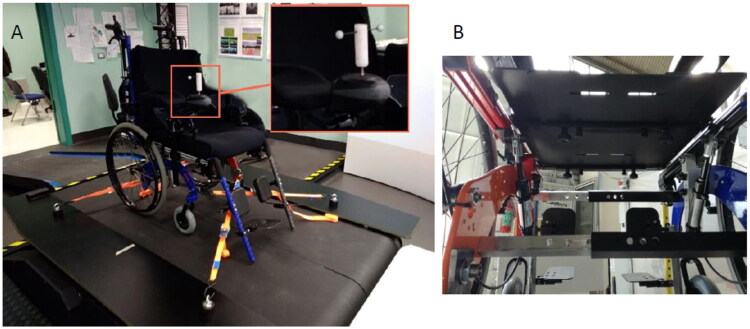
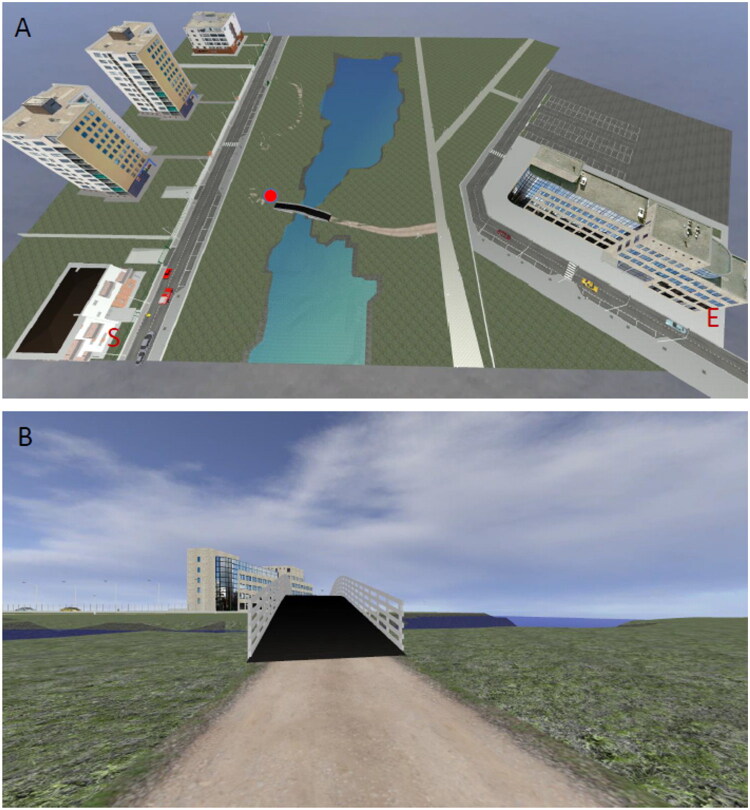
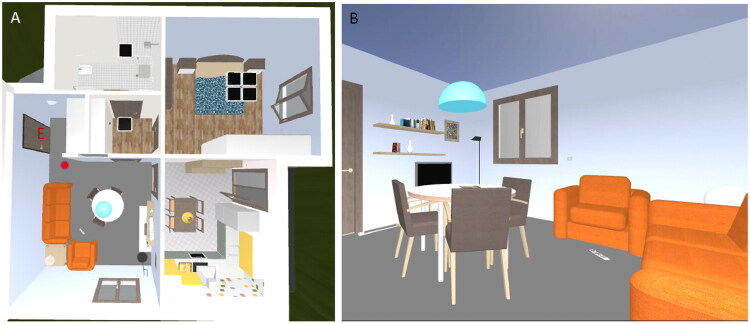
The simulator was composed of a moving platform, an adaptable wheelchair, and two VR environments (one outdoor - OE, one indoor - IE) projected on a 180° screen. 10 able-bodied volunteers (wheelchair naïve-users, WNUs) and 10 expert wheelchair users (WUs) due to spinal cord injury were recruited. They performed one session during which they tested the indoor (IE) and the outdoor (OE) VR environment. Measures to assess user experience, such as the System Usability Scale, the Technological Acceptance Measure, and the Suitability Evaluation Questionnaire were administered.
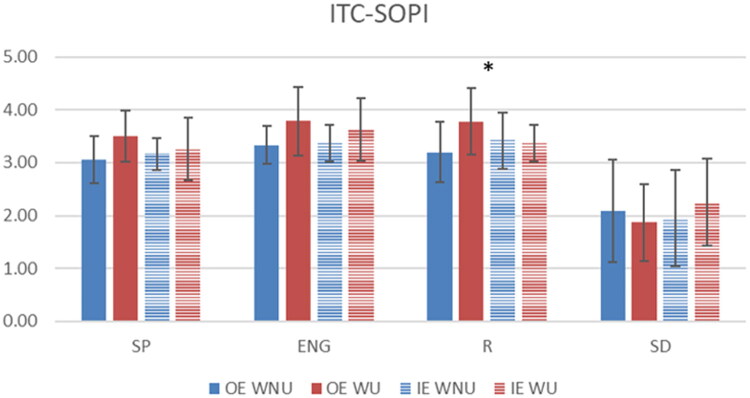
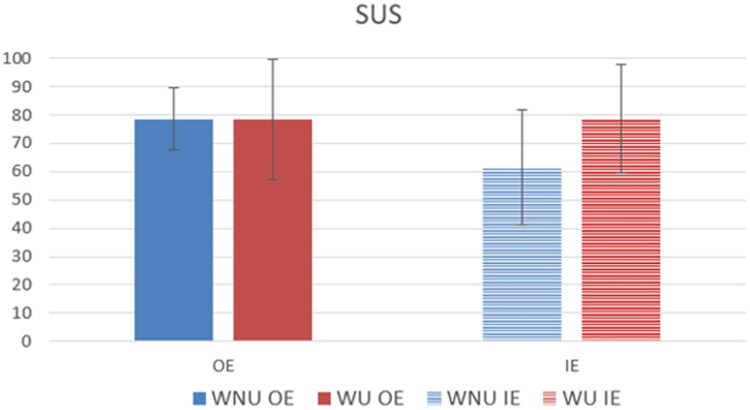
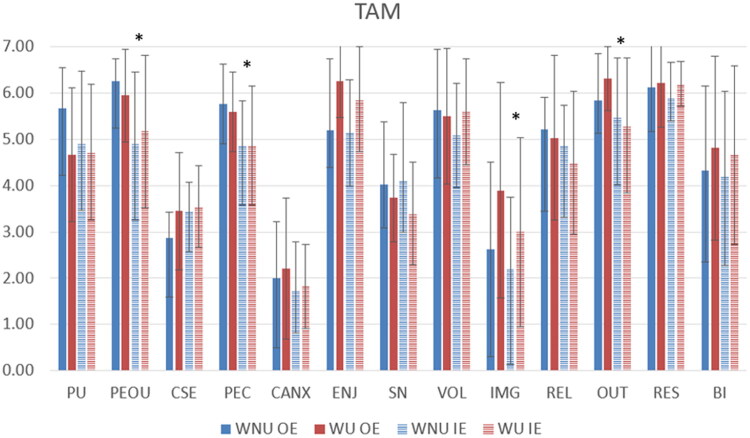
The usability of WUs was high in both environments, while WNUs had some difficulties in IE navigation. Acceptance (TAM mean score) was significantly higher for the OE (p-value = 0.017) in both groups (WNU-OE: 5.11 ± 0.44; WU-OE: 5.18 ± 0.67; WNU-IE: 4.75 ± 0.47; WU-IE: 4.85 ± 0.62). Suitability was higher for OE and generally higher for WUs.
Our study focused on user experience during VR-powered wheelchair navigation in both WUs and naïve ones. The system proved to be engaging and caused low cybersickness effects. Future works will focus on longer training and will assess performance improvements longitudinally.
由于受伤人数增加以及老年人数量不断增多,需要轮椅的人数正在上升。对新轮椅使用者进行培训,以使他们感到独立和安全是必不可少的。基于虚拟现实(VR)的轮椅模拟器能够在可控、安全且可重复的环境中训练轮椅技能。我们的团队最近为半沉浸式VR中的运动平台开发了一种轮椅模拟器。
在20名参与者中,考虑临场感、晕动症、VR系统的适用性、性能,评估两种基于VR的训练环境的可用性和用户体验,并评估这些评估是否受到轮椅使用专业知识的影响。
模拟器由一个移动平台、一把可适配的轮椅以及投射在180°屏幕上的两个VR环境(一个室外环境 - OE,一个室内环境 - IE)组成。招募了10名身体健全的志愿者(初次使用轮椅者,WNUs)和10名因脊髓损伤而成为专家级轮椅使用者(WUs)。他们进行了一次测试,期间测试了室内(IE)和室外(OE)VR环境。采用了一些评估用户体验的方法,如系统可用性量表、技术接受度量表和适用性评估问卷。
在两种环境中,WUs的可用性都很高,而WNUs在IE导航方面存在一些困难。两组中OE的接受度(TAM平均得分)均显著更高(p值 = 0.017)(WNUs - OE:5.11 ± 0.44;WUs - OE:5.18 ± 0.67;WNUs - IE:4.75 ± 0.47;WUs - IE:4.85 ± 0.62)。OE的适用性更高,并且总体上WUs的适用性更高。
我们的研究聚焦于WUs和初次使用者在VR驱动的轮椅导航过程中的用户体验。该系统被证明具有吸引力且晕动症影响较低。未来的工作将集中在更长时间的训练上,并将纵向评估性能的提升。