Department of Rehabilitation Science, Faculty of Rehabilitation Medicine, University of Alberta, Edmonton, Alberta, Canada.
PLoS One. 2021 Aug 19;16(8):e0255898. doi: 10.1371/journal.pone.0255898. eCollection 2021.
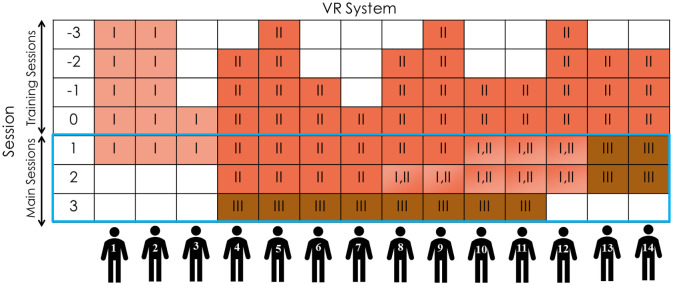
Visually Induced Motion Sickness (VIMS) is a bothersome and sometimes unsafe experience, frequently experienced in Virtual Reality (VR) environments. In this study, the effect of up to four training sessions to decrease VIMS in the VR environment to a minimal level was tested and verified through explicit declarations of all 14 healthy participants that were recruited in this study. Additionally, the Motion Sickness Assessment Questionnaire (MSAQ) was used at the end of each training session to measure responses to different aspects of VIMS. Total, gastrointestinal, and central motion sickness were shown to decrease significantly by the last training session, compared to the first one. After acclimatizing to motion sickness, participants' sense of presence and the level of their motion sickness in the VR environment were assessed while actuating three novel and sophisticated VR systems. They performed up to four trials of the Illinois agility test in the VR systems and the real world, then completed MSAQ and Igroup Presence Questionnaire (IPQ) at the end of each session. Following acclimatization, the three VR systems generated relatively little motion sickness and high virtual presence scores, with no statistically meaningful difference among them for either MSAQ or IPQ. Also, it was shown that presence has a significant negative correlation with VIMS.
视觉诱导运动病(VIMS)是一种令人烦恼且有时不安全的体验,在虚拟现实(VR)环境中经常发生。在这项研究中,通过对招募的 14 名健康参与者的明确声明,测试并验证了多达四个训练课程,将 VR 环境中的 VIMS 降低到最低水平的效果。此外,在每次训练课程结束时,还使用运动病评估问卷(MSAQ)来测量对 VIMS 不同方面的反应。与第一次训练相比,最后一次训练时,总运动病、胃肠道运动病和中枢运动病明显减少。在适应运动病后,评估参与者在 VR 环境中的存在感和运动病水平,同时操作三个新颖复杂的 VR 系统。他们在 VR 系统和现实世界中最多进行了四次伊利诺伊敏捷测试,然后在每次测试结束时完成 MSAQ 和 Igroup 存在感问卷(IPQ)。适应后,三个 VR 系统产生的运动病和高虚拟存在感评分相对较低,在 MSAQ 或 IPQ 方面,它们之间没有统计学上的显著差异。此外,还表明存在感与 VIMS 呈显著负相关。