Yu Daoning, Ma Xiaoming, Huang Chun, Wang Tong, Zhang Mengfan, Feng Fen, Wu Xiaoyun, La Yongfu, Guo Xian, Yan Ping, Zhang Derong, Liang Chunnian
Key Laboratory of Animal Genetics and Breeding on Tibetan Plateau, Ministry of Agriculture and Rural Affairs, Lanzhou 730050, China.
Key Laboratory for Yak Genetics, Breeding, and Reproduction Engineering of Gansu Province, Chinese Academy of Agricultural Sciences, Lanzhou 730050, China.
Animals (Basel). 2025 Jul 17;15(14):2114. doi: 10.3390/ani15142114.
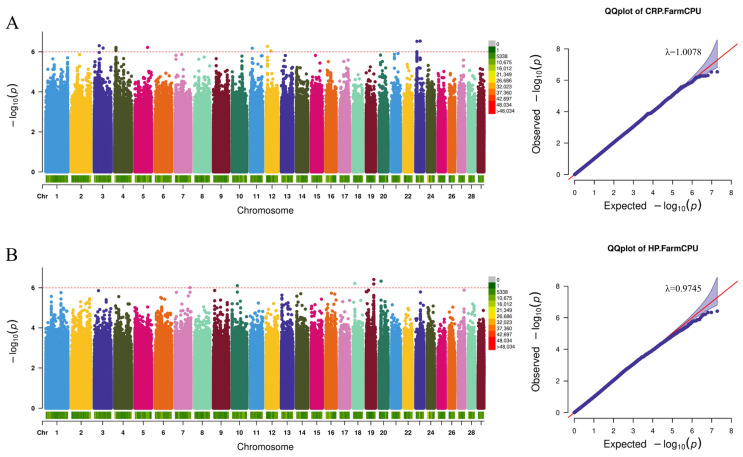
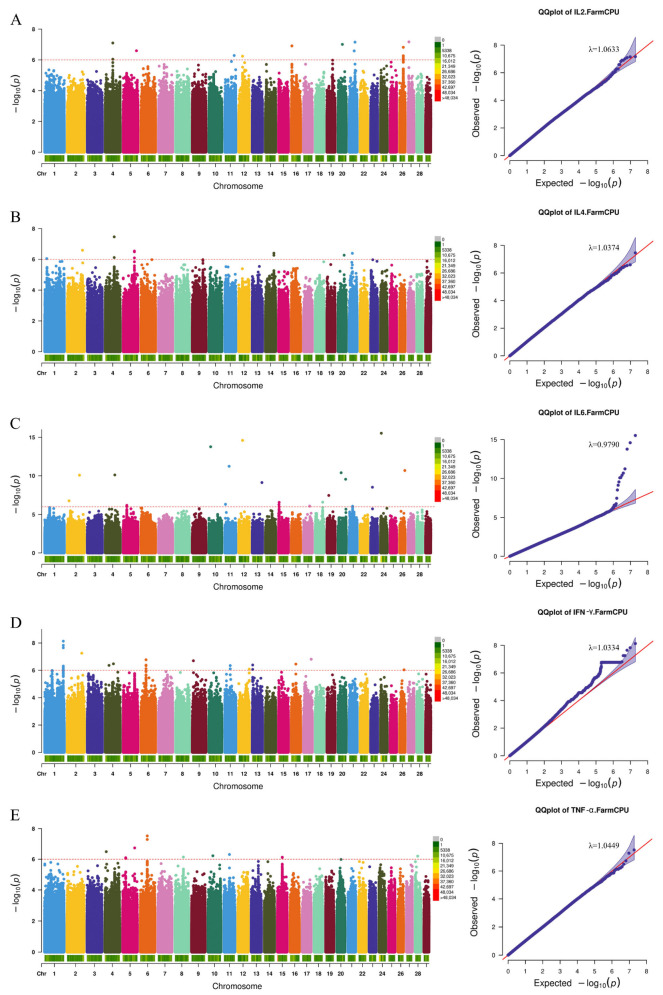
The yak is a vital livestock resource on the Qinghai-Tibet Plateau, renowned for its strong disease resistance and high-quality meat. However, various diseases pose significant threats to its health and lead to substantial economic losses. Current feeding management practices, along with available drugs and vaccines, have demonstrated limited effectiveness in preventing and controlling infectious diseases. Additionally, challenges such as drug resistance and the safety of animal products persist. Therefore, enhancing the disease-resistant breeding capacity of yaks is crucial. In this study, we examined 192 yaks by measuring the concentrations of 10 immune indicators in serum by using the ELISA method and conducting whole-genome resequencing, which identified 19,182,942 SNP loci. Through genome-wide association analysis, we detected 323 significant SNPs located near or within 125 candidate genes, most of which are associated with disease and significantly enriched in the TGF-β signaling pathway. Overall, our study identified a series of novel variants and candidate genes associated with disease resistance traits in yaks, providing important information for the molecular breeding of disease resistance in yaks. These results not only contribute to a deeper understanding of the function of disease resistance genes in yaks but also hold great potential for accelerating precision disease resistance breeding in yaks.
牦牛是青藏高原重要的家畜资源,以其强大的抗病能力和优质的肉而闻名。然而,各种疾病对其健康构成重大威胁,并导致巨大的经济损失。目前的饲养管理方法以及现有的药物和疫苗在预防和控制传染病方面效果有限。此外,耐药性和动物产品安全等挑战依然存在。因此,提高牦牛的抗病育种能力至关重要。在本研究中,我们通过酶联免疫吸附测定(ELISA)法测量血清中10种免疫指标的浓度,并进行全基因组重测序,对192头牦牛进行了检测,共鉴定出19,182,942个单核苷酸多态性(SNP)位点。通过全基因组关联分析,我们检测到323个位于125个候选基因附近或内部的显著SNP,其中大多数与疾病相关,并且在转化生长因子-β(TGF-β)信号通路中显著富集。总体而言,我们的研究鉴定出了一系列与牦牛抗病性状相关的新变异和候选基因,为牦牛抗病分子育种提供了重要信息。这些结果不仅有助于更深入地了解牦牛抗病基因的功能,也为加速牦牛精准抗病育种具有巨大潜力。